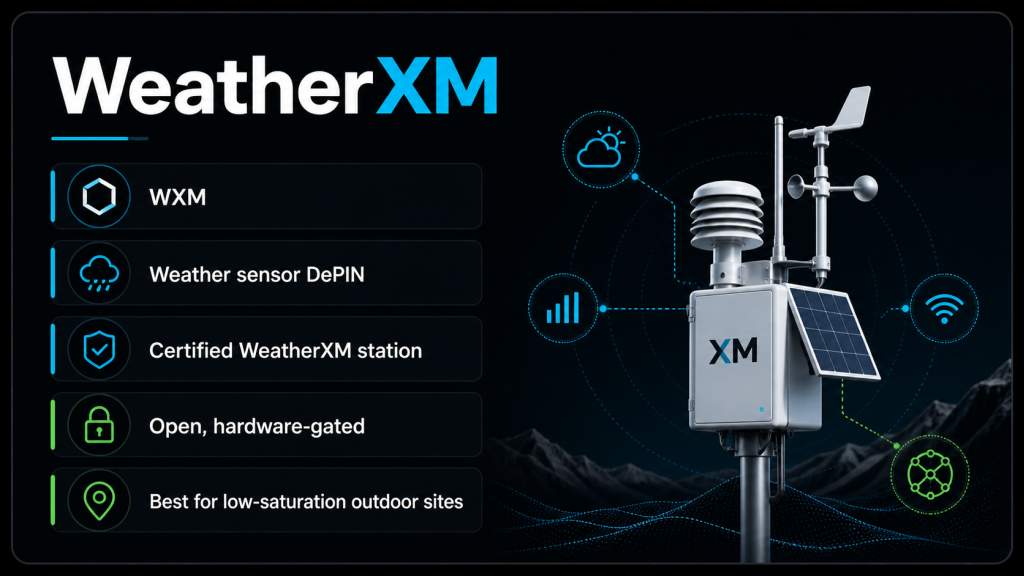
Disclaimer: WeatherXM rewards depend on station placement, Proof of Location, Quality of Data scoring, cell capacity, network participation, WXM token price, hardware model, connectivity, and ongoing maintenance. Before buying hardware, check your local WeatherXM cell, confirm that you can mount the station outdoors in a clear and permanent location, and assume that current token rewards may not recover the hardware cost. This guide is for operator research only and is not financial advice.
Quick Stats
| Token | WXM (ERC-20, Arbitrum One) |
| Network Type | Sensors / physical weather data infrastructure |
| Participation Model | Buy certified hardware, install outdoors, connect Arbitrum wallet, earn WXM |
| Onboarding Status | Open, permissionless. No KYC, no waitlist, no staking, no collateral |
| Supported Hardware | D1 WB1200, H2 WS2001, Pulse WB3000 |
| Non-Eligible Hardware | D1 Lite WB1100. Does not earn WXM rewards |
| Hardware Cost | D1: ~USD 360 / H2: ~USD 360 / Pulse: ~USD 810 (regional pricing varies) |
| Main Operator Requirement | Certified station, clear permanent outdoor mounting site, low-saturation cell |
| Reward Model | Fixed pool of 14,246 WXM/day shared across qualifying stations; per-station rewards vary by scoring, hardware class, and cell capacity |
| Current Reward Context | Calculated ceiling ~1.5 WXM/day at ~9,500 active stations; ~USD 7–11/year at current prices; not an official figure |
| Location Dependency | High. Cell saturation, outdoor placement quality, and sensor exposure all affect rewards |
| Maintenance Burden | Ongoing. Sensor cleanliness, gateway uptime, app monitoring, physical exposure |
| Main Risk | Hardware cost relative to very low current WXM reward value; cell saturation; placement penalties |
| Best For | Operators with a proper outdoor mounting site in a low-saturation cell who accept speculative token economics |
1. Quick Verdict
WeatherXM is technically open to anyone willing to buy certified hardware and mount it outdoors, but the economics in 2026 are weak. A simple emission-split calculation puts the theoretical ceiling around 1.5 WXM/day at roughly 9,500 active stations, and at current WXM prices that works out to something like USD 7–11 per year before scoring, cell caps, and hardware class adjustments. That does not support hardware recovery on a near-term basis under the current reward context.
The project is realistic for operators with a proper outdoor mounting site, a low-saturation cell, and the willingness to treat hardware cost as a speculative bet on future WXM value rather than a recoverable expense. For anyone buying primarily for near-term income, current conditions do not support that case.
2. Best Fit / Possible Fit / Poor Fit
| Operator Profile | Fit | Why |
|---|---|---|
| Rural or semi-rural homeowner with clear outdoor mounting space and low nearby station density | Best Fit | Best chance of clean sensor exposure, stable unobstructed placement, and an uncrowded reward cell |
| Weather enthusiast who wants hyperlocal data and accepts weak token economics | Best Fit | Non-financial utility can justify the hardware cost better than current rewards alone |
| Home operator in a data-scarce region who verifies cell capacity before purchasing | Possible Fit | Could work if the cell is not crowded, but still depends on token price, device cost, and scoring |
| Urban or suburban apartment resident with only balcony or window access | Poor Fit | Obstructions, near-building detection, and height limits can reduce QoD scoring and eliminate rewards |
| Operator considering Pulse where no WiFi or Helium coverage exists | Possible to Poor Fit | SIM connectivity is now covered by WeatherXM, but Pulse's USD 810 hardware cost makes the reward case harder than D1 or H2 |
| Operator buying primarily for short- or medium-term ROI | Poor Fit | At current WXM prices and reward dilution, hardware payback is not realistic without significant token recovery |
| Buyer considering D1 Lite as a cheaper entry point | Poor Fit | D1 Lite (WB1100) does not earn WXM rewards and is not a lower-cost path to participation |
3. Why This Project Matters
WeatherXM builds a distributed network of ground-level weather sensors operated by individuals rather than centralized meteorological services. Ground-level stations can add local weather readings that broader weather models may not capture at the same resolution, and that data can matter for agriculture, insurance, energy, and logistics applications. Individual operators are the source of that sensor data, and the network's commercial value depends on the density and quality of what they provide. Whether that commercial value translates into meaningful operator rewards at current network scale and token prices is a separate question, and this guide treats it as one.
4. Project Overview
WeatherXM distributes WXM tokens to individual operators who run certified weather stations and feed real-time sensor data into a shared network. Operators buy the hardware, mount it outdoors following placement requirements, claim the station through the WeatherXM app, and connect an Arbitrum wallet to receive rewards. A fixed daily token pool is split across qualifying stations based on scoring, station class, and cell capacity. The WeatherXM Network Association earns revenue from onboarding fees and commercial data licensing, but that revenue should not be treated as a direct guarantee of higher per-station rewards.
5. Main Operator Reality Check
-
Open access does not mean low-risk access. WeatherXM is permissionless with no waitlist, no KYC, no staking, and no collateral. Operators still spend USD 360 to USD 810 on hardware before knowing whether their specific cell and site will perform.
-
Placement quality is central. A station must be mounted outdoors, unobstructed, at a stable location, and at a height between 2 m and 5 m. Poor placement can reduce rewards to zero through Proof of Location or Quality of Data scoring. The 2025 QoD update, including indoor station detection, made this risk more serious than it was at launch.
-
Cell saturation can eliminate earnings entirely. Each hex cell has a reward cap, cited at 10 stations. In a crowded cell, stations above that limit may earn nothing even with well-placed, high-scoring hardware. This is checkable before purchase through the WeatherXM Explorer.
-
Reward dilution is structural. The daily emission pool is fixed at 14,246 WXM. At roughly 9,500 active stations, a simple emission split gives a theoretical ceiling around 1.5 WXM/day per station, before scoring weights, hardware class adjustments, boosts, and cell caps. That ceiling falls as more stations join.
-
Hardware cost dominates the economics. D1 and H2 are priced around USD 360 each. Pulse is around USD 810. At roughly 1.5 WXM/day and current WXM prices near USD 0.013, annual rewards may come to around USD 7–11. That is a rough scenario, not a forecast.
-
D1 Lite is not a cheaper path to rewards. The D1 Lite (WB1100) does not earn WXM. Buying it while expecting rewards is a preventable and costly mistake.
6. Is WeatherXM Suitable for Small/Medium Operators?
It depends on location and expectations.
WeatherXM is technically accessible to small operators. The hardware is consumer-grade, the app handles onboarding, there is no staking or collateral, and there is no approval process. For operators with genuine permanent outdoor mounting space and an uncrowded cell, the setup burden is real but manageable.
The economic case is a different matter:
- At current WXM prices and a calculated reward ceiling around 1.5 WXM/day, annual USD earnings appear to be in the range of USD 7–11. That does not recover USD 360–810 in hardware on a near-term basis under the current reward context.
- Poor site quality or a saturated cell can push rewards to zero regardless of hardware quality or effort.
- Operators who cannot permanently and properly mount the station outdoors should not expect meaningful earnings.
- D1 Lite shares a name with the D1 WB1200 but earns no WXM. It is an easy mistake to make when shopping by price.
Bottom line: Suitable for operators with the right outdoor site and a low-saturation local cell, if they accept speculative economics. Not suitable for anyone expecting near-term payback or passive income.
7. Infrastructure Requirements
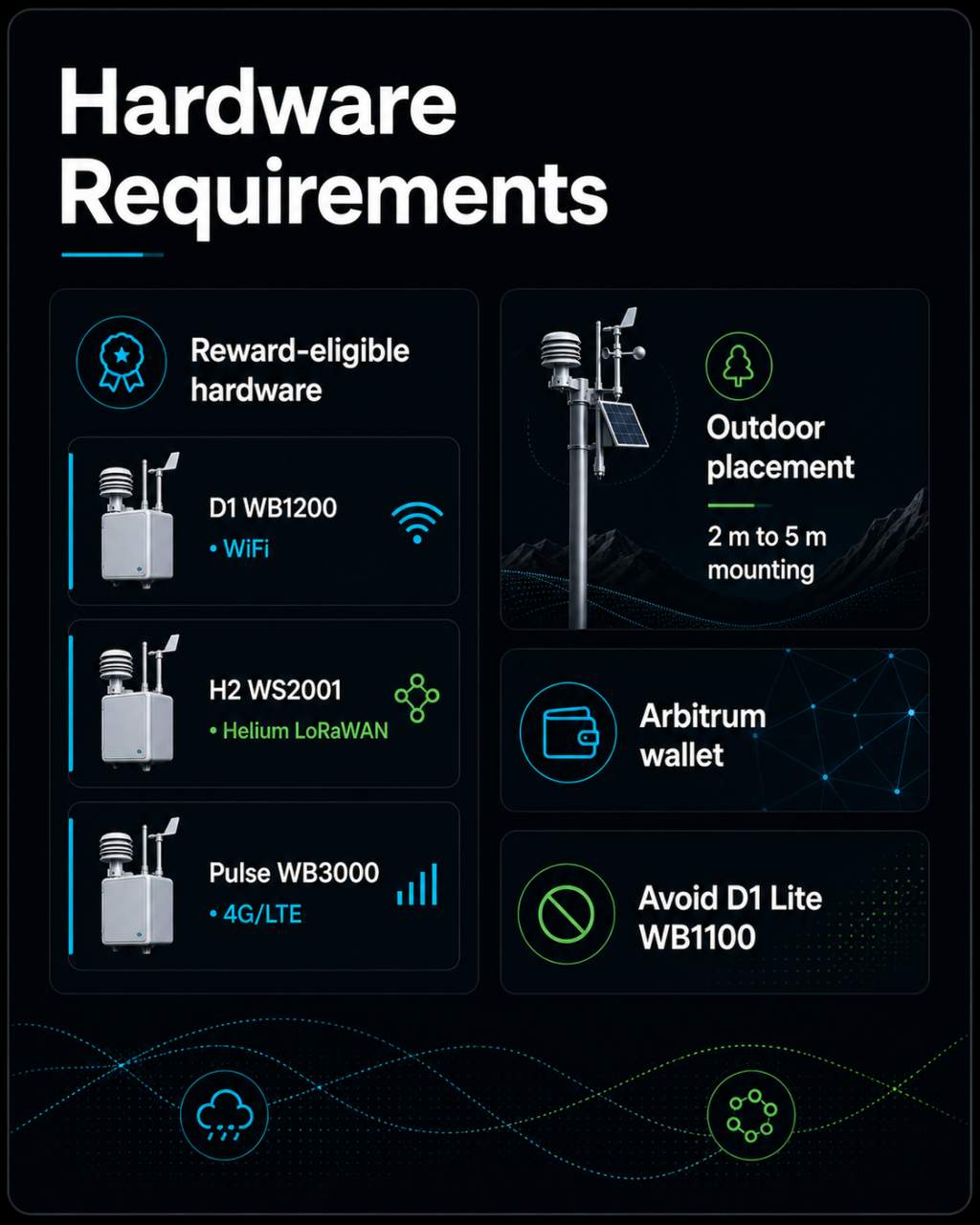
Reward-Eligible Hardware
| Model | Connectivity | Price (approx.) |
|---|---|---|
| D1 WB1200 | WiFi | USD 360 |
| H2 WS2001 | Helium LoRaWAN | USD 360 |
| Pulse WB3000 | 4G/LTE | USD 810 |
Regional pricing varies. EU operators should verify local delivered pricing, which may include VAT or reseller markup. Pulse pricing in some regions is higher than the USD 810 base figure.
Non-Reward Hardware
D1 Lite WB1100 does not earn WXM. It is not a budget-friendly version of the D1. If the goal is WXM rewards, it is the wrong device.
Connectivity
- D1: Requires stable home WiFi and reliable gateway uptime.
- H2: Requires verified Helium LoRaWAN network coverage at the exact deployment location. Check coverage before purchasing.
- Pulse: Requires 2G/3G/4G mobile coverage. Pulse ships with a 1NCE SIM card, and WeatherXM covers the connectivity cost. No operator-paid SIM plan is required. Local signal quality still needs to be confirmed before ordering.
Placement Requirements
- Outdoor installation is mandatory. Indoor or balcony placement carries scoring penalty risk.
- Mounting height: 2 m to 5 m above ground.
- Clear, unobstructed exposure with no nearby walls, trees, overhangs, or structures.
- Location must be permanent. Moving a station can trigger Proof of Location penalties.
Wallet
An Arbitrum-compatible wallet must be connected before rewards start. Wallet address can be updated later through the app, but days without a configured wallet address risk losing those rewards.
8. Step-by-Step Setup
-
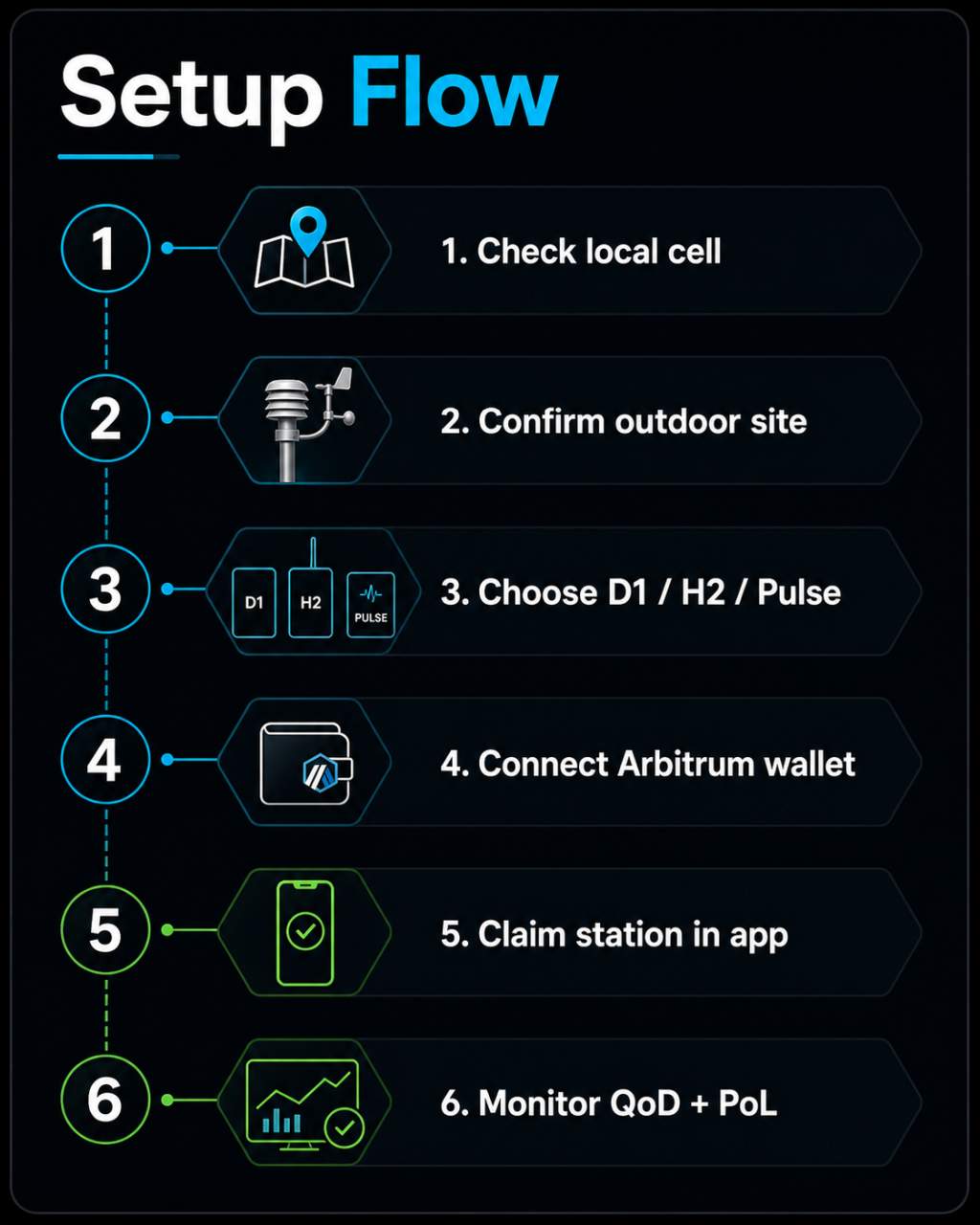
Check your local cell before buying anything. Open the WeatherXM Explorer or app flow, find your intended deployment address, and confirm how many stations are already active in your hex. The reward cap per cell is cited at 10 stations. If the cell is saturated, skip the rest of these steps.
-
Confirm you have a proper outdoor mounting site. You need a permanent, unobstructed outdoor location at 2 m to 5 m above ground. If that is not possible, the placement requirements alone rule out participation.
-
Choose hardware to match your actual connectivity. D1 if you have reliable WiFi at the site. H2 only if you have verified Helium LoRaWAN coverage at the deployment location. Pulse if you have confirmed mobile signal and can justify the higher hardware cost. Do not buy D1 Lite.
-
Purchase from the official WeatherXM store or verified reseller. Verify current pricing and regional availability before ordering.
-
Set up an Arbitrum wallet before installation. Create or prepare a compatible wallet and have the address ready. Connect it to your WeatherXM account during or immediately after onboarding.
-
Install the station following WeatherXM's placement guidelines. Mount at the correct height, ensure clear exposure, connect to WiFi, LoRaWAN gateway, or SIM as required for the hardware model.
-
Claim the station in the WeatherXM app. Complete onboarding, link the device to your account, and confirm your wallet address is connected.
-
Monitor regularly. Check QoD and PoL scores through the app. Physically inspect sensor cleanliness, mounting stability, gateway connectivity, and battery condition on a routine basis.
9. Current Earnings Picture
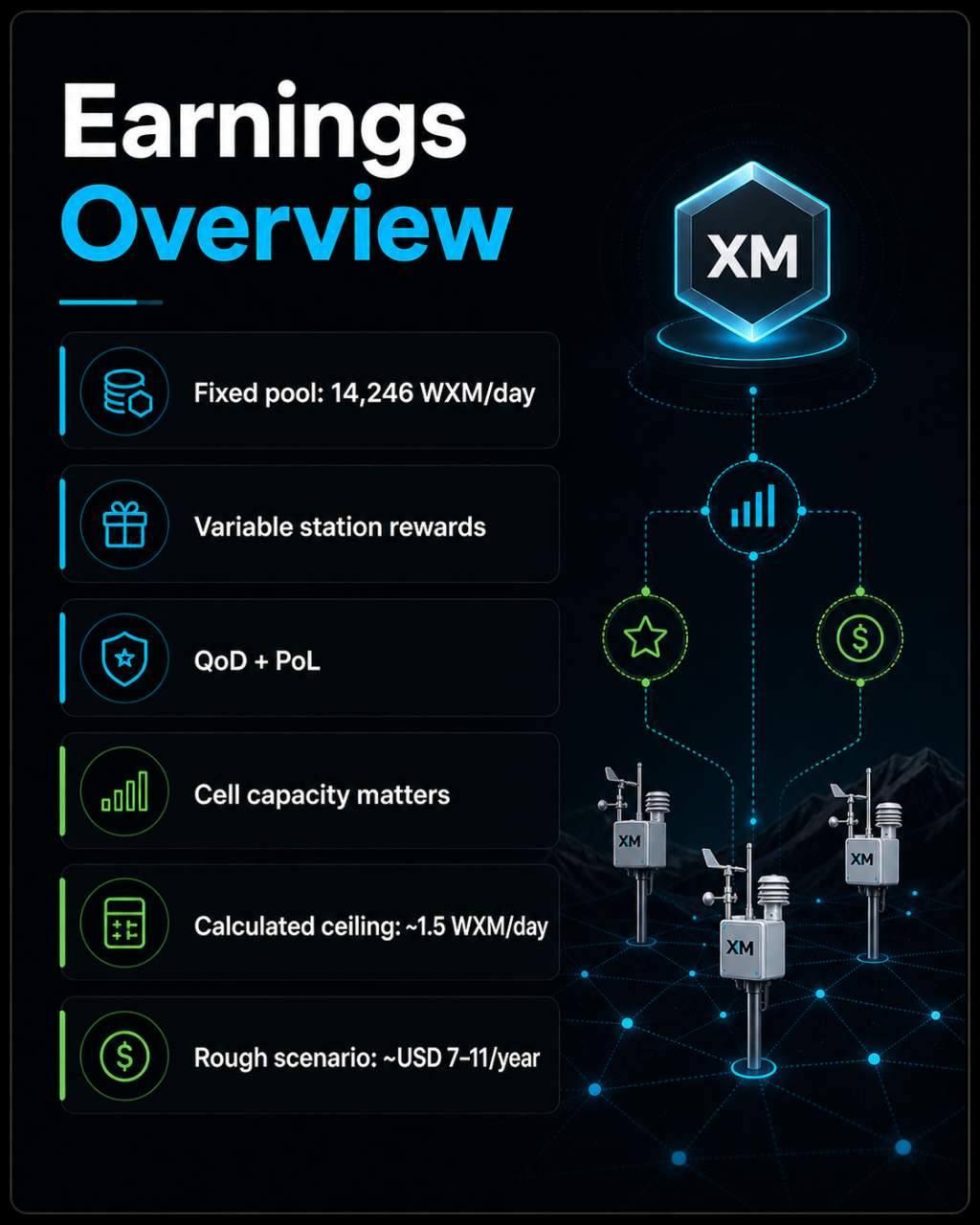
The fixed daily emission pool is 14,246 WXM distributed across qualifying stations. That figure does not change with station count. More active stations just means a lower per-station share.
At roughly 9,500 active stations, a basic emission-split gives a theoretical ceiling of around 1.5 WXM/day per station. This is not a confirmed 2026 official average. It is a back-of-envelope ceiling that assumes full scoring and ignores hardware class weights, cell caps, boosts, and QoD/PoL penalties. Actual per-station rewards vary based on all of those factors. A station with poor placement, a low QoD score, or a saturated cell earns less than that ceiling, sometimes nothing.
At current WXM prices near USD 0.013, a station earning at the 1.5 WXM/day ceiling would generate roughly USD 7–11 per year. That is a rough scenario for context, not a forecast or expected outcome.
Hardware costs USD 360–810. That gap does not close at current prices without materially higher token value, materially higher rewards, or both.
No confirmed 2026 per-station daily reward data exists from official dashboards or public operator screenshots. The historical 2.84 WXM/day figure from earlier network periods should not be used as a current expectation.
10. Recent and Operator-Relevant Network Updates
WIP-001 (Governance): This governance proposal passed and adjusted how GPS penalty handling works for station placement validation. Operators with placement scoring issues related to GPS verification were affected by the change.
QoD Update and Indoor Station Detection (2025): Quality of Data scoring now includes indoor station detection. Stations placed indoors, on balconies, or with obstructions nearby face more serious penalty risk than under the original scoring model. Getting outdoor placement right matters more than it did at launch.
Targeted Rollouts (Phase B ended): Targeted Rollouts are a separate participation path from standard home operation and should not be confused with buying and running a physical station at your own property. Phase B sale has ended. Staking is live, with 75% of rewards going to NFT holders and 25% to deployers, under optional staking terms. Future phases have not been confirmed open. Each NFT represents a fraction of a weather station deployment. If your goal is home operation, Targeted Rollouts are not that.
B2B and commercial data licensing: WeatherXM's public messaging has shifted increasingly toward data customers in insurance, agriculture, energy, and logistics. Association revenue from commercial data licensing is documented. This does not automatically translate into improved per-station rewards for home operators.
11. Pros & Cons
Pros
- Open, permissionless onboarding with no KYC, no staking, and no collateral
- Rewards are live and active on mainnet
- The station has genuine non-financial use as a personal weather tool, regardless of what WXM is worth
- You can check cell capacity through the Explorer before spending money on hardware
- Pulse ships with a covered SIM; no ongoing operator SIM cost
- Wallet address can be changed in the app after setup
- No slashing, no collateral loss exposure
Cons
- Hardware costs USD 360–810 before knowing whether the cell and site will actually perform
- At current WXM prices and a calculated reward ceiling around 1.5 WXM/day, annual USD rewards appear to be roughly USD 7–11 in the scenario used here
- Cell saturation can result in zero rewards even from a well-placed, correctly scored station
- Strict outdoor placement requirements rule out most apartment and renter situations
- D1 Lite is easy to buy by mistake; it earns nothing
- No confirmed 2026 per-station reward data from official sources or public operator screenshots
- Public community discussion is quiet, which limits visibility into real-world operator outcomes
- Token price has an outsized effect on payback; at current WXM levels, hardware cost recovery looks unlikely near-term
12. Common Pitfalls to Avoid
Buying D1 Lite expecting WXM rewards. It does not earn. Check the model number before purchasing: WB1100 is D1 Lite, WB1200 is the reward-eligible D1.
Not checking cell saturation before buying hardware. The WeatherXM Explorer shows how many stations are already active in your hex before you spend anything. If the cell is at capacity, no amount of good hardware or clean placement will earn you rewards.
Using 2.84 WXM/day as a current earnings benchmark. That is an earlier network figure. The calculated ceiling in 2026 is closer to 1.5 WXM/day before scoring and cell caps are applied.
Placing the station indoors, on a balcony, or near obstructions. The 2025 QoD update made indoor detection and obstruction penalties more serious. A bad location can mean zero rewards.
Not connecting a wallet before rewards begin. Days with no wallet configured may result in lost rewards. Set up the Arbitrum wallet address before or immediately during onboarding.
Choosing Pulse without verifying mobile coverage at the deployment site. Pulse includes a covered SIM plan, but it still requires real LTE signal. USD 810 hardware in a dead zone earns nothing.
Assuming H2 will have Helium LoRaWAN coverage without checking. Helium coverage is not universal. Check your specific location in a coverage map before ordering H2.
Conflating Targeted Rollouts with standard home operation. These are different participation paths. Phase B is over and future phases are not confirmed open.
Treating current WXM price as a floor. Reward economics at current prices are already weak and could get weaker.
13. Tips for Home Operators
Run the cell capacity check first, before anything else. Open the WeatherXM Explorer, find your address, and count active stations in your hex. If it is near or at 10, earnings potential is limited regardless of setup quality.
Verify your outdoor mounting site before purchasing. The station needs a permanent, unobstructed outdoor location at 2 m to 5 m height. If you cannot commit to that, the economics do not improve by buying anyway.
Match the connectivity model to what you actually have. D1 for reliable WiFi at the deployment site. H2 only with confirmed Helium coverage. Pulse only if mobile signal is verified and the higher hardware cost is acceptable.
Connect your Arbitrum wallet immediately during setup. Do not leave the station running without a configured payout wallet.
Monitor QoD and PoL scores after installation. The app shows scoring status. Low scores after setup point to a placement issue, not necessarily faulty hardware.
Treat the investment as speculative from day one. At current WXM prices, rewards are far too small to recover hardware cost. Make the purchase decision on that basis, not on the assumption that token prices will recover.
Check local pricing if you are in Europe. Pulse pricing may be higher due to VAT or reseller costs. Verify the actual delivered cost before ordering.
14. FAQ
Does D1 Lite earn WXM rewards? No. The D1 Lite (WB1100) is not reward-eligible. The reward-eligible hardware is D1 WB1200, H2 WS2001, and Pulse WB3000.
Does Pulse require a paid SIM plan? No. Pulse includes a 1NCE SIM card and WeatherXM covers the connectivity cost. You still need to confirm adequate 2G/3G/4G coverage exists at your specific outdoor installation location before purchasing.
How much can a station realistically earn in 2026? There is no confirmed official average for 2026. At roughly 9,500 active stations and a fixed pool of 14,246 WXM/day, a simple emission split gives a theoretical ceiling around 1.5 WXM/day before scoring, cell caps, hardware class weights, and boosts. At current WXM prices near USD 0.013, that translates to roughly USD 7–11 per year in the most favorable scenario. Do not treat this as a guaranteed outcome.
Can I check cell saturation before buying hardware? Yes. The WeatherXM Explorer and app flow allow you to check your local hex before purchase. The reward cap per cell is cited at 10 stations. Check this before committing to hardware.
Do I need to stake tokens or post collateral? No. WeatherXM home operation requires no staking, no collateral, and no KYC.
What happens if my station is placed indoors or on a balcony? Those placements risk penalties through Quality of Data scoring and indoor station detection. Rewards can be significantly reduced or eliminated. The station must be permanently mounted outdoors with clear exposure.
Can I change my wallet address after setup? Yes, the wallet address can be updated through the app. Days with no wallet configured are still at risk of lost rewards, and lost private key recovery remains unclear.
What causes rewards to drop or stop entirely? Low QoD or PoL scores from poor placement or obstructions. Cell saturation putting your station above the reward cap. Gateway or connectivity failure reducing uptime. Buying non-reward hardware such as D1 Lite.
15. Final Verdict
WeatherXM is a real, live, permissionless sensor network with confirmed rewards and documented commercial activity. In 2026, the home-operator economics are weak. At current WXM prices and a calculated reward ceiling around 1.5 WXM/day, the annual USD return is nowhere near hardware cost recovery at USD 360–810. Operators with a suitable outdoor mounting site, a low-saturation cell, and no expectation of short-term ROI can run WeatherXM as a data-contribution project with speculative token upside. Operators buying mainly for income should focus on the current WXM reward math, local cell capacity, and outdoor placement risk before spending USD 360–810. The verified data does not support a near-term income case.