Disclaimer: Theta EdgeCloud and Theta node participation can involve real costs, including GPU hardware, electricity, cooling, internet bandwidth, uptime maintenance, and token exposure. EdgeCloud rewards depend on actual job demand, your hardware, your hourly rate, uptime, location, network conditions, and TFUEL market conversion. Guardian and Elite Edge staking rewards are not fixed income, and past reward levels may not reflect current conditions after protocol changes. Do not buy hardware or stake tokens based only on projected rewards. Verify the current official requirements, payout rules, and local electricity costs before running a node.
Quick Stats
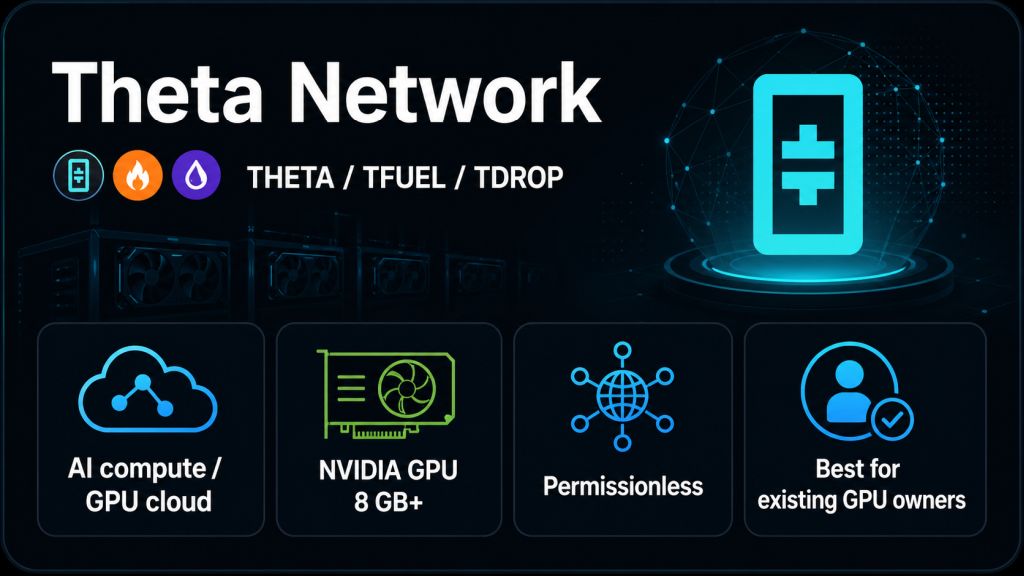
| Token | THETA (governance/staking), TFUEL (gas, compute payments, node rewards), TDROP (staking incentives, AI-agent mechanics) |
| Network Type | AI compute / decentralized GPU cloud, with legacy video and CDN roots |
| Min Hardware | NVIDIA GPU with at least 8 GB vRAM, 4+ CPU cores, 16 GB+ RAM, 256 GB+ free storage, 100 Mbps upload/download, Ubuntu 22.04+ preferred |
| Base Reward | None verified |
| Onboarding | Permissionless for Edge Node and EdgeCloud Client, but hardware-gated; no waitlist or KYC found for community participation |
| Best For | Operators who already own a strong NVIDIA GPU, have low electricity costs, can maintain uptime, and are comfortable with Linux or WSL2 troubleshooting |
1. Quick Verdict
Theta EdgeCloud is a real, permissionless GPU compute marketplace with working software, official documentation, and monthly TFUEL payouts. It makes the most sense for operators who already own a compatible NVIDIA GPU and can absorb electricity and uptime costs without depending on a specific monthly return. Guardian staking, once a common entry point, lost most of its appeal after the v4.1 reward cut. If you are considering buying hardware specifically to run a Theta node, there is not enough verified job-volume data to support that decision today.
2. Best Fit / Possible Fit / Poor Fit
| Operator Profile | Fit | Why |
|---|---|---|
| Already owns a compatible NVIDIA GPU (8 GB+ vRAM) | Best fit | Hardware cost is already sunk. The decision narrows to electricity, uptime, and setup effort. |
| Planning to buy a GPU mainly for Theta participation | Poor fit | No verified public job-volume data supports a hardware purchase decision today. |
| Comfortable with Linux CLI and driver management | Best fit | Linux is the stable path. Setup involves GPU drivers, software installation, wallet configuration, and ongoing monitoring. |
| Running Windows as their primary OS | Possible fit | Windows EdgeCloud Client support is Alpha preview. Expect more friction and less stability than the Linux path. |
| High electricity cost operator | Poor fit | GPU workloads run near full capacity during jobs. High electricity prices can wipe out any margin. |
| Passive-income seeker expecting stable monthly returns | Poor fit | There is no base payout and no guaranteed utilization. Rewards depend entirely on jobs completed. |
| Guardian staking candidate with 1,000+ THETA | Poor fit | Guardian rewards were cut sharply after v4.1. For most home operators, this path usually does not make sense as a primary earning route. |
3. Why This Project Matters
Theta operates a decentralized GPU compute marketplace where community hardware handles AI inference, transcoding, and rendering workloads. The project started in video streaming infrastructure and has since shifted toward AI compute, with EdgeCloud now its main GPU cloud product. For DePIN operators, Theta is a GPU network with working software, official documentation, and a live payment mechanism. The real question is not whether the network exists, but whether enough jobs flow through it to make your specific hardware worth running.
4. Project Overview
Theta Network uses a multi-token model: THETA is used for governance and staking, TFUEL covers gas, compute payments, and node rewards, and TDROP now has a larger role in staking incentives and AI-agent mechanics. The EdgeCloud product is Theta's main GPU compute offering, where community operators contribute hardware capacity and receive TFUEL for completed jobs. The network also supports lighter participation through Edge Nodes (bandwidth and caching) and Guardian Nodes (block validation staking), though for GPU owners today, EdgeCloud Client is the main path worth evaluating seriously.
5. Is Theta Network Suitable for Small/Medium Operators?
Maybe, with specific conditions.
- Already own a compatible NVIDIA GPU? EdgeCloud Client is technically accessible and requires no mandatory stake or waitlist. The question then comes down to electricity cost and setup effort, both of which are manageable if you go in knowing what is involved.
- Buying hardware from scratch? The earnings picture is not verified enough to justify that spending.
- Guardian staking used to be a common recommendation. After the v4.1 reward cut, which reduced TFUEL inflation from roughly 5% to roughly 0.5%, it no longer holds up as a serious option for most home operators.
- EdgeCloud Client setup is not a one-click process. Linux is strongly preferred, and Windows support is still in Alpha.
- Electricity is not a footnote. Official documentation flags power supply and cooling as operator responsibilities, and a high local rate can flip the outcome entirely.
- Payouts are distributed in TFUEL, so the fiat value can change after distribution if you hold the token instead of converting it.
- The 8 GB vRAM minimum is the official floor, but community experience suggests 24 GB+ cards are more competitive for higher-value jobs. That is a practical observation, not an official rule.
6. Infrastructure Requirements
EdgeCloud Client (main GPU participation path)
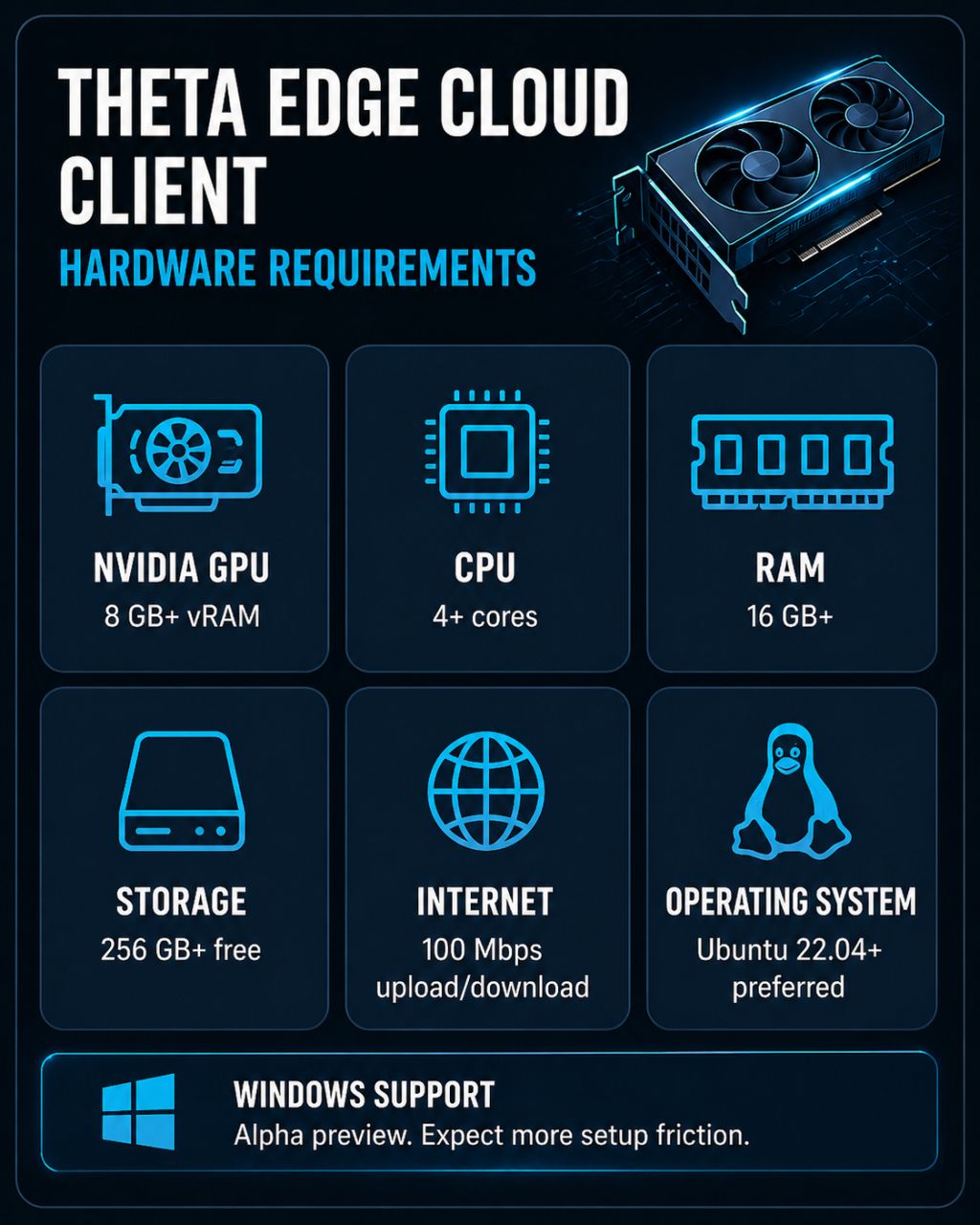
| Requirement | Official Minimum |
|---|---|
| GPU | NVIDIA with at least 8 GB vRAM |
| CPU | 4+ cores |
| RAM | 16 GB+ |
| Storage | 256 GB+ free |
| Internet | 100 Mbps upload and download (per official FAQ) |
| OS | Ubuntu 22.04+ preferred; Windows Alpha support available |
One thing to flag: the installation guide references 10 Mbps in some places, but the official FAQ lists 100 Mbps. Plan for the higher figure.
RTX 3090 and RTX 4090 class cards come up regularly in community discussion as practical choices for competing on higher-value jobs. They are not officially required, but cards at the 8 GB minimum may see lower job allocation when stronger hardware is on the same marketplace.
Edge Node (bandwidth and caching contribution)
A lighter participation path that runs on less demanding hardware. Earning potential is low compared to EdgeCloud GPU participation. Not the right focus for operators primarily interested in income.
Elite Edge Node (staking)
Requires 10,000 to 500,000 TFUEL per node, with an unstaking period of roughly 60 hours.
Guardian Node (block validation staking)
Requires a minimum of 1,000 THETA. Rewards were cut significantly after v4.1. Not a recommended primary path for home operators today.
Validator Nodes
Enterprise-only. Not open to individual community operators.
7. Step-by-Step Setup (EdgeCloud Client)
-
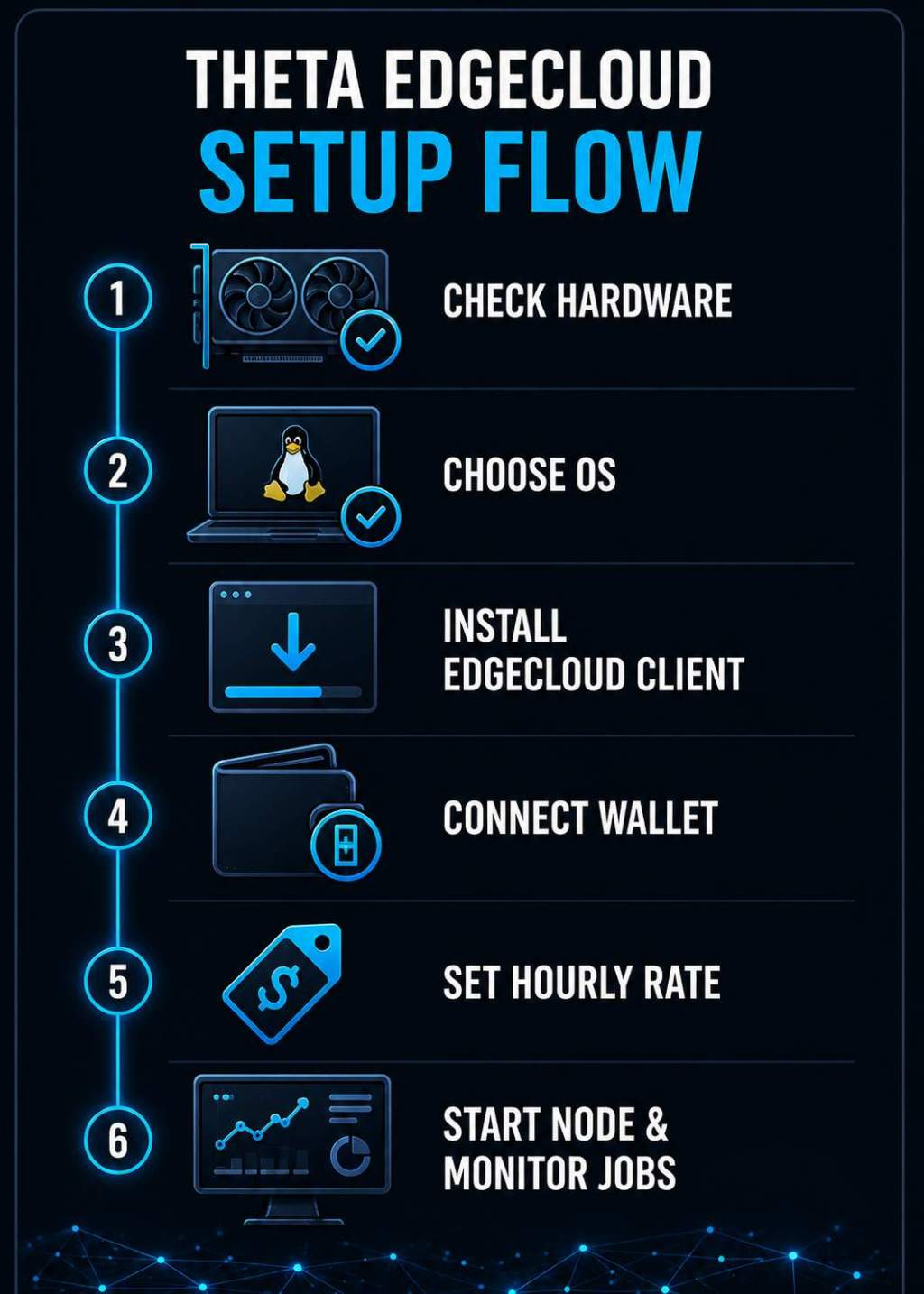
Confirm hardware compatibility. Check your NVIDIA GPU model, vRAM, and driver version. Confirm you have 100 Mbps internet and 256 GB+ free storage before going any further.
-
Choose your operating system. Linux (Ubuntu 22.04 or later) is the stable path. If you are on Windows, the EdgeCloud Client is currently Alpha preview and may require extra troubleshooting, admin permissions, or WSL2 configuration. Go in knowing that.
-
Download and install the EdgeCloud Client. Use only the official installation instructions from Theta's documentation site. Skip third-party installers.
-
Configure your wallet. Connect a compatible wallet for TFUEL payouts. Your wallet address ties directly to your node identity, so get this right before starting the client.
-
Set your hourly rental rate. You define your own GPU rental price. Check what other operators are charging first. Setting too high can reduce job allocation; too low cuts your per-job earnings.
-
Start the client and watch job activity. See whether jobs are actually being assigned. Check GPU temperatures and power draw under load during the first sessions. Sustained GPU workloads generate real heat.
-
Review payouts. Rewards land monthly between the 1st and 5th. If nothing shows up, check your wallet address configuration against your node settings before assuming the network is at fault.
8. Current Earnings Picture
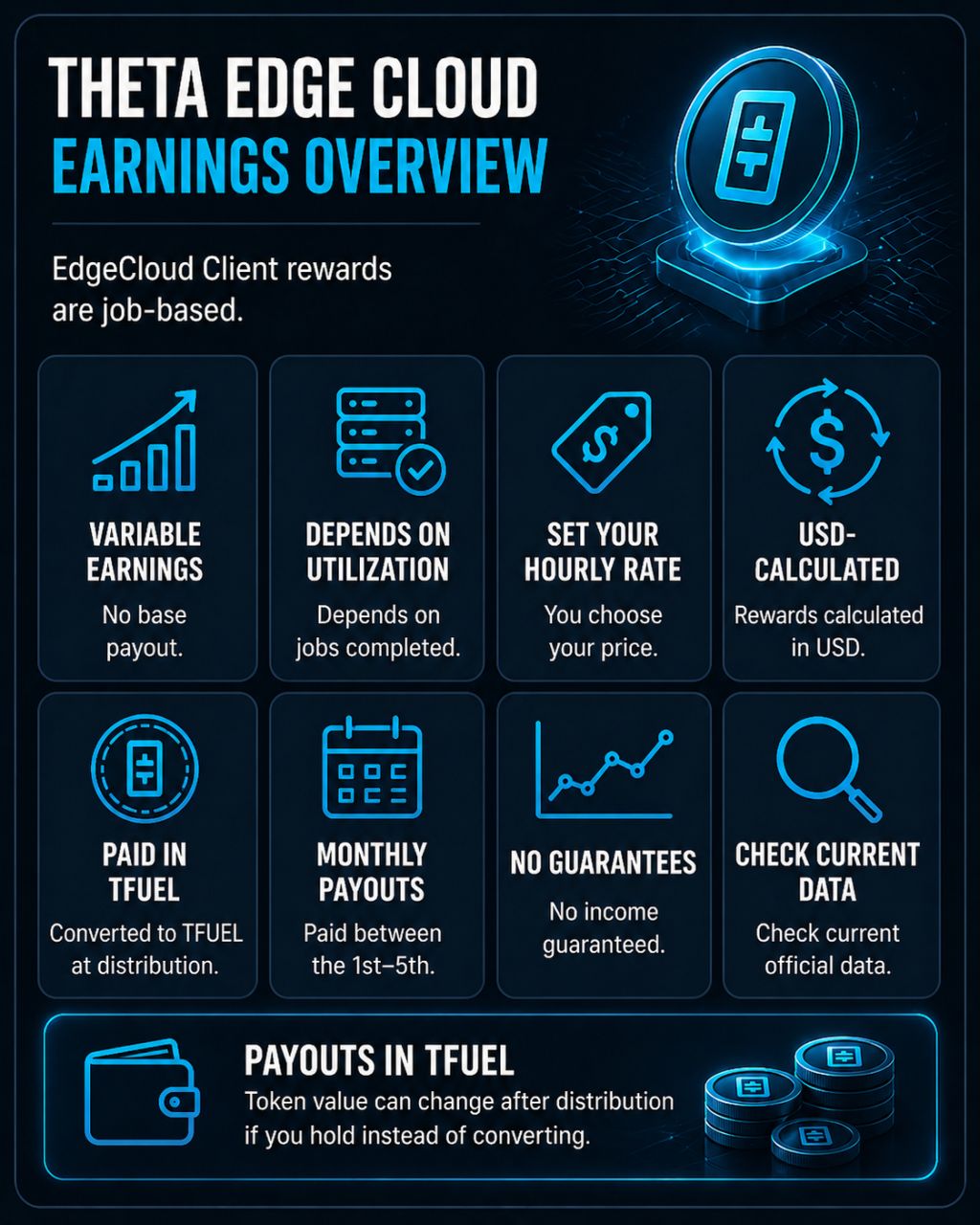
EdgeCloud Client rewards are calculated in USD based on completed jobs, converted to TFUEL at the market rate at distribution, and paid monthly between the 1st and 5th. Operators set their own hourly GPU rental rates.
What that means day to day:
- You earn nothing without job assignments. There is no base payout.
- The TFUEL amount you receive depends on the USD value of completed jobs and the TFUEL price at the moment of distribution. After payout, the fiat value of those tokens can rise or fall if you continue holding TFUEL.
- Meeting the hardware minimums does not guarantee work. A node can sit idle if demand is low, or if other operators on the marketplace are running faster or cheaper hardware.
- No verified public dataset exists that confirms a typical monthly income range for home operators. Community reports vary widely depending on GPU model, location, electricity cost, uptime, and pricing strategy.
Any estimate you build should spell out its assumptions: GPU model, expected utilization rate, your hourly rate, electricity cost per kWh, cooling overhead, hardware depreciation, and a TFUEL price scenario. Treat any output as an illustration, not a projection.
9. Recent Network Updates
Qwen3 32B on EdgeCloud (April 2026)
Alibaba's Qwen3 32B was deployed on Theta EdgeCloud as a decentralized on-demand inference API, running across community GPU nodes using pipeline parallelism. Real AI inference workloads are reaching the network, which matters for operators tracking whether demand is actually growing.
H200 GPU support
Theta added support for NVIDIA H200 GPUs. For operators considering higher-end hardware, this expands what the network can accept and may help support larger AI workloads.
TDROP 2.0 (January 2026)
A governance proposal reallocated 4 billion TDROP from NFT reward pools to extended staking incentives through 2030. This reshapes TDROP token economics but does not directly change EdgeCloud GPU operator payouts.
Roadmap: unified Edge/EdgeCloud client and RapidAPI integration
Theta has signaled plans to unify the Edge Node and EdgeCloud Client software and to make GPU access available through RapidAPI. Neither has shipped yet. If they gain adoption, more jobs could reach community operators. Plan around what is live, not what is announced.
10. Pros & Cons
Pros
- The software client works and is officially documented
- No waitlist, no KYC: anyone with eligible hardware can participate
- Rewards are calculated in USD before converting to TFUEL, which makes job pricing easier to understand, but payout value still depends on TFUEL conversion and any token holding after distribution
- You set your own hourly rate
- EdgeCloud Client participation does not require any token stake
- Real AI workloads are running on the network, with Qwen3 32B as a recent example
- Payouts arrive on a predictable monthly window: the 1st to 5th
Cons
- No jobs means no income. There is no floor.
- Every payout converts to TFUEL at market rate, so what you receive in fiat can shift if you continue holding the token
- Windows support is Alpha and routinely involves more friction than Linux
- Guardian Node rewards were slashed after v4.1, removing what used to be a workable home-operator option
- Cards at the 8 GB vRAM minimum may compete poorly against stronger hardware on the same marketplace
- Some operators report reward visibility problems and slow support response; these are community-reported, not confirmed as universal
- Electricity and cooling costs can flip the economics entirely if local rates are high
- No verified public earnings data for home operators exists to compare against
11. Common Pitfalls to Avoid
Buying hardware before confirming job demand. No verified job-volume data justifies purchasing a GPU specifically for Theta. Test with hardware you already own before spending anything.
Underestimating electricity cost. GPU workloads run near full capacity during active jobs. If your local electricity rate is high, the numbers may not work even with solid uptime. Calculate your all-in cost before committing to 24/7 operation.
Expecting Guardian staking to generate meaningful income. The v4.1 change cut TFUEL inflation on Guardian rewards from roughly 5% to roughly 0.5%. Running a Guardian Node as a primary income path no longer makes sense for most home operators.
Treating Windows as equivalent to Linux. The Windows EdgeCloud Client is Alpha software. That can mean admin-level friction, compatibility issues, and less stability. If you have a Linux option, use it.
Setting your hourly rate without checking the market. Pricing above competing nodes can leave your hardware idle. Look at what others are charging and revisit your rate after seeing actual job history.
Building a budget around expected TFUEL payouts. Rewards are variable by design. A monthly income figure built on projected job volume and TFUEL price is not something you can rely on.
Skipping thermal monitoring. A GPU running sustained compute loads generates real heat. Thermal throttling hurts job performance and wears hardware down over time. Check temperatures under real load before leaving the node running overnight.
12. Tips for Home Operators
- Only start if you already own hardware that meets the minimums. Buying in just to test should be avoided unless you can justify the hardware purchase independently.
- Use Linux. Ubuntu 22.04 or later gives you the most stable and documented setup path, and it avoids the Alpha friction that comes with Windows.
- Before leaving the node unattended, get GPU temperature and power draw monitoring in place. Know where your thermal ceiling is and set an alert if you can.
- Look at your job history before drawing any earnings conclusions. If jobs stop coming in after a few weeks, check whether your rate, hardware tier, or uptime is the problem before assuming it is a network issue.
- When estimating electricity payback, model the pessimistic case, not the best one. Community earnings claims in forums tend to represent favorable conditions, not typical ones.
- Staking decisions are separate from hardware decisions. Buying THETA or TFUEL to hold alongside EdgeCloud participation adds token exposure that is not required and not without risk.
- The TDROP 2.0 and unified client developments are worth following. Do not make hardware or capital decisions based on them until they have actually shipped and shown adoption.
- A 24 GB+ card puts you in a stronger position to compete for higher-value jobs. If you are running an 8 GB card, keep your utilization expectations proportionate.
13. FAQ
Can I run a Theta EdgeCloud node with consumer-grade hardware?
Yes, if your NVIDIA GPU has at least 8 GB vRAM and the rest of your system qualifies: 4+ CPU cores, 16 GB RAM, 256 GB free storage, and 100 Mbps internet. Cards like the RTX 3090 or RTX 4090 exceed the minimum and come up frequently in community discussion as practical choices. Cards sitting right at the 8 GB floor will run the software, but may see less job allocation in a competitive marketplace.
Is onboarding currently open?
Yes. EdgeCloud Client participation is permissionless. No waitlist or KYC process was found for community GPU operators at the time this guide was written. Check the official Theta documentation for any changes before you start.
Do I need to buy tokens to participate?
Not for EdgeCloud Client. No stake is required to run the GPU client. Guardian Node staking requires a minimum of 1,000 THETA, and Elite Edge Node staking requires 10,000 to 500,000 TFUEL per node, but neither is required to participate through EdgeCloud.
How are operators paid?
Rewards are calculated in USD based on completed compute jobs, then converted to TFUEL at the market rate at distribution, and paid monthly between the 1st and 5th. You set your own hourly GPU rental rate.
Is Theta EdgeCloud profitable for home operators in 2026?
No verified public data confirms a typical earnings range for home operators. What you earn depends on your GPU model, job allocation, hourly rate, electricity cost, cooling overhead, hardware depreciation, and the TFUEL price at payout time. It may work out for operators with existing hardware and low electricity costs. It cannot be called reliable income.
What hardware is not supported?
AMD GPUs are not supported. Intel Arc and integrated graphics are not supported. The EdgeCloud Client requires an NVIDIA GPU with at least 8 GB vRAM. Windows is supported in Alpha only.
What are the main risks for small operators?
No guaranteed job allocation, TFUEL price exposure after payout, electricity costs that can erase margins, hardware thermal stress from sustained workloads, Windows setup friction if you are not on Linux, and the reality that nodes with stronger hardware may consistently win jobs over lower-tier cards.
What should I check before spending money?
Your local electricity rate, your GPU model and vRAM, your comfort level with Linux CLI, current TFUEL market conditions, and whether the Theta EdgeCloud marketplace shows enough active job flow to justify setup time. Community earnings claims in forums should not be taken at face value without knowing the poster's hardware, location, and cost structure.
14. Final Verdict
Theta EdgeCloud is a DePIN GPU network with working software, official documentation, and a real payout mechanism already in use. For operators who already own a compatible NVIDIA GPU and can tolerate variable income and TFUEL price exposure, it is a reasonable project to test. Guardian staking is not a practical focus for home operators anymore after the v4.1 reward cut. The open question on EdgeCloud is job volume: real AI inference workloads are reaching the network, but no verified data tells you what a home operator with typical hardware actually earns over a full month of uptime.