Disclaimer: This guide is for informational purposes only and is not financial, investment, hardware-purchasing, or tax advice. Storj node earnings depend on available storage, customer demand, egress traffic, vetting status, withheld earnings, uptime, bandwidth, electricity cost, payout method, and the market value of STORJ. Do not buy drives, servers, or other equipment solely for Storj unless you are comfortable with low, variable, and potentially uneconomic returns. Check the current Storj documentation, payout rules, software version notes, and wallet/payment settings before running a node.
Quick Stats
| Token | STORJ (ERC-20) |
| Network Type | Decentralized cloud storage / S3-compatible object storage |
| Min Hardware | 1 CPU core, 500 GB available storage per node (2 TB recommended); no SMR drives; 99.3% uptime minimum; port forwarding required |
| Base Reward | Official rate card: $1.50/TB/month stored, $2.00/TB egress, $2.00/TB repair/audit traffic, ingress unpaid. Actual earnings are usually much lower due to slow fill, vetting, withholding, and variable egress; treat these as rates, not expected income. |
| Payout Method | zkSync Era is the practical route for small operators; Ethereum L1 thresholds depend on gas and can be impractical for small balances |
| Onboarding | Public node onboarding is open; commercial node path is application-based |
| Best For | Operators with an always-on NAS, homelab server, or Raspberry Pi with spare HDD capacity and low marginal electricity cost |
1. Quick Verdict
Storj is one of the more accessible DePIN storage projects for home operators in 2026. Public onboarding is open, no GPU or enterprise hardware is required, and the setup process is less demanding than most compute-based DePIN projects. The catch is that the economics only make sense for operators who are already running hardware. If your NAS, homelab server, or Raspberry Pi is always on anyway, converting idle storage into small STORJ payouts is a reasonable proposition with limited additional cost. If you are planning to buy new drives or a dedicated machine specifically for Storj, the current fill rates, withholding structure, and community-reported earnings make that a difficult case to justify. The core decision is whether you have spare storage on already-powered hardware, not whether Storj sounds promising in the abstract.
2. Best Fit / Possible Fit / Poor Fit
| Operator Profile | Fit | Why |
|---|---|---|
| Home operator with an always-on NAS or homelab server, spare HDD capacity, reliable broadband, and low marginal electricity cost | Best Fit | This is the practical use case Storj is built around. You convert unused storage and bandwidth into small STORJ payouts without meaningful additional hardware spend or power draw. |
| Raspberry Pi or mini-PC user with a spare external HDD and unlimited or high-cap broadband | Best Fit / Possible Fit | Low power draw keeps the math workable, but you still need port forwarding, stable uptime, patience through the vetting period, and realistic payout expectations. |
| Operator planning to buy new drives or a dedicated server mainly for Storj | Poor Fit | Slow fill rates, partial utilization, first-year withholding, and current community-reported earnings make hardware payback uncertain and likely very long. Do not buy hardware only for Storj. |
| High-electricity-cost operator running an old server or power-hungry storage rack | Poor Fit | Electricity costs can consume most or all of what a node earns, especially before it fills. Older legacy hardware makes the math worse, not better. |
| User behind CGNAT, unstable broadband, metered internet, or without port-forwarding access | Poor Fit | Storj requires reliable inbound connectivity and strong uptime. Network limitations often prevent stable participation. |
| Small business or data center with underused storage and relevant compliance credentials | Possible Fit | The commercial node path may be worth exploring, but it is application-based and not the primary route for home operators. Commercial payout rates have not been published officially. |
3. Why This Project Matters
Storj has been operating as a public decentralized storage network since 2019, making it one of the longer-running DePIN projects in the storage category. It gives home operators a practical example of what participating in a real decentralized storage economy looks like: your machine stores encrypted customer data, earns from retrieval, and gets audited for uptime and integrity. Storj's S3-compatible interface matters because operator earnings depend on real storage and retrieval demand, not only token incentives. For anyone researching the storage segment of DePIN, Storj is a useful reference point because it is mature enough to surface real operator economics rather than only projections.
4. Project Overview
Storj runs a decentralized cloud storage network where individual operators contribute hard drive space and bandwidth to store encrypted customer data. The network is organized around satellites, which coordinate data placement and operator audits, and storage nodes, which are the machines run by individual operators. Customers pay for storage and retrieval, and a share of that revenue flows to node operators in STORJ tokens. Operators earn from stored data, egress traffic when customers retrieve files, and repair/audit tasks. Ingress, meaning uploads to your node, is not paid.
5. Main Operator Reality Check
- Open public access is real, but two tracks exist. Any home operator can join the public Storj network without a license, enterprise approval, or GPU. Commercial nodes are a separate, application-based path aimed at larger or certified operators. For most home operators, public node participation is the only relevant path.
- Hardware is simple, but not any drive works. Consumer and prosumer HDD hardware is fine for Storj. SMR (shingled magnetic recording) drives are not suitable under official requirements. RAID controllers should not be used in RAID mode; one drive per node process is the recommended approach.
- Networking is a real barrier for some operators. Port forwarding on port 28967, a static IP or reliable DDNS service, and avoiding CGNAT are practical requirements. These are not difficult for a confident home network user, but they can completely block casual participation if the ISP or router setup does not cooperate.
- New nodes earn very little at first. Vetting delays reduce upload traffic during the early period. Storage fills gradually, not immediately. The first-year withholding structure holds back a significant share of earnings, so actual cash flow in the first several months is modest at best.
- The strongest economics come from existing hardware. Storj works best when the node runs on a machine that is already powered on for other reasons: a NAS, a home server, a Pi running other services. Incremental power draw is low, and you are not adding a new electricity bill to justify.
- Community sentiment in 2026 is realistic to pessimistic. Forum and community discussion frequently points to slow or declining data fill, modest monthly earnings, oversupply concerns, token price pressure, and recent software issues. That does not make Storj a bad project, but operator expectations need to be realistic going in.
6. Is Storj Suitable for Small/Medium Operators?
Yes, but with real conditions attached.
Storj is technically accessible to small operators, and the public onboarding path is open. Suitability depends almost entirely on whether you already have appropriate hardware running.
- If you have an always-on NAS, homelab server, or low-power mini PC with spare HDD space, Storj is worth testing. The downside is not only time and electricity. Operators still need working port forwarding, reliable uptime, careful config backups, patience through vetting and withholding, and tolerance for token-price volatility.
- If you are behind CGNAT, have metered broadband, or cannot do port forwarding, stop here. These networking constraints make reliable node operation practically impossible.
- Thinking about buying new drives or dedicated hardware for Storj? The current earnings picture does not support it. Community-reported fill rates suggest a node may not meaningfully offset itself until it has around 2 TB of actually used space, and reaching that takes time. This is a community benchmark, not a guaranteed threshold, but it illustrates the scale.
- Withholding applies to all new nodes. The first few months hold back a large share of earned STORJ. You will not see your full earnings picture for over a year.
- You are paid in tokens, not dollars. STORJ was trading around $0.098–0.099 as of April 29, 2026. Realized value depends on when and whether you convert.
- Drive compatibility, networking setup, and software maintenance all require attention. Storj is not a set-and-forget project.
7. Infrastructure Requirements
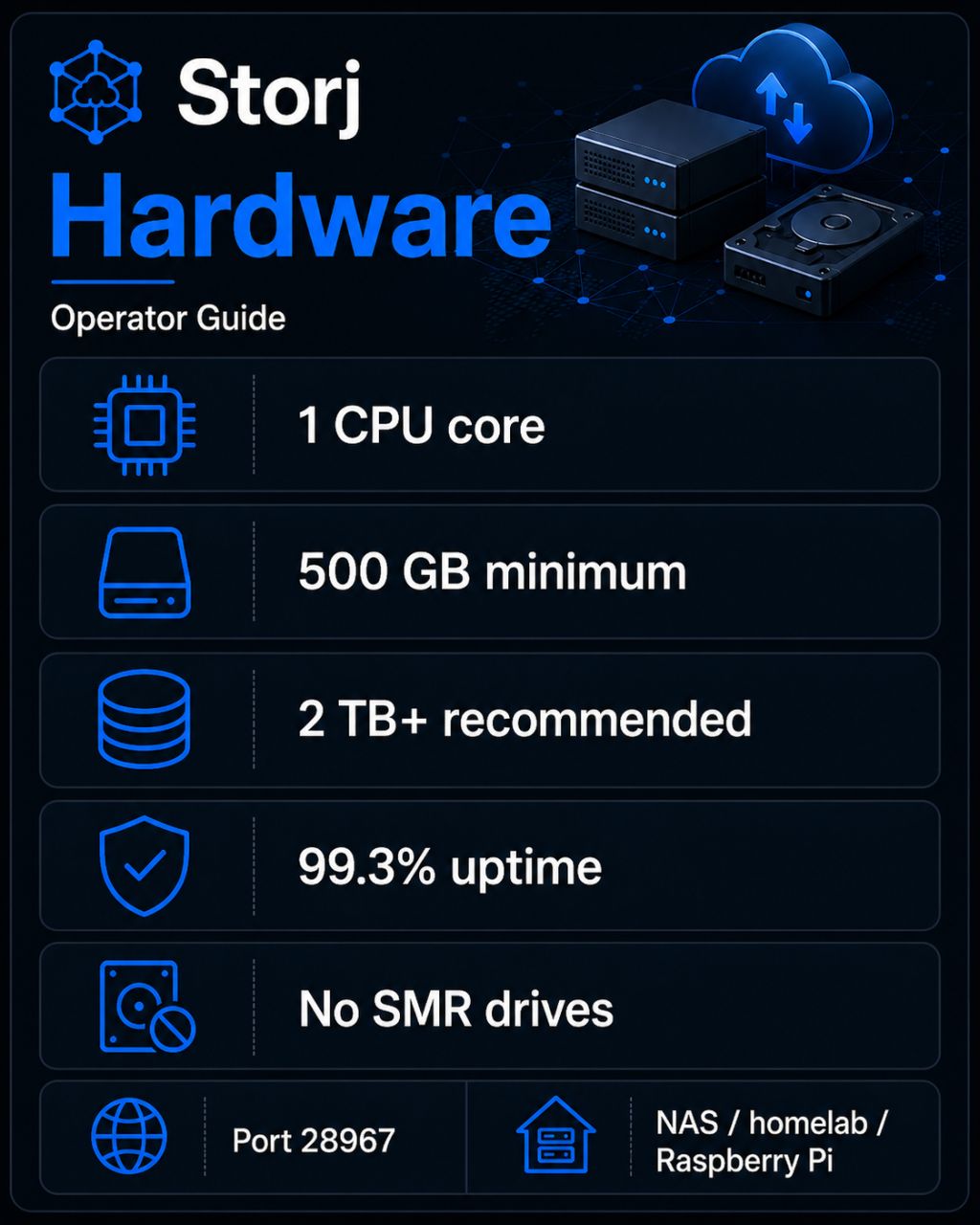
Official minimum requirements per node:
- 1 CPU core (shared is acceptable)
- 500 GB available HDD storage (2 TB or more strongly recommended)
- Bandwidth: official minimum guidance is 1 Mbps upload and 3 Mbps download per TB of capacity, with 1.5 TB monthly transit per TB of capacity. Recommended guidance is higher, at 3 Mbps upload and 5 Mbps download per TB.
- 99.3% uptime minimum (approximately 5 hours of downtime per month)
- Port 28967 open and forwarded (TCP and UDP; QUIC support recommended)
- Static IP or reliable DDNS service
- No CGNAT
Drive and RAID requirements:
- No SMR (shingled magnetic recording) drives; these cause performance problems under Storj's write patterns
- Do not use RAID controllers in RAID mode; run one drive per node process
- If you are adding multiple drives, run separate node processes, one per physical drive
Configuration requirements:
- Persistent storage path for identity files and config
- A backed-up
config.yaml; this file is critical and must survive container recreation or manual upgrade steps - Wallet address for STORJ payouts (zkSync Era or Ethereum L1)
Power draw:
Power consumption varies significantly by hardware. Community examples show why hardware efficiency matters. A Raspberry Pi 4 with a 12 TB external HDD has been cited at around 16W total, while older server hardware can draw hundreds of watts and weaken the economics. Measure your own setup before assuming Storj will offset power costs.
8. Step-by-Step Setup
-
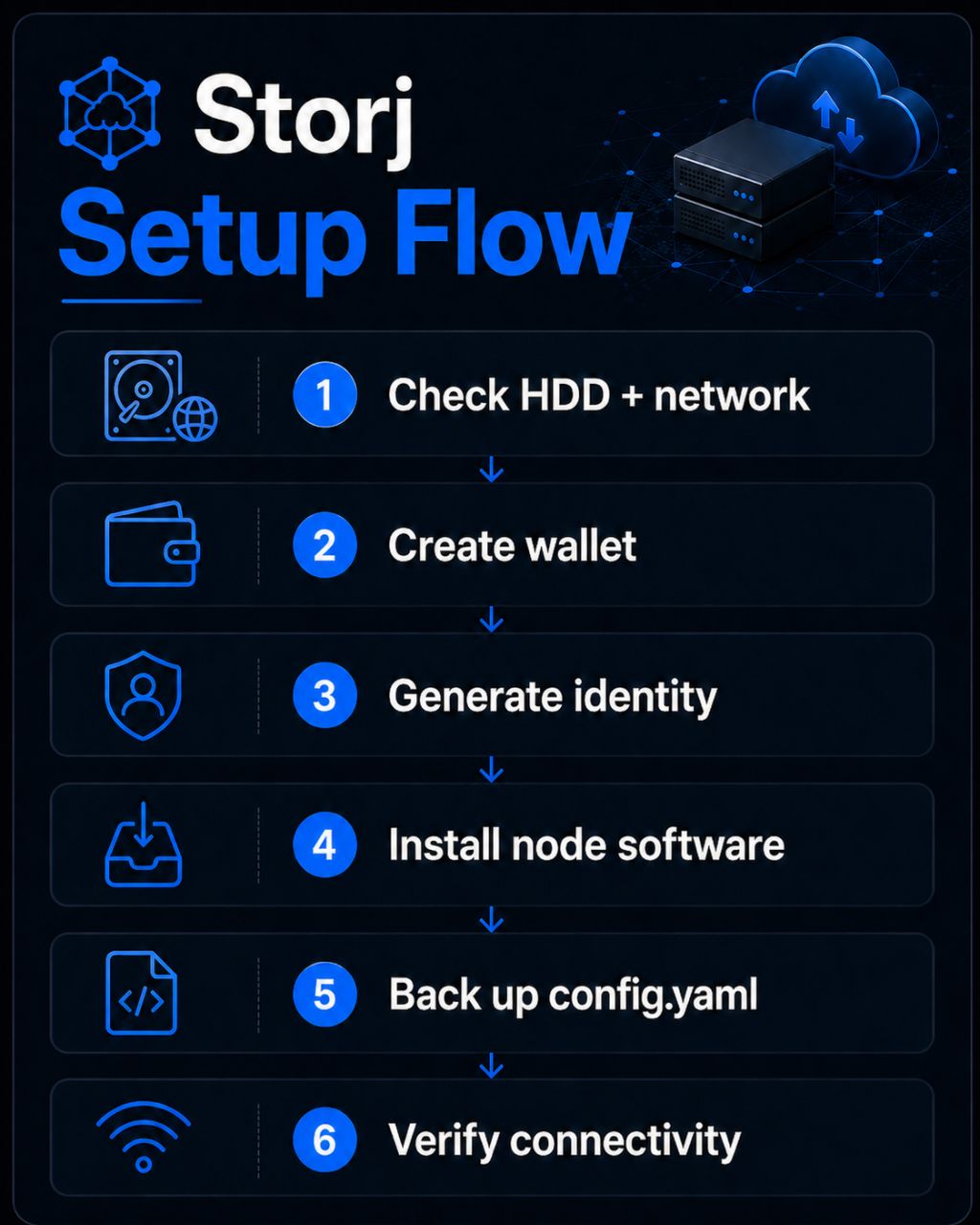
Confirm your hardware and network setup. Verify you have a compatible HDD (no SMR), port 28967 is forwardable, and you are not behind CGNAT. Confirm your storage path is persistent and that you have a static IP or working DDNS.
-
Create a Storj wallet or connect an existing one. You need a wallet address to receive STORJ payouts. Decide at this stage whether you will use zkSync Era (recommended for small operators) or Ethereum L1. zkSync thresholds are near-zero in practice: a March 2025 payout cycle included zkSync payouts at roughly $0.08. L1 thresholds vary with gas and can be impractical for small balances.
-
Generate your node identity. Storj requires a node identity certificate generated through the official CLI tool. This can take time depending on your hardware. Keep the identity files stored safely and backed up; they cannot be trivially regenerated.
-
Install the storage node software. Storj supports Docker-based installation and a native installer depending on your platform. Docker is common for Linux homelab setups. Read the current official documentation for your platform. The authorization token step previously required for new nodes is no longer part of the process, but confirm the docs before setup.
-
Configure and back up
config.yaml. Set your storage allocation, wallet address, and satellite connections in the config file. Back this file up before any forced Docker container recreation or manual upgrade steps. Losing or corrupting this file during an upgrade can cause connectivity problems. -
Configure port forwarding. Forward port 28967 (TCP and UDP) on your router. Enable QUIC if your setup supports it. Verify that the port is externally reachable using a port-check tool.
-
Start the node and verify satellite connectivity. Launch the node, check logs for connection errors, and confirm that satellites are reachable. Look specifically for port 28967 connection errors or satellite connection failures in the logs. After any upgrade, re-verify connectivity. Do not assume a locally running node means satellites can reach it.
-
Monitor during vetting. New nodes receive limited upload traffic while they are being vetted by the network. Expect at least several weeks under recent vetting expectations, and potentially longer depending on audits and satellite-specific progress. Earnings will be very small during this time. Use the storage node dashboard to monitor uptime, audit scores, and satellite connections.
9. Current Earnings Picture
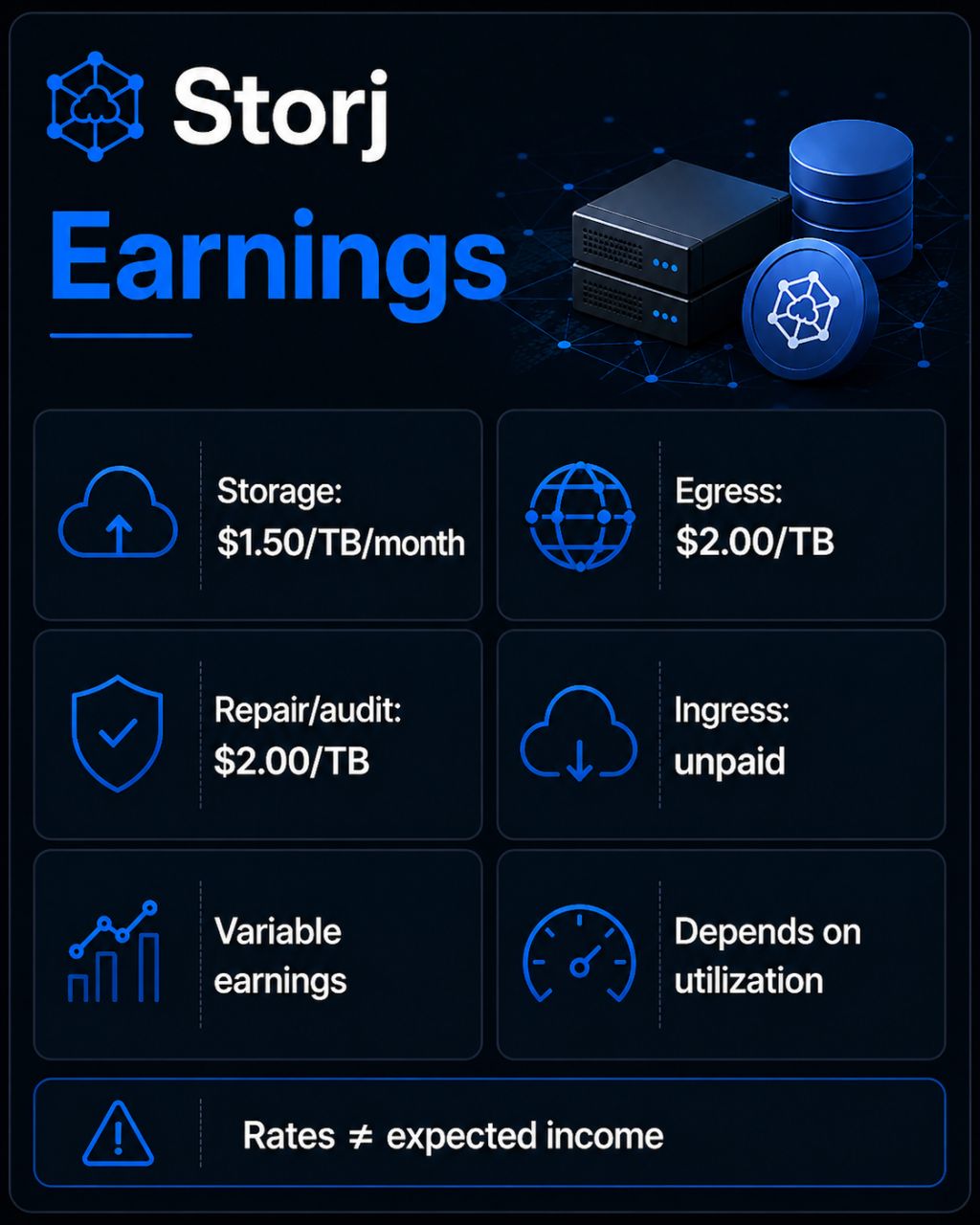
Official payout rates:
- $1.50 per TB/month stored
- $2.00 per TB egress (customer retrieval)
- $2.00 per TB repair/audit traffic
- Ingress is not paid
Why these rates do not equal predictable income:
A fully filled 5 TB node would generate about $7.50/month from storage alone before egress and before withholding, but new or partially filled nodes may earn far less. Most nodes do not fill to capacity quickly. Fill rate depends on network demand, satellite routing, and your node's vetting status. Egress varies based on customer retrieval patterns, which cannot be predicted.
The withholding structure applies for the first 15 months. In the first months, the held-back percentage is highest, so actual payouts are a fraction of what a settled node would see.
Under the current held-back model, 75% of earnings are withheld in months 1–3, 50% in months 4–6, 25% in months 7–9, and 0% in months 10–15. Half of the held amount is returned in month 16, while the rest is released only after a graceful exit.
One community-reported example from September 2025 showed a node with 5.03 TB stored earning $8.31/month total. It is a single data point from a specific moment in time. Do not plan around it.
Electricity cost sits on top of all of this. A node running on hardware that is already powered on may add negligible marginal cost. A node requiring a new machine or older, power-hungry hardware can erase most earnings.
STORJ token price adds another layer of variability. As of April 29, 2026, STORJ was trading around $0.098–0.099. The value you realize depends on when you convert, or whether you hold.
The honest summary: Storj works as a storage offset on existing hardware. It does not work as a standalone income source for most home operators.
10. Recent Network Updates
April 2026: Software update chain (v1.152.5 and v1.152.6): The v1.152.5 release introduced a disk-size reporting bug that caused crashes on some nodes. v1.152.6 fixed this for most nodes. Some operators who force-upgraded to v1.152.6 by recreating their Docker container reported new connectivity issues linked to a lost or corrupted config.yaml. This does not affect every node, but it is common enough that operators should back up config files, read current release notes, and verify satellite connectivity before and after any forced upgrade.
April 2026: Salt Lake satellite connectivity: Connectivity issues with the Salt Lake satellite were an active and unresolved forum topic as of late April 2026. This should be treated as a current issue only for that publication window, so operators should re-check the Storj forum and release notes before assuming it is still active. If your node shows reduced traffic or connectivity problems, check satellite-specific status before assuming a local hardware or network cause.
July 2025: Tokenomics update (buybacks and staking Phase 1): Storj introduced a token buyback mechanism in July 2025 using a portion of network revenue. Phase 1 of a staking reserve was also introduced. Phase 2 staking remains pending with no announced launch date. Do not count on staking income being available today. Do not include staking yield in operator ROI calculations until the actual contract, terms, and eligibility rules are live.
Late 2025: Inveniam acquisition: Storj was acquired by Inveniam. No immediate operator payout change was confirmed in available sources. What the acquisition means for operators long-term is not yet clear.
November 2025: Customer pricing context: Some customer pricing adjustments were reported in the network, but operator payout rates were not officially changed. Check the current docs if you think rates may have shifted since April 29, 2026.
11. Pros & Cons
Pros:
- Public node onboarding is open; no application, license, or enterprise credentials required for home operators
- No GPU needed; consumer or prosumer HDD hardware is sufficient
- Low power draw on efficient hardware means better economics for already-on machines
- Mature network with real customer data and a track record since 2019
- One of the more accessible DePIN storage projects for operators new to the category
- zkSync Era makes small-balance payouts practical without Ethereum L1 gas friction
Cons:
- Earnings are modest and variable; not realistic as a primary or meaningful income source
- New nodes earn very little during vetting, and the first-year withholding structure limits short-term cash flow
- Slow or declining data fill rates are a consistent community complaint in 2026
- STORJ token price risk applies to all payouts; the realized value depends on when you convert
- Network setup (port forwarding, DDNS, CGNAT avoidance) can block operators who assumed it would be plug-and-play
- Recent software update chain (v1.152.5 / v1.152.6) shows that even a mature project requires active monitoring and occasional hands-on maintenance
- Salt Lake satellite connectivity remains an active unresolved issue as of late April 2026
- Buying new hardware for Storj is hard to justify based on current economics
12. Common Pitfalls to Avoid
- Buying hardware to run Storj. New drives, a dedicated NAS, or a new server purchased specifically for Storj is difficult to justify at current fill rates and earnings levels. If you are buying hardware anyway for other reasons, that is a different calculation.
- SMR drives. They cause write performance problems under Storj's data patterns. Check your drives before setup. Some consumer drives are SMR without making it obvious in the product name.
- Ignoring CGNAT. Many ISPs in residential areas route through CGNAT, which prevents inbound port forwarding. Confirm your situation before spending time on setup. CGNAT can block normal Storj operation because inbound connectivity is required. If your ISP uses CGNAT, resolve that before spending time on node setup.
- Expecting fast fill. A new node does not fill quickly. Traffic during vetting is intentionally limited, and even vetting completion does not guarantee fast fill in a network with current oversupply concerns. Do not project full-capacity earnings onto a node that has been running for a few weeks.
- Misreading your dashboard earnings. A significant share of your early earnings is held back for the first 15 months. What the dashboard shows and what you actually receive in STORJ are not the same number during this period.
- Using Ethereum L1 for small balances. L1 payout thresholds depend on gas and can be impractically high for small operators. Use zkSync Era unless you have a specific reason not to.
- Force-upgrading Docker without backing up
config.yaml. The v1.152.6 update experience showed that forced Docker container recreation can corrupt or lose config files. Back up identity files and config before any manual upgrade or container recreation step. - Assuming a crashed node will auto-update itself. Storj nodes use auto-update flows, but a crashed node may not reach the update check at all. If a node is down, verify it manually and check whether an update or config fix is needed.
- Treating satellite issues as a local problem. If your node is running and appears healthy locally but traffic or connectivity is lower than expected, check satellite-specific status in the community forums before assuming the issue is on your end.
13. Tips for Home Operators
- Start with hardware you already own. The only operators for whom Storj makes clear economic sense are those running it on machines that are already powered on. If you have to power up something new, the math gets harder fast.
- One node, one drive, to start. Get familiar with vetting, monitoring, and the update process before adding storage capacity. Adding drives later is straightforward; diagnosing a multi-drive multi-node setup when something goes wrong is not.
- Use zkSync Era for payouts. Unless you are accumulating a large STORJ balance, zkSync is the practical choice for small operators. Ethereum L1 thresholds can be high enough that you wait a long time to receive anything.
- Keep identity and config files backed up. Your node identity and
config.yamlare operationally important, especially during manual Docker upgrades or container recreation. - Watch the forums during active bug windows. The v1.152.5/v1.152.6 update chain showed that releases can introduce new issues. During periods of known software problems, check the forums before upgrading and verify satellite connectivity after.
- Verify satellite connectivity after every upgrade. A node that appears online locally may not actually be reachable by satellites. Check logs for connection errors on port 28967 and satellite-specific errors after any update.
- Leave room on your drives. Do not allocate 100% of a drive's capacity. A drive filled past safe limits under active bug conditions, like the recent disk-size issues, can cause operational problems.
- Check your drive type before setup. Look up your specific drive model and confirm it is CMR, not SMR. If in doubt, check the manufacturer's spec sheet or cross-reference community drive lists.
14. FAQ
Can I run a Storj node with consumer hardware?
Yes. Storj is one of the few DePIN projects where consumer or prosumer hardware is genuinely appropriate. You need a compatible HDD (no SMR drives), a CPU, reliable internet with port forwarding, and enough uptime. No GPU is required. The main hardware-related pitfalls are SMR drives, CGNAT, and running RAID controllers in RAID mode.
Is Storj onboarding currently open?
Yes. Public node onboarding no longer requires the old manual authorization token step. Any eligible operator can set up a node and join the public network. The commercial node path is separate and application-based. Confirm the current state of the onboarding docs before starting, as this has changed in the past.
Do I need to buy hardware, a license, or tokens to participate?
No license is required for public nodes. You do not need to buy STORJ tokens to operate a node; you earn them. But you do need suitable hardware: a compatible drive, a machine with sufficient uptime, and a working network setup. Buying new hardware specifically for Storj is not recommended given current economics.
How are operators paid?
In STORJ tokens, at $1.50/TB/month stored and $2.00/TB for egress. Ingress is unpaid. The amount you actually receive depends on fill rate, vetting status, withheld earnings schedule, egress activity, and token price. New nodes have a portion of earnings withheld for up to 15 months. zkSync Era is the practical payout route for small operators; Ethereum L1 has gas-dependent thresholds that can be impractical for small balances.
Is running a Storj node profitable in 2026?
It depends heavily on your setup. If you are running Storj on always-on hardware with low marginal electricity cost, it can be net-positive, meaning it offsets some infrastructure cost with small STORJ payouts. It is not a meaningful income source for most home operators. Buying dedicated hardware for Storj is hard to justify based on current fill rates, earnings reports, and token price.
What hardware, locations, or operator profiles are unsupported?
SMR drives are officially unsupported. RAID mode on storage controllers is not recommended. Operators behind CGNAT, without port-forwarding access, with metered broadband, or with unstable uptime are likely to have persistent problems. High-electricity-cost operators running old or power-hungry hardware are at a disadvantage.
What are the main risks for small operators?
Slow fill rates that result in months of very low earnings, the first-year withholding schedule, STORJ token price volatility, networking setup failures, software update issues (specifically the v1.152.5/v1.152.6 update chain in early 2026), Salt Lake satellite connectivity problems, and the risk of buying hardware that does not pay back at current economics.
Was the Storj v1.152.5 bug fixed?
The disk-size crash in v1.152.5 was fixed in v1.152.6 for most nodes. Some operators who force-upgraded to v1.152.6 reported a new satellite connectivity and config issue related to config.yaml corruption during the upgrade process. Check the current release notes before upgrading, back up your config file first, and verify satellite connectivity after upgrading.
Should I use zkSync or Ethereum L1 for payouts?
zkSync Era is the practical choice for small operators. Ethereum L1 payout thresholds depend on gas and can be high enough to delay receipt of small balances indefinitely. A March 2025 payout cycle included zkSync Era payouts at roughly $0.08, which illustrates how low the practical threshold is on zkSync relative to L1.
Are Storj nodes maintenance-free?
No. Updates, config file persistence, satellite connectivity, disk usage, and uptime all require monitoring. The April 2026 update chain is a clear example: even a mature project can have software issues that require manual intervention. Plan for occasional maintenance, not a permanent hands-off setup.
15. Final Verdict
Storj is worth considering in 2026 only if you already have suitable always-on storage hardware with spare capacity and low marginal electricity cost. In that situation, running a public storage node can turn idle HDD space and bandwidth into small STORJ payouts with limited additional infrastructure cost. The case becomes much weaker if new drives, a dedicated machine, or higher electricity use are required. The main uncertainties are network demand and fill rates, the ongoing Salt Lake satellite connectivity issue as of late April 2026, and the STORJ token price, none of which are within an operator's control.