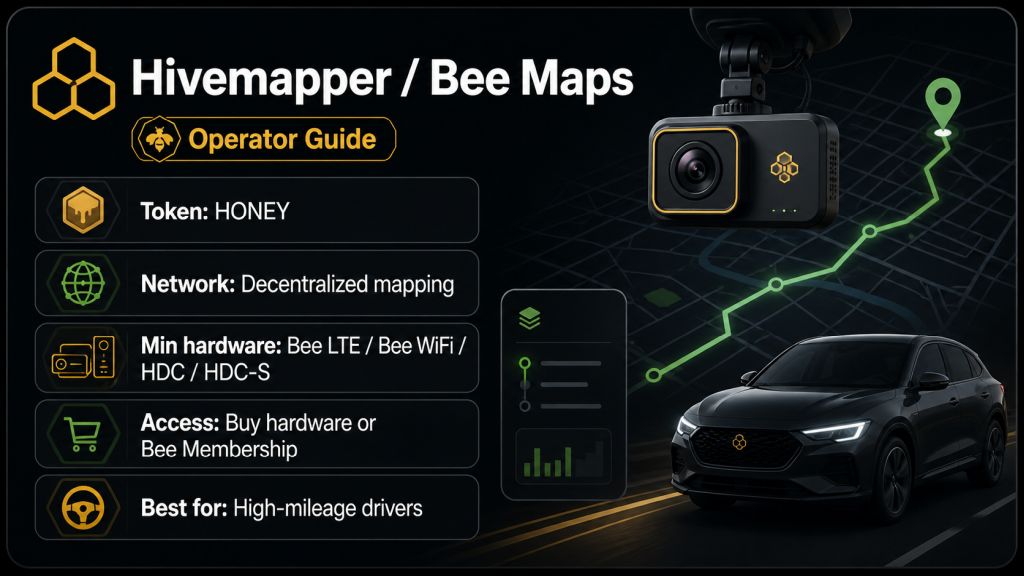
Operator disclaimer: Hivemapper rewards are not guaranteed. Before buying a Bee device or starting a Bee Membership, check the current HONEY price, your local map coverage and route freshness, current MIP reward rules, upload requirements, and whether Bee Membership is available in your region. Hardware cost, subscription commitments, driving volume, GPS quality, upload timing, wallet security, token volatility, and local route saturation can materially change your results.
Quick Stats
| Token | HONEY (Solana-based) |
| Network Type | Decentralized mapping / geospatial data network |
| Participation Model | Vehicle-mounted dashcam mapping |
| Onboarding Status | Hardware purchase open globally; Bee Membership restricted to U.S. and Puerto Rico only |
| Main Operator Requirement | Supported Hivemapper dashcam device + regular driving |
| Reward Model | HONEY tokens based on region progress, route freshness, quality, and upload timing |
| Main Risk | Weak ROI at current HONEY price for casual or low-mileage drivers |
| Best For | High-mileage drivers covering useful or under-mapped routes |
| Min Hardware | Bee LTE, Bee WiFi, HDC, or HDC-S; Bee LTE global buyers must supply their own SIM/data plan |
| Supported Hardware | Bee LTE ($589), Bee WiFi ($489), HDC (discontinued, still supported), HDC-S (discontinued, still supported) |
| Hardware Cost | $489-$589 outright; or $19/month on a 24-month contract via Bee Membership (U.S./Puerto Rico only) |
| Bandwidth Requirement | Bee LTE: BYO SIM and data plan; Bee WiFi: trusted WiFi, hotspot, or Bee Maps App bridge upload |
| Location Dependency | High. Route saturation, regional map progress, and route freshness all affect rewards directly. |
| Current Reward Context | Variable; depends on HONEY price (~$0.0018), route value, upload timing, and MIP formula weightings |
| Slashing / Penalty Risk | No formal slashing, but poor image quality and missed distance minimums reduce or eliminate rewards |
1. Quick Verdict
Hivemapper is technically one of the simpler DePIN setups available. No server, no GPU, no static IP. You mount a dashcam, connect a wallet, and drive. The economic case is harder. At the current HONEY price of around $0.0018, meaningful USD-denominated returns depend on how many kilometres you drive, how useful your routes are, and how well your region is already mapped. High-mileage drivers covering under-mapped areas have a plausible case for the hardware cost. Ordinary commuters driving the same saturated routes are unlikely to see positive ROI without a significant HONEY price recovery. Bee Membership at $19/month lowers upfront cost, but it is a 24-month commitment available only in the U.S. and Puerto Rico.
2. Best Fit / Possible Fit / Poor Fit
| Operator Profile | Fit | Why |
|---|---|---|
| Rideshare, delivery, taxi, courier, or logistics driver already covering high mileage | Best fit | They already drive enough kilometres for the device to collect useful data without requiring extra trips. There is no server to manage and no separate monitoring overhead. |
| Driver in an under-mapped city, rural area, or region with low route saturation | Best fit | Rewards depend on route freshness and regional progress. Low-saturation areas produce more useful data than repeatedly covered urban commutes. |
| U.S. or Puerto Rico driver considering Bee Membership | Possible fit | Membership lowers upfront hardware cost, but the 24-month contract creates financial exposure if HONEY earnings stay weak or the driver's circumstances change. |
| International driver buying a Bee outright | Possible fit, but cautious | Bee LTE is $589 and Bee WiFi is $489. Break-even depends on driving volume, local route freshness, HONEY price, and whether the operator can set up a reliable SIM or upload workflow. |
| Operator willing to accept token volatility | Possible fit | HONEY rewards carry meaningful price risk. Operators comfortable treating rewards as a speculative position rather than predictable income are better placed than those expecting stable USD returns. |
| Casual commuter driving the same short route daily | Poor fit | Repeated routes in mapped areas, low weekly distance, and the current token price combine to make meaningful returns unlikely. The 50 km/device/week minimum under MIP-23 may also be hard to meet consistently. |
| Non-driver looking for no-hardware earnings | Poor fit | The fixed 10% AI Trainer rewards allocation was removed under MIP-22. Variable bounty-style AI Trainer tasks may still exist under Foundation management, but this should not be treated as a dependable income stream. |
3. Why This Project Matters
Hivemapper, commercially branded as Bee Maps, collects street-level map imagery through vehicle-mounted dashcams and makes that data available to enterprise customers who pay in HONEY tokens. Customers burn HONEY to access map data, and under the burn-and-mint model established by MIP-15, 75% of burned tokens are permanently removed and 25% are reminted as rewards for contributing operators. The practical value of the network is freshness: Hivemapper's contributor model is built around regularly refreshed street-level imagery, and route freshness is also part of the operator reward context. Fresh, granular map data is what customers pay for, but that demand does not guarantee strong earnings for every driver.
4. Project Overview
Hivemapper operates a decentralized mapping network on Solana, where individual contributors earn HONEY tokens by driving with a supported dashcam device and submitting verifiable street-level imagery. Operators provide the physical infrastructure: the vehicle, the dashcam, the driving, and the data upload. The network aggregates this imagery into a living map and sells data access to commercial and enterprise customers. Rewards are not fixed. How much you earn depends on the quality and freshness of what you contribute, measured against the network's weekly pool and regional targets.
5. Main Operator Reality Check
- The 50 km/week minimum is a real filter. MIP-23 set a 50 km/device/week floor for reward eligibility and a 3,000 km/device/week ceiling. Drivers who don't consistently hit that floor will miss rewards entirely some weeks.
- There is no server to run, no CLI to learn, and no firewall to configure. The complexity here is in the economics, not the setup.
- Route quality matters as much as distance. Repeated driving on already well-mapped routes may produce less useful reward value than covering fresh or under-mapped roads. The reward formula considers regional progress and freshness, not raw distance alone.
- Since MIP-24, freshness scoring uses upload time rather than when the footage was collected. Bee LTE operators upload automatically while driving; Bee WiFi operators need a consistent upload routine at home, work, a hotspot, or via the Bee Maps App. Missed uploads can cost freshness credit.
- HONEY price dominates the USD outcome. At around $0.0018 per HONEY, even regular driving may translate to a modest USD figure unless the operator covers high-value routes or the token price changes materially. The token price moves independently of network activity.
- Bee Membership is available in the U.S. and Puerto Rico only. The $19/month subscription runs for 24 months. International operators should expect to buy hardware outright at $489 to $589, plus their own SIM/data plan if they go with Bee LTE.
6. Is Hivemapper Suitable for Small/Medium Operators?
Maybe, depending on driver profile and location.
Hivemapper has active dashcam hardware, HONEY reward mechanics, and Bee Maps App workflows, but suitability depends on your driving habits and location more than anything else.
Likely suitable if:
- You already drive high weekly mileage as part of work or routine.
- Your routes cover areas that are under-mapped or infrequently refreshed.
- You are in the U.S. or Puerto Rico and want to test Bee Membership with lower upfront cost.
- Holding HONEY as a speculative position is acceptable to you. If you need predictable USD income, the math is hard at current prices.
- A reliable upload setup is already in place, whether that's a SIM for Bee LTE or a consistent WiFi routine.
Likely not suitable if:
- You drive a short, repeated commute in a well-mapped urban area.
- You need the hardware to pay for itself within 6-12 months at current HONEY prices.
- You are outside the U.S./Puerto Rico and setting up a compatible SIM for Bee LTE internationally adds friction your carrier or country makes difficult.
- You are expecting AI Trainer tasks to replace hardware-based earnings.
- The device needs occasional checking, and you are not prepared for that. Upload failures can go unnoticed, and missed uploads mean lost freshness credit.
The project does not require technical expertise, but it does require an honest look at your driving volume, location, and tolerance for token-denominated uncertainty.
7. Infrastructure Requirements
Supported Devices
Hivemapper currently supports four dashcam models:
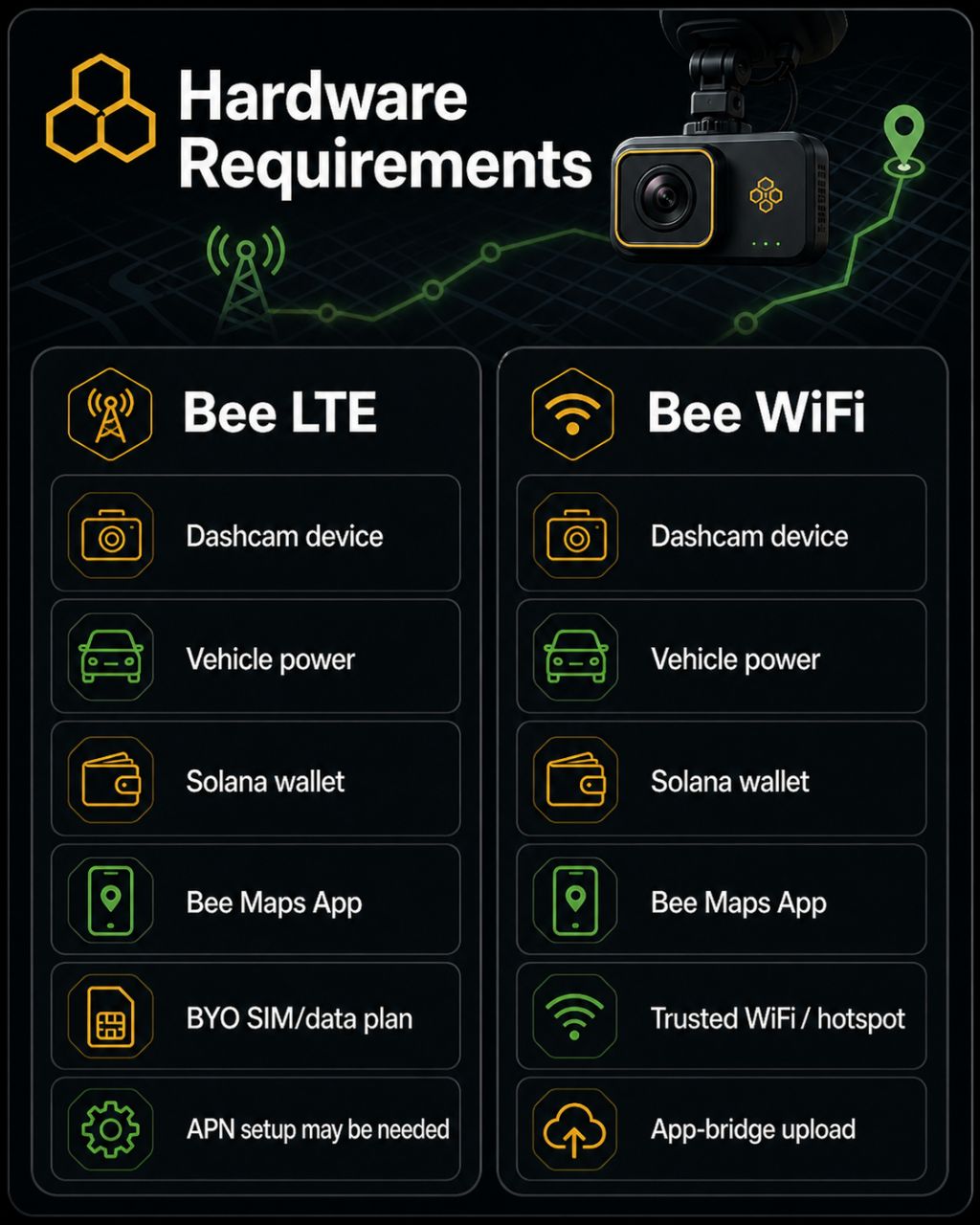
- Bee LTE ($589 outright). Uploads over cellular. Global buyers must provide their own SIM/data plan and may need to disable SIM PIN and configure APN settings through the Bee Maps App.
- Bee WiFi ($489 outright). Uploads via trusted WiFi networks using WiFi Connect, or through the Bee Maps App as a bridge using the phone's WiFi or cellular data.
- HDC. Discontinued, but existing devices are still supported for earning.
- HDC-S. Discontinued, but existing devices are still supported for earning.
If you already own an HDC or HDC-S, check the current Bee Maps App documentation to confirm your device's supported status before assuming full reward eligibility.
Vehicle and Mounting Requirements
The Bee device mounts to a windshield. GPS lock and an unobstructed forward-facing camera view are required for valid submissions. Vehicles must have a 12V or USB power source compatible with the device.
Wallet
A Solana-compatible wallet is required to receive HONEY rewards. Wallet setup is done through the Bee Maps App. Keep private key access secure. Hivemapper's documentation notes that losing or exposing the private key can result in loss of token access.
Phone and App
The Bee Maps App (iOS or Android) is used for device pairing, wallet connection, upload management, and reward monitoring. No separate desktop software is required.
Network and Upload
- Bee LTE: Needs a compatible SIM/data plan in your region. Carriers must support the Bee LTE modem. International buyers should confirm carrier compatibility before purchasing.
- Bee WiFi: Upload via home WiFi, work WiFi, hotspot (including Starlink), or phone as a data bridge through the Bee Maps App.
Distance Requirements
- Minimum: 50 km/device/week (MIP-23). Weeks below this threshold may not qualify for rewards.
- Maximum rewarded: 3,000 km/device/week. Distance above this ceiling earns no additional rewards.
Electricity
Power draw from the dashcam while driving is negligible compared to a typical vehicle's electrical load. Electricity cost is not a material factor for most operators.
8. Step-by-Step Setup
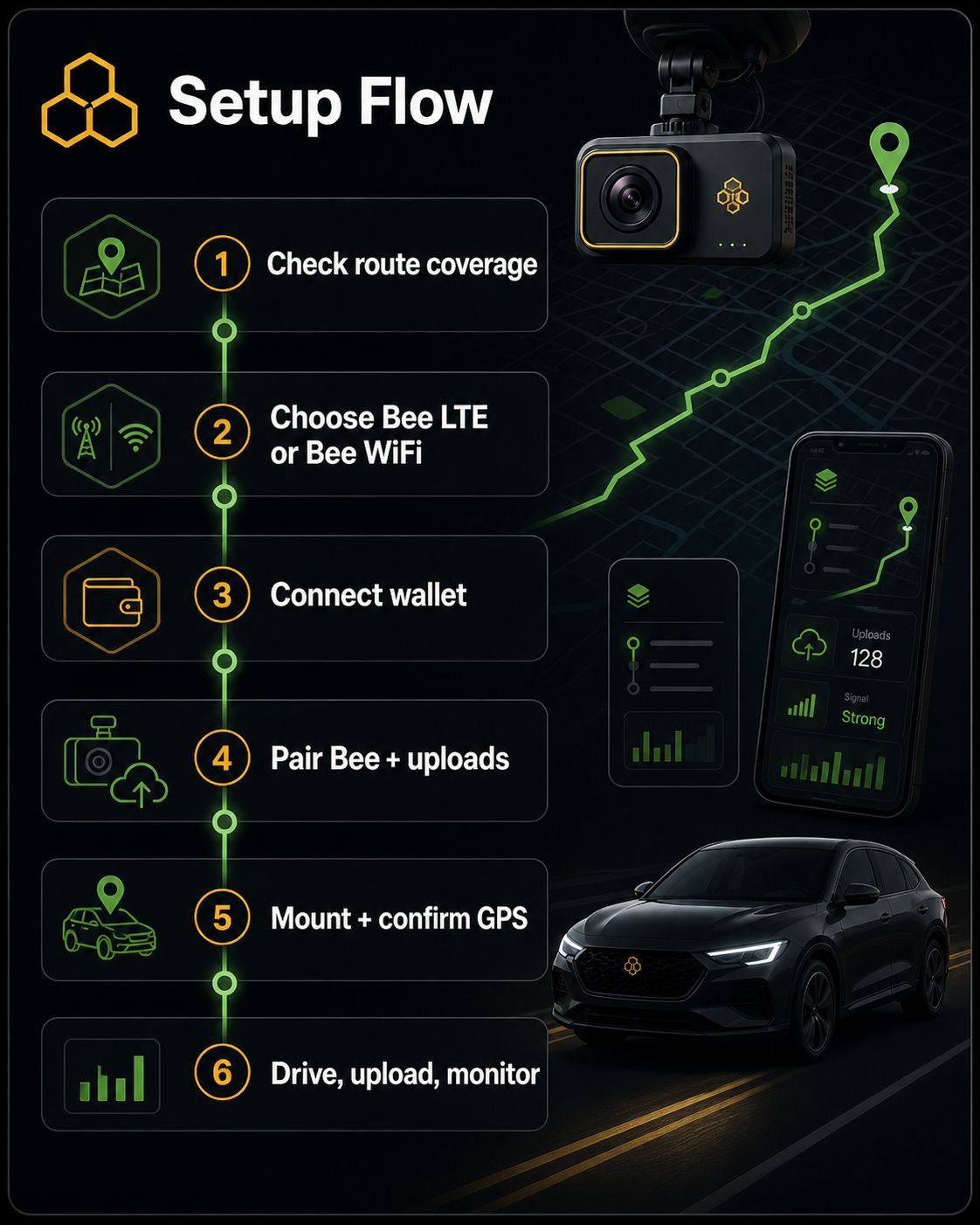
- Check route and region conditions first. Before purchasing, check Bee Maps to see how saturated your regular routes are and whether your area has active mapping incentives or HONEY Burst opportunities. HONEY Burst opportunities appear mainly in the app, so do not assume they are available in every region.
- Confirm your access path and eligibility. If you are in the U.S. or Puerto Rico, decide between Bee Membership ($19/month, 24-month contract) and outright purchase. If you are outside those regions, plan for outright purchase plus your own SIM/data setup for Bee LTE, or a reliable WiFi upload workflow for Bee WiFi.
- Assess the economic risk before spending. Check the current HONEY price and estimate realistic weekly driving volume. Do not use old screenshots or dashboard estimates with stale USD assumptions as the basis for a purchase decision.
- Order hardware. Purchase through the official Bee Maps shop. International buyers planning on Bee LTE should research SIM carrier compatibility for their country before ordering.
- Set up the Bee Maps App. Download the Bee Maps App, create an account, and connect a Solana wallet. The App guides you through scanning the Bee QR code to pair the device.
- Configure upload mode. For Bee LTE: insert SIM, disable SIM PIN if needed, configure APN through the App, and confirm LTE is active. For Bee WiFi: add trusted home or work WiFi networks in the App, or set up the App-bridge upload workflow using your phone's connection. Confirm that uploads complete after each drive.
- Mount and calibrate. Attach the Bee to your windshield per the hardware guide, confirm GPS lock before your first drive, and check that the camera field of view is unobstructed.
- Monitor regularly. Check the Bee Maps dashboard for upload status, distance submitted, and reward activity. Track route freshness for your area and do not assume the device is working correctly without periodic verification.
9. Current Earnings Picture
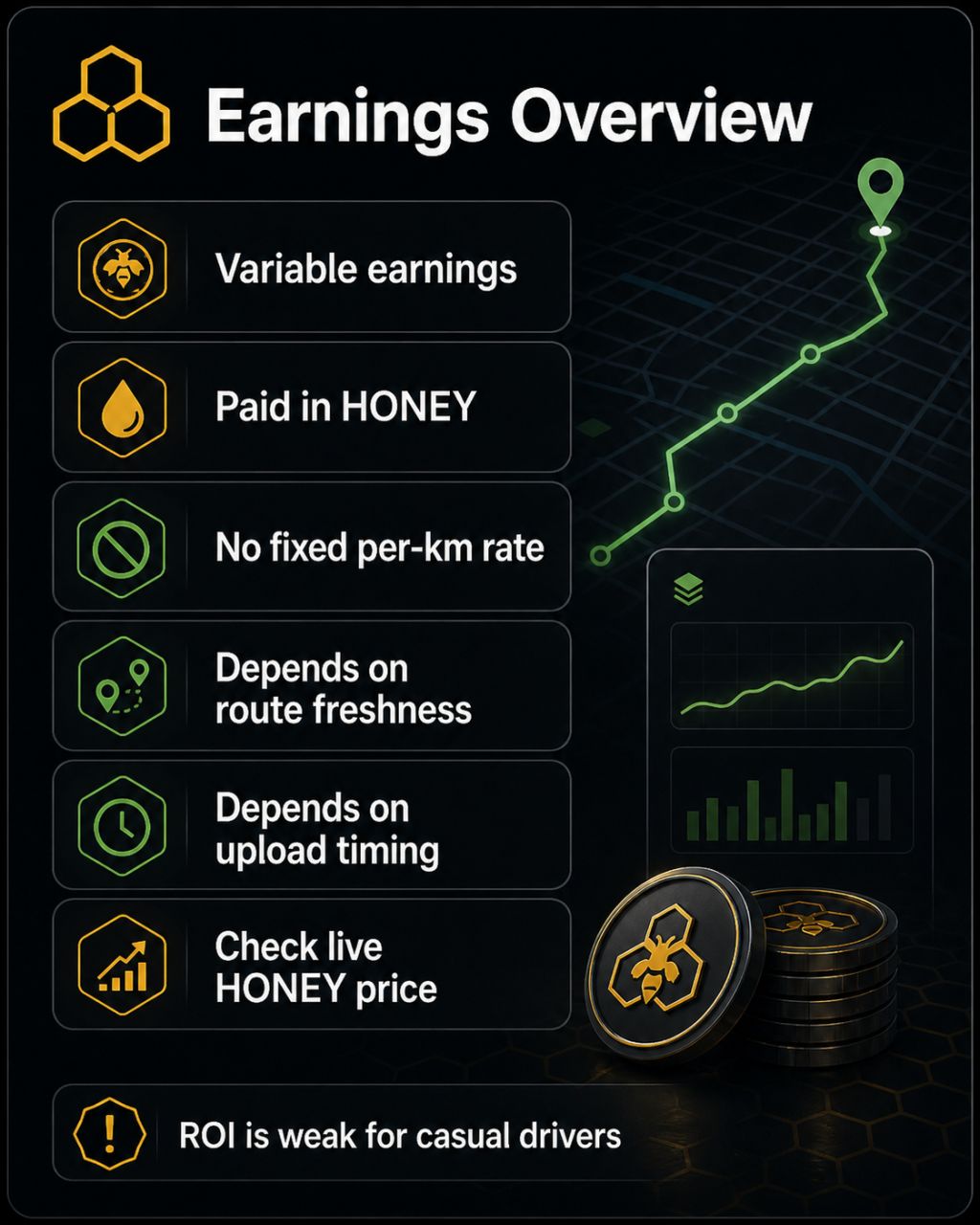
Hivemapper rewards are not fixed and cannot be reliably predicted for a specific operator.
What affects weekly earnings:
- Global Map Progress: How much the overall network is advancing toward total road coverage.
- Regional progress and freshness: How valuable your specific routes are relative to what the network already has. A fresh road in an under-mapped region is worth more than another pass over a fully covered highway.
- Upload timing: Under MIP-24, Upload Time is used for freshness scoring. Getting data uploaded sooner preserves more of its value.
- Image quality: Poor GPS data, obstructed views, or night imagery in low-light conditions can reduce the quality score of submissions.
- HONEY price: At approximately $0.0018 per HONEY, the USD value of any reward output is highly sensitive to token price movement.
Burn-and-mint context: Under MIP-15, customers burn HONEY to access map data: 75% is permanently destroyed, and 25% is reminted as Consumption Rewards, capped at 500,000 HONEY per week. Weekly contributor rewards draw from this pool and from network emissions.
On DePINscan data: DePINscan shows around 8,037 active Hivemapper devices and tracks HONEY-denominated daily metrics. Use HONEY/day as a directional reference. Any USD conversion from DePINscan requires checking the live HONEY price at the time you're reading it. Those USD figures shift with the token price and should not be used as static break-even calculations.
Community reports and DePINscan snapshots suggest that active drivers in useful areas can accumulate HONEY, but the USD value remains highly dependent on the token price at the time of conversion. Treat HONEY rewards as speculative income until converted, because the USD value can change sharply between collection and sale.
10. Recent and Operator-Relevant Network Updates
MIP-22: AI Trainer rewards restructured
The fixed 10% emissions allocation for AI Trainer tasks was removed and the share was repurposed. Variable, Foundation-managed bounty-style AI Trainer tasks may still exist, but the formal protocol-level income path is gone. Do not plan your participation model around AI Trainer income.
MIP-23: Distance floor and ceiling introduced
A 50 km/device/week minimum was set for reward eligibility, along with a 3,000 km/device/week maximum. Casual operators with low weekly distance are directly affected by the floor. The ceiling also caps how much credit high-volume operators can claim per device per week.
MIP-24: Upload Time replaces Collection Time for freshness; 24/7 mapping added
Freshness scoring now uses when data is uploaded, not when it was collected. Bee LTE operators who upload automatically in the field are less affected. Bee WiFi operators need a regular upload routine to preserve freshness value. MIP-24 also confirmed that 24/7 mapping is supported, so night driving on well-lit routes can contribute valid imagery when quality requirements are met.
Together, those three changes shape how the network pays contributors today. Anything you read about Hivemapper earnings that predates MIP-24 is working from outdated reward mechanics.
11. Pros & Cons
Pros
- No server, GPU, or technical infrastructure required. Setup is dashcam-level, not node-level.
- Bee Membership reduces upfront cost for U.S. and Puerto Rico operators willing to commit to 24 months.
- Active dashcam-based mapping product with documented HONEY reward mechanics.
- HDC and HDC-S owners may be able to continue earning while those legacy devices remain supported.
- 24/7 mapping support after MIP-24 means night drivers in lit areas can contribute when imagery meets quality requirements.
- The Bee Maps App handles upload, pairing, and monitoring in one place.
- The burn-and-mint model creates a documented link between customer map-data usage and HONEY token mechanics.
Cons
- HONEY at around $0.0018 makes USD-denominated ROI very sensitive to token price. Break-even timelines shift with small price changes.
- Bee Membership is restricted to U.S. and Puerto Rico. International operators face full hardware cost plus SIM setup.
- The 50 km/week minimum under MIP-23 filters out casual and low-mileage operators.
- Route saturation means urban operators driving common commutes may earn less than expected.
- Upload timing now affects reward value, and Bee WiFi operators who miss uploads lose freshness credit.
- Bee LTE global buyers need their own SIM/data plan. Carrier compatibility is not guaranteed, and APN setup can add friction.
- After MIP-22, AI Trainer cannot be treated as a reliable fallback income stream.
- The Foundation can adjust reward formula weightings, so any earnings model you build today may not hold tomorrow.
- Community members have flagged impersonation scams on Discord targeting Hivemapper operators.
12. Common Pitfalls to Avoid
Buying hardware before checking your routes. The coverage map is public. Driving the same route thousands of other operators have already mapped in detail may earn far less than covering fresh roads. Check saturation before purchasing.
Assuming Bee Membership is available where you live. The $19/month subscription is U.S. and Puerto Rico only. International operators who assume membership is global will find they need to pay full hardware price instead.
Ordering Bee LTE without planning the SIM. Bee LTE does not include a global data plan. Outright buyers outside membership regions must source a compatible SIM, confirm carrier support, and potentially configure APN manually. Do this research before the device ships.
Relying on AI Trainer as a no-hardware fallback. The fixed protocol allocation is gone. Bounty-style tasks may exist but cannot be treated as stable income.
Using old DePINscan USD break-even figures. USD output from any earnings metric must be recalculated against the live HONEY price at the time you're evaluating it. Numbers from six months ago are not useful for current ROI planning.
Not setting up a reliable upload routine for Bee WiFi. Data collected but not uploaded loses freshness value. Bee WiFi requires intentional upload management, whether through home WiFi, hotspot, or App-bridge workflow.
Ignoring the 50 km/week minimum. Casual drivers who only cover short distances may not qualify for rewards in a given week. The threshold is a real eligibility gate, not a soft guideline.
Treating community earnings posts as guaranteed outcomes. HONEY earnings vary significantly by region, route freshness, driving volume, upload timing, and token price. Community screenshots may reflect better conditions than a new operator will experience.
13. Tips for Home Operators
Check your routes before spending any money. Bee Maps shows current coverage and freshness. If your regular driving area is already well-mapped, your earning potential is limited regardless of how many kilometres you drive.
Choosing between Bee LTE and Bee WiFi mostly comes down to your upload situation. If your car has reliable cellular coverage, LTE handles uploads automatically after MIP-24. Bee WiFi works with a consistent routine, whether that's home WiFi, a hotspot, or the App-bridge method.
For international Bee LTE buyers: research carriers before ordering. Confirm that a local SIM will work with the Bee LTE modem and that APN settings are documented. Some carriers require PIN removal and manual configuration through the Bee Maps App.
When reading DePINscan, look at HONEY/day rather than the USD figure. The USD conversion shifts with the token price, so apply the live rate yourself at the time you're making a decision.
Vary your routes where practical. Driving the same road repeatedly adds diminishing freshness value once it's recently mapped. Side streets and infrequently covered areas contribute more.
Night mapping on Bee is supported in lit areas, and it can add useful volume for drivers who commute after dark. Image quality still needs to meet standards, and poorly lit footage is unlikely to earn much.
Do not trust unsolicited DMs in Discord or Telegram. Impersonation scams targeting Hivemapper operators have been reported. Never share your wallet seed phrase or private key with anyone, including accounts claiming to be from official support.
After each drive, confirm that uploads actually completed. A device that looks active but isn't uploading earns nothing, and it can take a few days before you notice the gap in your dashboard.
14. FAQ
Can I run Hivemapper outside the U.S.?
Yes, with outright hardware purchase. Bee LTE is $589 and Bee WiFi is $489. Bee Membership at $19/month is only available in the U.S. and Puerto Rico. International buyers also need to source their own SIM/data plan for Bee LTE and confirm carrier compatibility.
Do I need any technical skills to set up a Bee device?
No. Setup is managed entirely through the Bee Maps App. There is no command line, no server configuration, and no port forwarding. Bee LTE SIM setup may require disabling a SIM PIN or entering APN settings, which adds a small amount of friction for some operators.
Can I earn HONEY without buying hardware?
The fixed 10% AI Trainer emissions allocation was removed under MIP-22. Variable bounty-style AI Trainer tasks may still exist under Foundation management, but this is not a dependable or protocol-backed income path. The primary earning model requires a supported dashcam device.
How are Hivemapper rewards calculated?
Rewards depend on Global Map Progress, your regional progress contribution, route freshness at upload time, image quality, and the weekly reward pool. There is no fixed per-kilometre rate. The Hivemapper Foundation can adjust formula weightings over time.
How much can I earn?
Earnings cannot be stated as a reliable number. They vary by driving volume, route freshness, region, upload timing, and the HONEY price at the time you evaluate USD output. At approximately $0.0018 per HONEY, even consistent weekly driving produces modest USD results. Any break-even calculation should use the live HONEY price at the time you're running the numbers.
Does my weekly distance matter?
Yes. MIP-23 set a 50 km/device/week floor for reward eligibility. Weeks below that threshold may not qualify for rewards. The rewarded ceiling is 3,000 km/device/week.
Is Bee Membership a 24-month commitment?
Yes. Bee Membership is priced at $19/month with a 24-month contract. If your earnings or circumstances change, you are still committed to the subscription term. Confirm this before signing up.
Does Bee WiFi have a clear upload path?
Yes. Bee WiFi can upload through trusted home or work WiFi networks via WiFi Connect, through a mobile hotspot, or through the Bee Maps App acting as a bridge using your phone's connection. Upload timing matters for freshness scoring under MIP-24, so building a reliable upload habit matters.
Can Bee map at night?
Yes. Bee supports 24/7 mapping, including night driving where street lighting is sufficient. Night imagery still needs to meet normal quality requirements. Poor lighting, blocked views, or weak GPS can reduce reward eligibility.
15. Final Verdict
Hivemapper is an active dashcam-based mapping network with a working product, documented reward mechanics, and a device that is genuinely simple to operate. The operator case is limited by current economics: at around $0.0018 per HONEY, casual commuters with short or heavily saturated routes are unlikely to recover hardware or subscription costs in a reasonable timeframe. High-mileage drivers who already cover useful routes, live in under-mapped areas, and are comfortable with token-denominated uncertainty have a more defensible case for the hardware investment. Before spending anything, check the live HONEY price, check your local coverage saturation, and confirm your Bee access path. Those three checks will tell you more than any fixed ROI estimate.