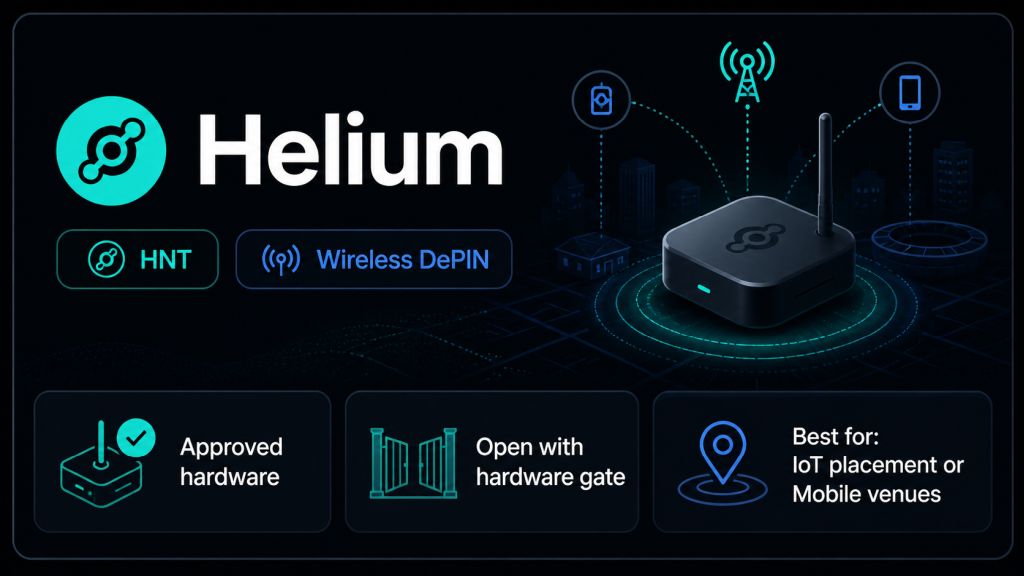
Operator note: Helium rewards are not fixed and should not be treated as predictable income. IoT hotspot earnings depend on antenna placement, elevation, local density, uptime, and HNT price. Mobile hotspot earnings depend heavily on real carrier offload, foot traffic, supported geography, venue quality, and carrier selection that the operator may not control. Hardware costs, location assertion fees, Data Credits, SOL fees, wallet risk, reward delays, and the possible future Mobile reward escrow introduced by HIP-144 (authorized but not yet deployed as of May 4, 2026) should all be checked before deploying.
| Token | HNT (sole reward token since HIP-138; IOT and MOBILE sub-tokens no longer issued as separate emissions) |
| Network Type | Wireless DePIN: IoT LoRaWAN and Mobile Wi-Fi/carrier offload (two separate subnetworks) |
| Participation Model | Deploy approved hardware, assert location, earn HNT based on coverage activity or carrier data offload |
| Onboarding Status | Open, with hardware gate; low Data Credit fees often bundled by makers; Helium World reduces account friction |
| Main Operator Requirement | Approved hotspot hardware; for Mobile, a high-footfall commercial venue in an active carrier offload region |
| Reward Model | Variable; IoT rewards based on PoC witnessing and data transfer; Mobile rewards based on real carrier offload and data transfer |
| Main Risk | Poor placement or unsupported region makes earnings minimal or zero; HNT price volatility affects fiat value of all rewards |
| Best For | IoT hobbyists with good elevation and low-density placement, or Mobile operators with genuine commercial venue access in the USA, Mexico, or Brazil |
| Min Hardware | Approved IoT LoRaWAN gateway (from current approved Maker list), Helium Mobile indoor or outdoor hotspot, or compatible enterprise Wi-Fi AP for Helium Plus |
| Hardware Cost | IoT: varies by approved Maker; Mobile: $249 indoor, $499 outdoor |
| Electricity Sensitivity | Low overall; IoT hotspots typically draw 3-5 W, Mobile hotspots up to around 20 W; placement and carrier traffic matter far more than power cost |
| Location Dependency | High for both paths; IoT rewards depend on elevation, antenna quality, and local density; Mobile rewards require high foot traffic and carrier offload activity |
| Geographic Availability | IoT network is global; Mobile carrier offload is currently limited to USA, Mexico, and Brazil; UK expansion was announced but not confirmed live as of May 4, 2026 |
| Current Reward Context | IoT: community-reported $0.05-$5/month for typical deployments; Mobile: community-reported near $0 to modest for home units, higher for commercial venues; treat all figures as variable |
| Setup Difficulty | IoT: beginner-friendly with approved hardware; Mobile: moderate; Helium Plus: technical/advanced |
1. Quick Verdict
Helium is a long-running wireless DePIN network with real usage, but what "running Helium" means in 2026 depends entirely on which path you choose. IoT hotspots are globally accessible to operators with approved hardware and a decent placement, but realistic monthly earnings for a typical urban or suburban deployment are usually a few dollars or less. Mobile hotspots are a different calculation altogether: they usually only make economic sense for operators with access to a genuine high-footfall commercial venue in the USA, Mexico, or Brazil, where real carrier offload can occur. A home Mobile deployment in a residential area is likely to earn close to nothing. Helium Plus, which converts compatible enterprise Wi-Fi equipment into the Helium network, is a niche technical path, not a home-operator option.
The central question before spending money on any Helium hardware is: do you have the placement to make this category worth deploying?
2. Best Fit / Possible Fit / Poor Fit
| Operator Profile | Fit | Why |
|---|---|---|
| Small business owner with a cafe, gym, clinic, shop, or transit hub in the USA, Mexico, or Brazil | Best Fit | Mobile hotspot deployment may make sense here. Real carrier offload requires foot traffic and an active Mobile region. Carrier selection is still not fully under the operator's control, but this profile has the strongest fit. |
| Operator with rooftop access, good elevation, and a rural or less-saturated IoT coverage area | Possible Fit | IoT hotspots run cheaply and work globally, but earnings depend strongly on placement quality and local witness density. A well-placed rural hotspot can outperform a densely clustered urban one. |
| IT or networking professional managing compatible enterprise Wi-Fi in a commercial venue | Possible Fit | Helium Plus may be relevant if the existing hardware supports Hotspot 2.0/Passpoint, but setup is technical and community earnings data for this path is still unclear. |
| Crypto hobbyist comfortable with low or inconsistent returns who wants to experiment with wireless DePIN | Possible Fit | IoT can serve as a low-power, low-cost learning project. Should be framed as experimentation rather than reliable income. |
| Home operator in a dense urban area with only window or indoor placement | Poor Fit | IoT earnings are frequently diluted by local saturation and poor witness angles. Mobile at home is rarely a meaningful earner based on current community reports. |
| Operator outside the USA, Mexico, or Brazil who wants to buy a Mobile hotspot for passive income | Poor Fit | Mobile carrier offload is geographically concentrated in the USA, Mexico, and Brazil. IoT is global, but meaningful Mobile earnings outside active carrier regions are unlikely under current conditions. |
| Operator needing fast or predictable ROI from hardware purchase | Poor Fit | Neither IoT nor Mobile offers a reliable or calculable payback timeline. Both paths carry real hardware cost risk in poor placements. |
3. Why This Project Matters
Helium matters because it is not only a token-incentive network. Its IoT LoRaWAN network provides low-power, long-range connectivity for sensors and tracking devices, while its Mobile network supports Wi-Fi offload for carrier subscribers at participating venues. The network had 371,314 active hotspots on the official Explorer as of May 4, 2026. Dashboard data also showed ongoing Data Credit creation and HNT burns, which confirms live network activity, but those point-in-time figures should not be converted into operator ROI assumptions.
4. Project Overview
Helium operates two parallel wireless subnetworks on Solana. The IoT network uses LoRaWAN for low-power wide-area device connectivity and is globally deployable with approved hardware. The Mobile network offers Wi-Fi and carrier data offload, but has geographically narrower operator suitability: meaningful Mobile earnings currently require a commercial venue in an active carrier offload region, with the USA, Mexico, and Brazil being the confirmed active zones. Operators deploy approved hotspot hardware, assert a physical location on-chain, and earn HNT based on network activity. Since HIP-138, HNT is the sole reward token; the earlier IOT and MOBILE sub-tokens are no longer issued as separate reward emissions. The two paths use different hardware, reward different behaviors, and suit different operator situations. The network had 371,314 active hotspots as of May 4, 2026. Picking a path without understanding that difference leads to the wrong purchase.
5. Main Operator Reality Check
-
Helium is not one operator model. IoT LoRaWAN hotspots, Mobile Wi-Fi/carrier-offload hotspots, and Helium Plus enterprise access points all use different hardware, have different earning mechanics, and suit different operator profiles. Treating them as one "Helium node" leads to the wrong purchase decision.
-
IoT is open to small operators globally, but earnings are usually modest. With approved LoRaWAN hardware and a decent placement, anyone can participate. Community-reported earnings for typical home or urban deployments run from around $0.05 to $5 per month. Better-placed outliers earn more, but that is not the median experience.
-
Home Mobile deployments are unlikely to earn anything significant. Rewards depend on real carrier offload, which needs genuine foot traffic and an active region. Residential locations are reported to earn less than $1 per month or near zero, and the community data on this is consistent.
-
Carrier selection is proprietary and not under the operator's control. Operators cannot steer AT&T, T-Mobile, or other carriers toward their hotspot. Even in the USA, consistent offload traffic is not guaranteed.
-
Mobile earning potential is geographically narrow. Carrier offload has been confirmed mainly in the USA, Mexico, and Brazil. The UK expansion was announced but not confirmed live as of May 4, 2026. Outside those active zones, meaningful Mobile data earnings are not realistic under current conditions.
-
The IoT network is globally available. The geographic restriction discussed above applies to Mobile carrier offload, not to IoT participation.
-
Governance changes over the past year have shifted the economics. HIP-138 switched all rewards to HNT. HIP-148 removed separate Mobile mapping rewards and redirected that allocation toward hotspots with real carrier traffic. HIP-144 authorized a Mobile reward escrow mechanism, but it had not been deployed as of May 4, 2026, so the cash-flow risk exists but is not yet active. These changes directly affect what operators earn.
6. Is Helium Suitable for Small and Medium Operators?
For IoT: yes, with realistic expectations. A small operator with approved LoRaWAN hardware, decent elevation, and a placement in a less-saturated area can run a hotspot at low cost with minimal ongoing effort. The IoT network operates globally; for IoT, placement quality and density matter more than country access. The realistic ceiling for most home setups is modest. A few dollars per month is a more honest reference point than the returns early operators saw in 2020-2021.
For Mobile: it depends, and the conditions are specific. You need a genuine high-footfall commercial venue, a location in the USA, Mexico, or Brazil, and a hardware budget that accounts for the real possibility of near-zero earnings. If any of those conditions are missing, the $249 to $499 hardware cost is hard to justify.
For Helium Plus: only if you already have the infrastructure. This path needs enterprise Wi-Fi hardware with Hotspot 2.0/Passpoint support and the networking skill to configure it. Not a beginner path and not a home-user path.
Across IoT, Mobile, and Helium Plus, the same financial risks still apply:
- HNT price at any given time directly affects the fiat value of all rewards. At the time of the data refresh, HNT was $3.54 USD. Do not use that as a planning assumption.
- Location assertion fees, Data Credits, and Solana transaction fees are real upfront costs. Check them before purchasing.
- Helium World has made onboarding easier than the older wallet-heavy flow, but operators still need basic awareness of Data Credits and Solana fees.
- Venue-based Mobile deployments that split rewards with a landlord or business owner should handle that arrangement in writing. Official tax guidance on reward splitting has not been published by the Helium Foundation. A local professional is the right resource there.
7. Infrastructure Requirements
IoT LoRaWAN Hotspot
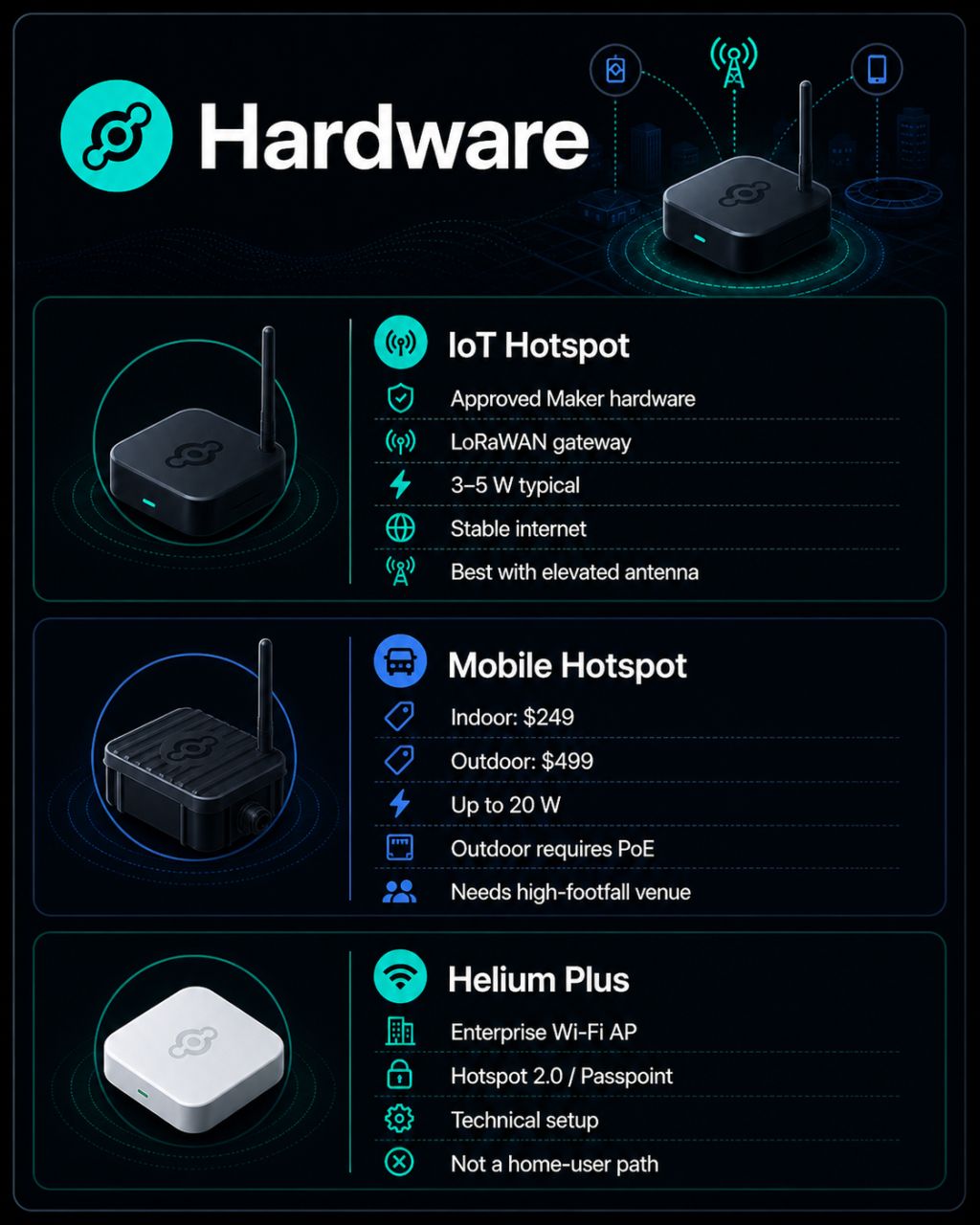
Official path: Purchase an approved hotspot from one of the current approved Makers. The Helium documentation listed 15 approved IoT Makers as of May 4, 2026; check the current list directly before purchasing. Unapproved or DIY LoRaWAN gateways do not qualify for full Proof of Coverage rewards.
- Power draw: typically 3-5 W
- Internet: standard home broadband; stable connection matters more than speed
- Antenna: indoor antenna included with most hardware; an outdoor or elevated antenna makes a real difference to witness quality and coverage
- Onboarding cost: approximately $10 in Data Credits plus a small SOL fee; often bundled by the Maker at purchase
Helium Mobile Hotspot
Official hardware: Helium Mobile indoor or outdoor hotspot
- Indoor: $249
- Outdoor: $499
- Power: outdoor units typically require Power over Ethernet (PoE)
- Onboarding cost: approximately $40 in Data Credits; often bundled
- Location assertion: required on-chain for both device types
- Venue: a high-footfall commercial location in the USA, Mexico, or Brazil is the realistic requirement for material Mobile earnings
Helium had 5 approved Mobile Makers listed in official docs as of May 4, 2026.
Helium Plus (Enterprise AP Path)
Compatible enterprise Wi-Fi access points from vendors such as Meraki, Ruckus, Aruba, Fortinet, or Ubiquiti can potentially participate through Hotspot 2.0/Passpoint configuration.
Existing compatible enterprise hardware is required, along with Hotspot 2.0/Passpoint support and the networking knowledge to configure it correctly. Vendor-specific setup guides were not confirmed available in official Helium documentation as of the data refresh. Community earnings data for this path is also thin. If you are not already managing enterprise Wi-Fi in a commercial setting, this is not the route for you.
Account and Wallet Requirements
Helium World supports email-based account management and reduces direct wallet complexity. Operators still need basic awareness of Solana, Data Credits, and on-chain fees. SOL is required for transaction fees.
8. Step-by-Step Setup
IoT Hotspot
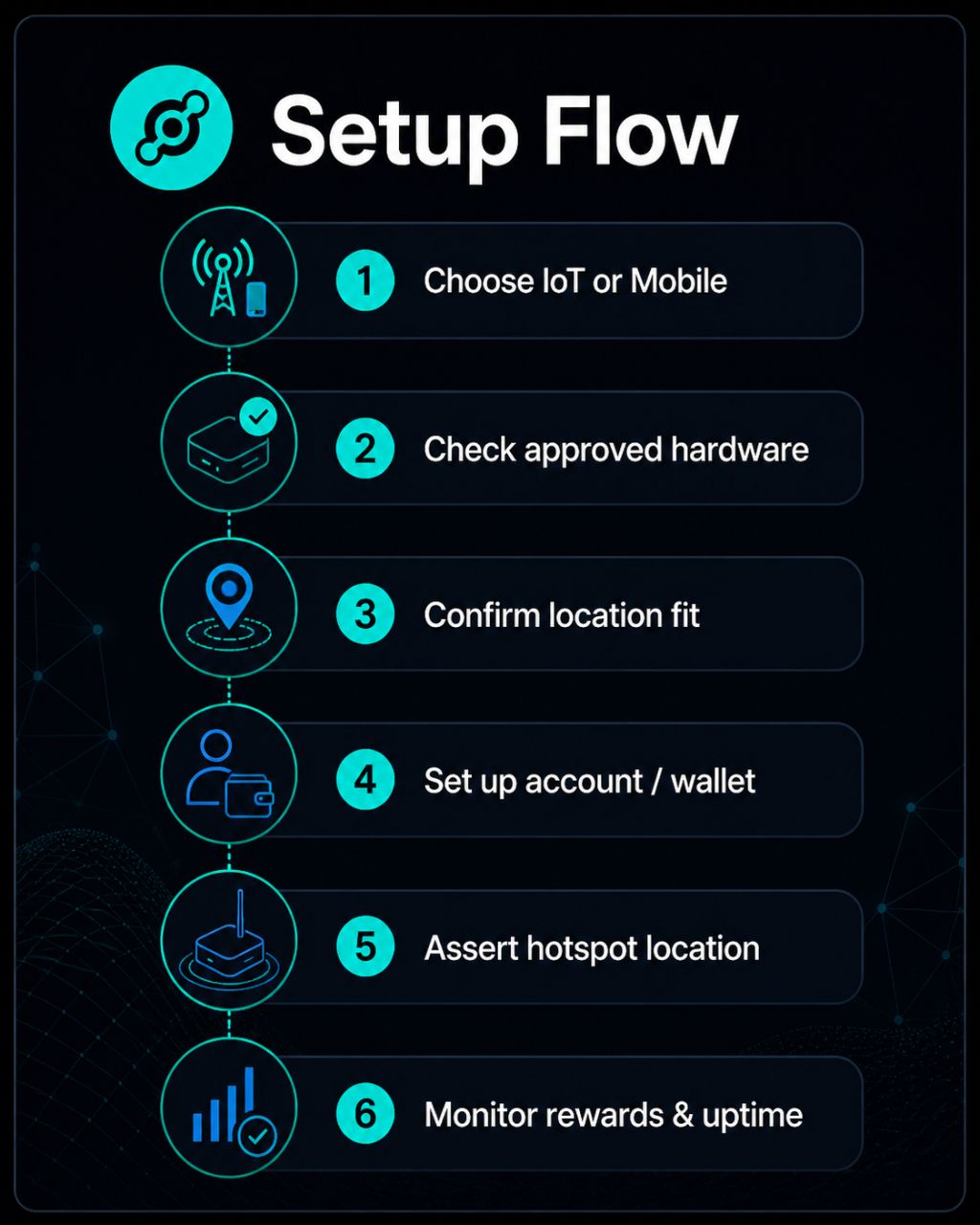
- Check the current approved Maker list in official Helium documentation and confirm the specific device you are considering is currently eligible for PoC rewards.
- Estimate the realistic earnings for your location before purchasing: check coverage maps, local hotspot density, and elevation options. A window placement in a saturated urban area is unlikely to produce meaningful returns.
- Create a Helium World account or set up a compatible Solana wallet; load a small amount of SOL for transaction fees.
- Purchase the approved IoT hotspot. Confirm whether onboarding fees are bundled by the Maker.
- Place the hotspot in the highest, least-obstructed position available. An outdoor or elevated antenna improves witnessing significantly.
- Power on, connect to the internet, and complete the location assertion through the Helium app or Helium World dashboard.
- Monitor the dashboard for witness count, uptime, and reward activity. Placement adjustments may improve performance.
Mobile Hotspot
- Confirm that your venue or location is in an active carrier offload region: currently USA, Mexico, and Brazil. If you are outside those regions, stop here and reassess.
- Assess foot traffic honestly. A cafe, gym, clinic, transit area, or retail space with consistent daily visitors is the target. A residential home or low-traffic location is not.
- Budget for the hardware cost ($249 indoor or $499 outdoor) and onboarding fees, and accept that Mobile earnings may be near zero in poor placements before purchasing.
- If deploying in a third-party venue, set up a reward-sharing agreement with the venue owner before installation.
- Create a Helium World account; set up wallet and Data Credits as needed.
- Install the hotspot at the venue location. Outdoor units require PoE and weatherproof placement.
- Complete location assertion in the Helium app or dashboard.
- Monitor the dashboard for carrier offload events and reward activity. No offload traffic means no meaningful Mobile reward.
Helium Plus
- Verify that your existing enterprise Wi-Fi hardware supports Hotspot 2.0/Passpoint.
- Check Helium's official Helium Plus documentation for your specific vendor before proceeding; vendor-specific guides were not confirmed in official docs as of May 4, 2026.
- Complete the technical network configuration required for carrier offload passthrough.
- Register the device and assert location through appropriate Helium tooling.
- Monitor for carrier association and reward activity.
9. Current Earnings Picture
No safe base reward exists for any Helium operator path, and none is presented here.
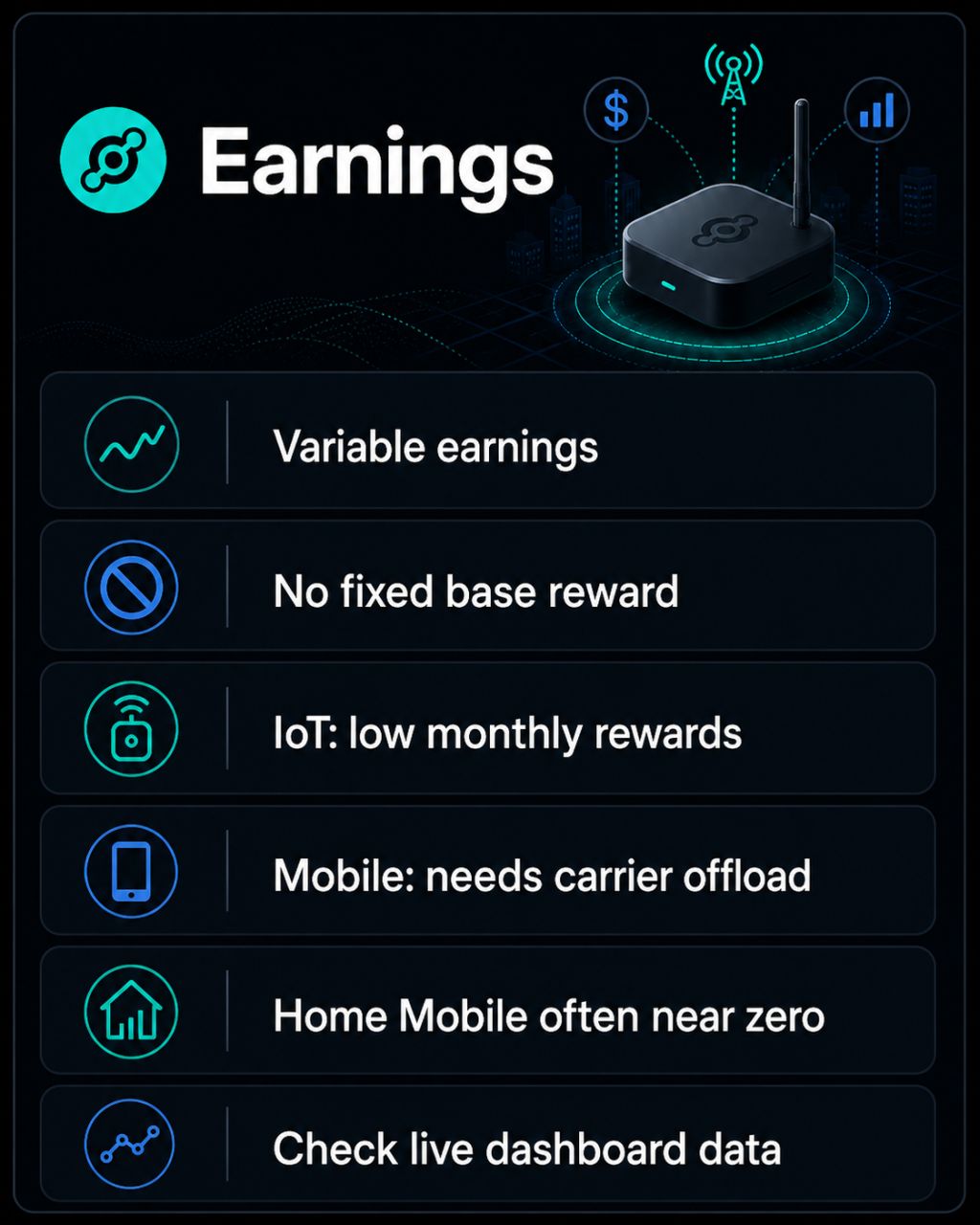
IoT: Community-reported earnings for typical home or urban deployments range from around $0.05 to $5 per month, depending heavily on placement, local witness density, and HNT price. Hotspots with rooftop access in less-saturated areas can earn more. Hotspots in dense cities with indoor or window placement are frequently at the low end or below. These figures are community-reported and variable; they are not guaranteed outcomes.
Mobile: Community reports consistently indicate that residential and low-footfall Mobile deployments earn less than $1 per month or near zero without real carrier offload traffic. Commercial venues in active regions that do receive carrier offload can earn more, but the carrier selection algorithm is not public and traffic is not guaranteed.
For IoT, rewards come from Proof of Coverage witnessing (other nearby hotspots must hear your transmissions), data transfer from LoRaWAN device clients, uptime, and HNT price. For Mobile, it comes down to real carrier data offload at the hotspot location and uptime. Since HIP-148, separate mapping rewards for Mobile no longer exist; that allocation now goes to hotspots with actual carrier traffic.
HNT was priced at $3.54 USD at the time of the data refresh on May 4, 2026. That is a point-in-time number. Hardware cost recovery math built around that price is not a reliable plan.
10. Recent and Operator-Relevant Network Updates
HIP-138: HNT as sole reward token
IOT and MOBILE sub-tokens are no longer issued as separate reward emissions. All operator rewards are now paid in HNT. The upside is a simpler reward picture. The tradeoff is that HNT price now determines the fiat value of everything, for every operator, across both subnetworks.
HIP-141: Unified governance under veHNT
Governance for both subnetworks now sits under veHNT. For most operators this has no direct effect on daily earnings. It matters mainly if you want a say in future network decisions.
HIP-148: Mobile reward reallocation away from mapping
Emissions that previously went to Mobile mapping now go to hotspots with real carrier traffic. If your Mobile deployment sees little to no offload activity, HIP-148 reduces the value of passive or low-traffic Mobile deployments. The threshold for earning meaningfully from Mobile has moved up.
HIP-144: Mobile reward escrow (authorized, not deployed)
HIP-144 would hold Mobile rewards in escrow and release them based on performance conditions. As of May 4, 2026, it has passed governance but has not been deployed; it still requires future HRP implementation. The cash-flow risk is real but not currently active. Check official sources before making a new Mobile deployment decision, since the status may change.
Helium World platform
Helium World handles account management by email and includes reward-splitting tools for venue deployments. Helium World reduces some account and wallet friction compared with the older wallet-heavy flow. Operators still need basic SOL and Data Credit awareness.
Network scale correction
The Helium Explorer showed 371,314 active hotspots as of May 4, 2026. Older figures of 800,000 or more appear to include historical, unverified, or inactive devices and should not be used as the current active network count.
11. Pros & Cons
Pros
- Mature network with confirmed real-world usage and active Data Credit consumption; not purely speculative
- IoT onboarding is straightforward with approved hardware, and power draw is low enough that electricity is rarely worth worrying about
- HNT-only rewards since HIP-138 make the token picture simpler than it used to be
- Helium World has reduced the account setup burden for new operators
- For commercial venue operators in active regions, the Mobile path provides a role in a real wireless network
- IoT participation is open globally with approved hardware
Cons
- IoT earnings for typical urban or home placements are low, frequently single-digit dollars or less per month
- Mobile rewards require real carrier offload and are geographically concentrated in the USA, Mexico, and Brazil; Mobile operators outside those regions have limited realistic earning potential, though IoT remains globally accessible
- Carriers choose which hotspots to use. That algorithm is proprietary and not under the operator's control
- HNT price determines the fiat value of all rewards, with no stable floor
- HIP-148 reduced the earning floor for Mobile operators without real data traffic
- HIP-144 escrow could become a cash-flow constraint for Mobile operators once deployed; the risk is authorized but not yet live
- Helium Plus demands enterprise hardware and advanced configuration skills; most home operators cannot access this path
- The active network count of 371,314 as of May 4, 2026 is substantially lower than figures still circulating in some older sources, which may mix active, inactive, historical, or unverified devices
- No official minimum uptime requirement is documented; running 24/7 is practically necessary but not formally defined
12. Common Pitfalls to Avoid
Buying a Mobile hotspot for a home or apartment. The community data is clear: home Mobile deployments rarely generate meaningful earnings. The $249 to $499 hardware cost is difficult to recover without real carrier offload from genuine foot traffic.
Relying on old hotspot count figures. The 800,000+ hotspot figure that still appears in some sources includes historical, inactive, or unverified devices. The active network was 371,314 as of May 4, 2026 per the official Explorer. Using the inflated number to infer network health or future earning potential is misleading.
Buying IoT hardware without checking local density first. Densely saturated areas with many existing hotspots will dilute PoC rewards. Check coverage maps before purchasing.
Purchasing unapproved IoT hardware. Only hardware from the current approved Maker list qualifies for full PoC rewards. Third-party or DIY LoRaWAN gateways do not receive the same reward eligibility.
Assuming carrier offload is guaranteed in the USA. Being in the USA is a necessary condition for meaningful Mobile earnings, but not sufficient. The carrier still has to select your hotspot, and that depends on factors you cannot fully control.
Treating 2020 or 2021 IoT reward screenshots as current earnings data. The reward structure, competition, and HNT price have changed substantially. Early Helium operators earned far more per hotspot because the network was new. Those figures are not relevant to 2026 deployment decisions.
Assuming HIP-144 escrow is already live. As of May 4, 2026, it is authorized but not deployed. Do not factor in escrow delays as an active constraint yet, but check official sources before finalizing a Mobile deployment decision.
Treating Helium Plus as a no-cost opportunity. Compatible enterprise hardware is required, and the configuration is technical. Vendor-specific official guides remain limited. It is not a plug-and-play option.
Overlooking Data Credit and SOL fees. Onboarding fees, location assertions, and on-chain transactions have real costs. Many Makers bundle the IoT onboarding fee, but operators should confirm this before assuming zero upfront cost.
Confusing IoT and Mobile geographic availability. The USA, Mexico, and Brazil restriction applies to Mobile carrier offload, not to the global IoT network.
13. Tips for Home Operators
Check coverage maps before anything else. The Helium Explorer shows existing hotspot density by area. If your neighborhood is already well-covered by IoT hotspots, your marginal contribution and PoC rewards will be lower. For Mobile, check whether active carrier offload has been documented in your area.
For IoT, elevation is the single most impactful variable you actually control. A hotspot on a roof or upper floor with an outdoor antenna is more likely to outperform the same device sitting on a desk by a window. If you have no realistic path to a better placement, build that into your earnings expectations before buying.
For Mobile, be honest about your venue. If you do not have access to a commercial space with consistent daily foot traffic in the USA, Mexico, or Brazil, the Mobile hotspot is not the right purchase. No firmware update or antenna adjustment changes what the location is.
For most new operators, Helium World is the simpler route than starting with a raw Solana wallet setup. It handles account management by email, makes reward splitting practical for venue deployments, and reduces the number of crypto steps a new operator needs to get through.
Monitor your dashboard regularly. An offline hotspot earns nothing, and some issues only appear as dashboard alerts. For IoT, check witness counts. For Mobile, watch for carrier offload events. Both paths need periodic attention; neither is fully set-and-forget.
Token rewards are variable. HNT was $3.54 at the time of the refresh. If your hardware cost recovery math only works at that price or higher, your plan is fragile.
If deploying in a third-party venue, get the reward-split arrangement in writing before installation. The Helium Foundation has not published official tax guidance on reward splitting. A local tax professional is the right resource, not forum speculation.
For Helium, start with one hotspot in your best available location because actual witness count or carrier offload data is more useful than theoretical coverage estimates. Run it for 30-60 days and check actual earnings before adding more hardware.
14. FAQ
Can I run Helium with consumer hardware?
For IoT, yes, as long as the specific device is from the current approved Maker list. Consumer-grade LoRaWAN gateways from unapproved sources do not qualify for full PoC rewards. For Mobile, consumer internet is fine, but the hardware itself is purpose-built (Helium Mobile indoor or outdoor hotspot). For Helium Plus, you need enterprise Wi-Fi access points with Hotspot 2.0/Passpoint support.
Is Helium onboarding currently open?
Yes, for both IoT and Mobile paths. There is no waitlist for standard deployment. The main gates are hardware availability from approved Makers, location assertion fees, and meeting the practical requirements for your chosen path.
Do I need staking or collateral?
No staking or collateral is required for IoT or standard Mobile hotspot operation. Data Credits and a small SOL balance for transaction fees are the main upfront financial requirements beyond hardware.
How are operators paid?
In HNT, deposited to the operator's Helium or Solana-compatible wallet. Since HIP-138, IOT and MOBILE sub-tokens are no longer issued as separate reward emissions. Helium World provides reward-splitting tools for venue-based deployments.
Is Helium still worth it in 2026?
That depends heavily on which path and what "worth it" means for your situation. IoT can be a low-cost, low-effort project for someone with good placement and realistic expectations of modest returns. Mobile can be worth pursuing for a commercial venue operator in an active region. For a home operator without location advantages, the hardware cost is difficult to justify based on current community earnings data.
What earns more, IoT or Mobile?
Mobile has higher theoretical earning potential in the right commercial venue, but home Mobile deployments are reported to earn less than IoT hotspots in many cases. A well-placed IoT hotspot in a less-saturated area will typically outperform a Mobile hotspot in a home environment.
How many active Helium hotspots are there?
The official Helium Explorer showed 371,314 active hotspots as of May 4, 2026. Older figures circulating online, including numbers above 800,000, appear to include historical, unverified, or inactive devices. Check the live Explorer before publishing or making decisions based on this figure.
Does electricity cost matter?
For IoT, power draw is so low (typically 3-5 W) that electricity is rarely a material factor. For Mobile, maximum draw is around 20 W. In either case, placement quality, carrier traffic, HNT price, and local density have a much greater impact on profitability than power costs.
What is HIP-144, and does it affect me now?
HIP-144 introduces a Mobile reward escrow system where rewards are held and released based on performance conditions. It was authorized through governance but had not been deployed as of May 4, 2026. It is not currently active, but Mobile operators should monitor official channels for the implementation date before making new Mobile deployments.
Is Helium Plus a realistic option for a home user?
No. Helium Plus requires compatible enterprise Wi-Fi access points with Hotspot 2.0/Passpoint support, advanced network configuration, and typically an existing commercial deployment. It is a business-oriented path, not a home-user option.
Should I buy IoT or Mobile hardware first?
For most home operators, IoT is the safer first test because the hardware is lower power, the network is global, and the setup is simpler. Mobile should come first only if you already have access to a real commercial venue in the USA, Mexico, or Brazil where carrier offload is likely. Without that venue advantage, Mobile hardware is harder to justify.
Can I deploy Helium outside the USA, Mexico, and Brazil?
Yes for IoT, not realistically for Mobile under current conditions. Helium IoT is globally deployable with approved hardware, subject to local frequency compatibility, placement quality, density, and witness conditions.
Helium Mobile carrier offload is a separate path and is currently concentrated in the USA, Mexico, and Brazil. International roaming on the Helium Mobile subscriber plan is not the same thing as being able to deploy Mobile hotspots profitably outside active carrier-offload regions.
15. Final Verdict
Helium in 2026 works for two specific operator situations. The first is a well-placed IoT hotspot: rooftop or elevated access, approved hardware, a less-saturated area, and expectations calibrated to a few dollars a month or less. The second is a Mobile hotspot at a genuine commercial venue in the USA, Mexico, or Brazil, where real carrier offload traffic actually flows. Outside those two cases, and especially for home operators expecting passive income from a residential Mobile hotspot, the hardware cost is difficult to justify based on what current community data shows. HNT price is the uncertainty that runs through every calculation, and no placement or hardware choice eliminates that. Get the location right first. Hardware decisions follow from there.