Disclaimer: This guide is for informational purposes only and is not financial advice. Grass rewards are not fixed income. Software-node participation depends on residential IP quality, actual network demand, uptime, region, wallet safety, and unresolved Season 2 reward details. Grasshopper hardware may involve additional upfront cost, but its price, availability, reward treatment, and payback period are not verified enough to calculate ROI. GRASS token value can change materially before any distribution. Use only official Grass links and verify Season 2 claims directly through official channels before connecting a wallet or acting on airdrop information.
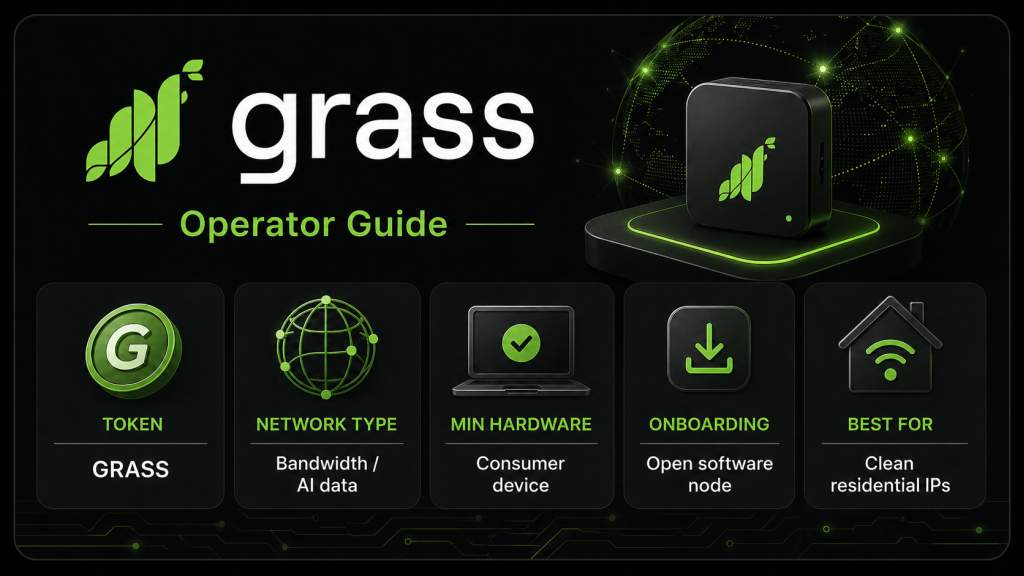
| Token | GRASS (Solana, total supply 1,000,000,000) |
| Network Type | Bandwidth / AI data network |
| Min Hardware | Consumer device + residential internet connection |
| Reward Model | Uptime Points: official tier-based GRASS table published; Network Points reward treatment remains unclear |
| Onboarding | Open software-node onboarding |
| Best For | Users with clean residential IPs and devices already online |
1. Quick Verdict
Grass is one of the more accessible DePIN projects to start. No specialized hardware, no upfront purchase, no minimum staking for a software node. The real question is not whether you can run it. It is whether running it is worth your time, given that your residential IP quality determines whether you earn Network Points at all, and the full Season 2 reward picture is still unsettled.
Grass now publishes an official tier-based Uptime Points reward table with fixed GRASS amounts per rank. That improves reward visibility. It still does not mean you can calculate monthly income. Network Points allocation, Season 2 eligibility, and the GRASS price at distribution are all separate unknowns.
If you already have a clean residential IP and an always-on device, the cost to test Grass is low. If you are thinking about buying Grasshopper hardware or building expectations around a specific Season 2 payout, caution is warranted.
2. Best Fit / Possible Fit / Poor Fit
| Operator Profile | Fit | Why |
|---|---|---|
| User with an existing always-on desktop, laptop, or Android device on a clean residential IP | Best Fit | Lowest incremental cost. No hardware to buy, no capital at risk. If the IP qualifies, you are not chasing uncertain rewards with money already spent. |
| User in a high-demand region with stable home internet and consistent uptime | Best Fit | Network Points depend partly on regional demand and actual routed bandwidth. A stable residential connection in a region Grass actively routes through has better odds than one in a low-demand area. |
| Android user willing to run the official mobile app consistently | Possible Fit | Android carries a higher Uptime Points multiplier. Final token value still depends on Season 2 rules that are not fully published, so the multiplier improves your rank odds but not your USD certainty. |
| User considering buying Grasshopper hardware | Possible Fit | Grasshopper is optional physical hardware. It may offer stronger connection stability and better Network Points performance, but it is not required for Season 2 software-node participation. Price and availability are not confirmed publicly, and Grass has not published an official reward multiplier, so payback period cannot be calculated. |
| User planning to run Grass on a VPS, VPN, proxy, or datacenter IP | Poor Fit | These setups routinely receive 0% Network Quality or violate participation rules. There is no supported workaround. |
| Operator expecting predictable monthly income | Poor Fit | Grass works more like speculative points farming than a fixed income stream. The tier table gives GRASS amounts by Uptime rank, but Network Points, token price, and eligibility are all separate variables. |
| User trying to operate Routers as a home operator | Poor Fit | Router participation is capital-heavy and not comparable to running a software node. It is outside reach for typical home operators. |
3. Why This Project Matters
Grass runs differently from most DePIN projects. There is no GPU, no storage hardware, no wireless radio. What limits your participation is not the equipment you own but whether your home internet connection is clean and residential enough to qualify.
Grass routes unused residential bandwidth to collect public web data for AI training workflows, so demand comes from external AI data needs rather than only from token incentives. Recent third-party reports cite around $33 million in protocol-level revenue, but this should not be treated as an audited financial statement or as direct operator income. That suggests external demand exists, but it does not resolve Season 2 reward uncertainty.
4. Project Overview
Grass is a bandwidth-sharing DePIN network where participants run software nodes that route unused residential internet capacity. Grass sells access to that bandwidth to buyers who use it for public web data collection in AI workflows. Operators earn Uptime Points for staying connected and Network Points based on how much traffic is actually routed through their connection.
There are three operator roles with different requirements:
- Software nodes: consumer device, residential IP, official app, and wallet.
- Grasshopper: dedicated hardware, currently waitlist-only, with no public price or official reward multiplier.
- Routers: capital-heavy infrastructure role requiring substantial GRASS stake, not realistic for typical home operators.
Validators exist on the roadmap but are not currently open to independent operators.
What Season 2 Means
Season 2 is Grass's second rewards and airdrop phase. It does not mean the Grass network is closed, and it does not mean users need Grasshopper hardware to participate.
For home operators, the key point is simple: software-node participation is open through the desktop or mobile app, while Grasshopper is a separate optional physical hardware device that is still waitlist-only. A user can run the Grass app and accumulate Season 2 points without owning a Grasshopper.
The uncertainty around Season 2 is not whether software nodes can run. The uncertainty is how final eligibility, Network Points treatment, and distribution timing will be handled.
5. Main Operator Reality Check
-
Starting is easy. Valuing your participation financially is not. The software node needs only a device, the Grass app, a residential IP, and a wallet. What you cannot do is calculate expected total token rewards, because Network Points treatment and final Season 2 eligibility are not fully published.
-
Your residential IP classification is the main gate. VPS IPs, datacenter IPs, VPNs, proxies, and some flagged residential IPs get 0% Network Quality. That means zero Network Points, even if the device runs around the clock.
-
Network Points track demand, not just uptime. A fixed daily pool of 1,000,000 Network Points is distributed based on actual bandwidth routed, connection stability, regional demand, and usage history. More participants can reduce each operator's share.
-
The Uptime Points tier table is useful, but it covers only part of the picture. Fixed GRASS amounts are now published per Uptime rank. That does not resolve Network Points treatment, Season 2 eligibility, or what GRASS is worth when it lands.
-
Grasshopper, the optional physical hardware device, is still waitlist-only, with no public price and no official reward multiplier. This does not affect open software-node participation through the Grass desktop or mobile app. Community estimates exist, but they are not official.
-
Season 2 is the biggest open variable. The 170 million GRASS allocation is confirmed. Eligibility criteria, conversion weighting, and distribution timing are not fully resolved.
6. Is Grass Suitable for Small/Medium Operators?
Yes for low-cost experimentation. No for predictable income or hardware investment.
- If your device is already running and your residential IP is clean, incremental cost is close to zero. It is reasonable to test.
- The Uptime tier table gives you a clearer sense of GRASS amounts by rank, but that is not monthly income. Token price and Network Points handling remain separate variables.
- Router status is not a realistic target for home operators. It requires substantial GRASS stake and belongs in a different category.
- Buying Grasshopper before price and reward details are confirmed means putting capital into an undefined return. It is harder to justify than using what you already own.
- Community frustration around Season 2 delays is real. That does not make Grass a bad project, but the timeline to any payout is not something you control.
- Historical Season 1 community reports suggest modest returns were possible. Season 2 now includes a published Uptime Points tier table, while Network Points treatment, final eligibility, and token price remain unresolved variables. Season 1 outcomes are not a forecast.
7. Infrastructure Requirements
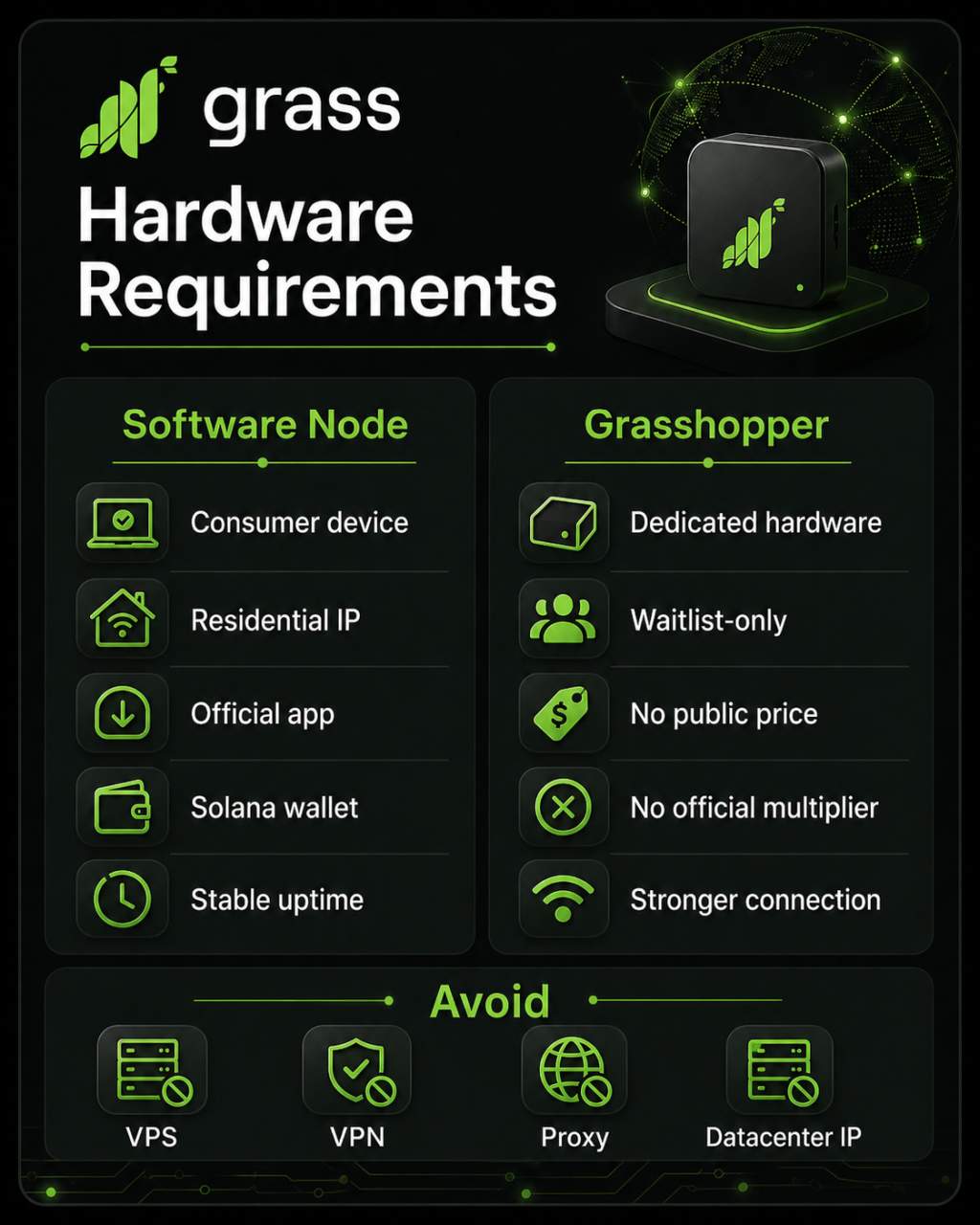
Software Node (standard participation)
- Any consumer desktop, laptop, or Android device
- Residential internet connection with a clean IP, not VPS, VPN, datacenter, or proxy-classified
- Official Grass app, desktop or mobile
- Solana-compatible wallet
- Stable uptime improves Uptime Points rank
- Connection consistency matters for Network Points
Platform Uptime Points multipliers (official):
| Platform | Uptime Points Multiplier |
|---|---|
| Android | 3x |
| Mac | 2x |
| Windows | 2x |
| Linux | 2x |
These apply to Uptime Points only. They do not guarantee proportionally higher token outcomes because Network Points and Season 2 eligibility are separate.
Grasshopper (optional dedicated hardware)
- Currently waitlist-only
- No public price confirmed
- Official positioning: stronger and more stable connection performance
- No official fixed reward multiplier published
- Community estimates should not be treated as fact
- Power consumption described by Grass as comparable to a small smart-home device or internet router, with no official wattage published
- Do not purchase based on ROI assumptions, because the numbers to support that calculation are not confirmed
Routers
- Require substantial GRASS stake. Some earlier sources referenced around 1.25 million GRASS per Router, but operators should verify the latest requirement directly before acting.
- Not comparable to software node participation
- Not realistic for typical home operators
8. Step-by-Step Setup
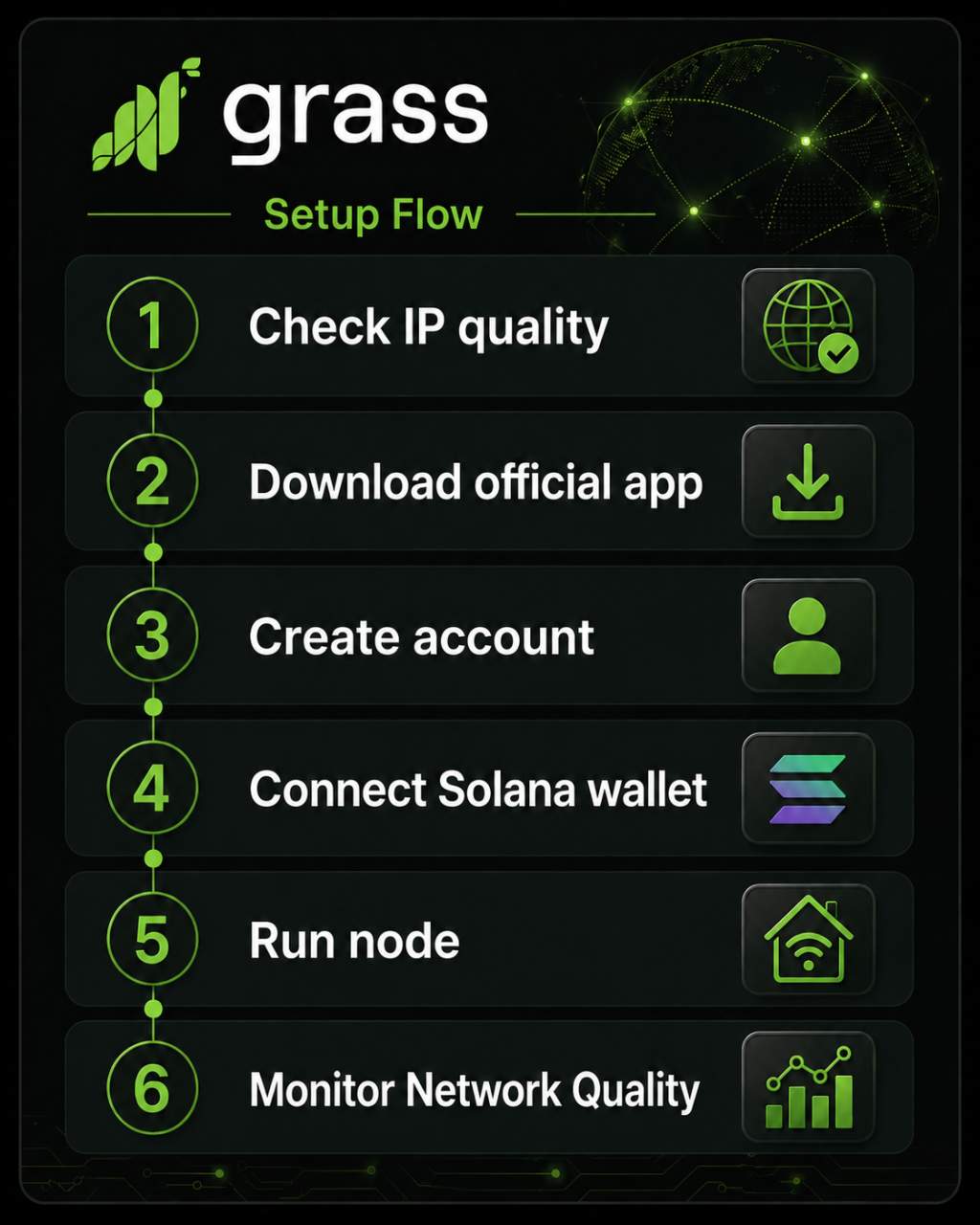
These steps cover the open software-node path. They do not require Grasshopper hardware. Grasshopper is a separate optional device with waitlist-only access.
-
Check your IP type before installing. Some DePIN networks prefer normal residential internet connections and may treat datacenter, VPN, proxy, or abused IPs as lower quality or ineligible. Before setting up a node, check how your public IP is classified by basic IP lookup or IP reputation tools. Ideally, it should appear as a residential ISP connection and not as a VPN, proxy, hosting provider, or high-risk IP.
This matters if you are using a VPS, business internet line, shared ISP range, or a home connection that previously hosted VPN/proxy traffic. A flagged IP may reduce rewards, fail eligibility checks, or create account risk depending on the project's rules.
-
Download the official Grass app. Use only official links from grass.io or the Grass Foundation channels. Season 2 attention has made phishing links more common. Do not install from third-party sources or follow wallet connection links from Discord DMs or social posts.
-
Create a Grass account. Sign up through the official app or site.
-
Connect a Solana-compatible wallet. Use a wallet you control. For Season 2 and any future claim flow, check the domain carefully before approving wallet permissions. Do not connect a wallet holding significant funds unless you understand what you are approving.
-
Run the node. Start the Grass app and leave it active. It runs in the background. On mobile, make sure background app activity is permitted.
-
Check your Network Quality score. After the node has been running for a while, check your Network Quality percentage in the dashboard. A score near 0% means your IP is likely being flagged or classified as non-residential. Try restarting your router and disabling any VPN or proxy on the same connection. There is no formal appeal process for these scores.
-
Monitor your Uptime Points tier. Use the official app or dashboard to check your current rank against the published tier table.
-
Avoid unofficial airdrop links. Fake claim pages and phishing wallets will circulate when Season 2 distribution gets close. Only interact with wallets through verified Grass Foundation sources.
9. Current Earnings Picture
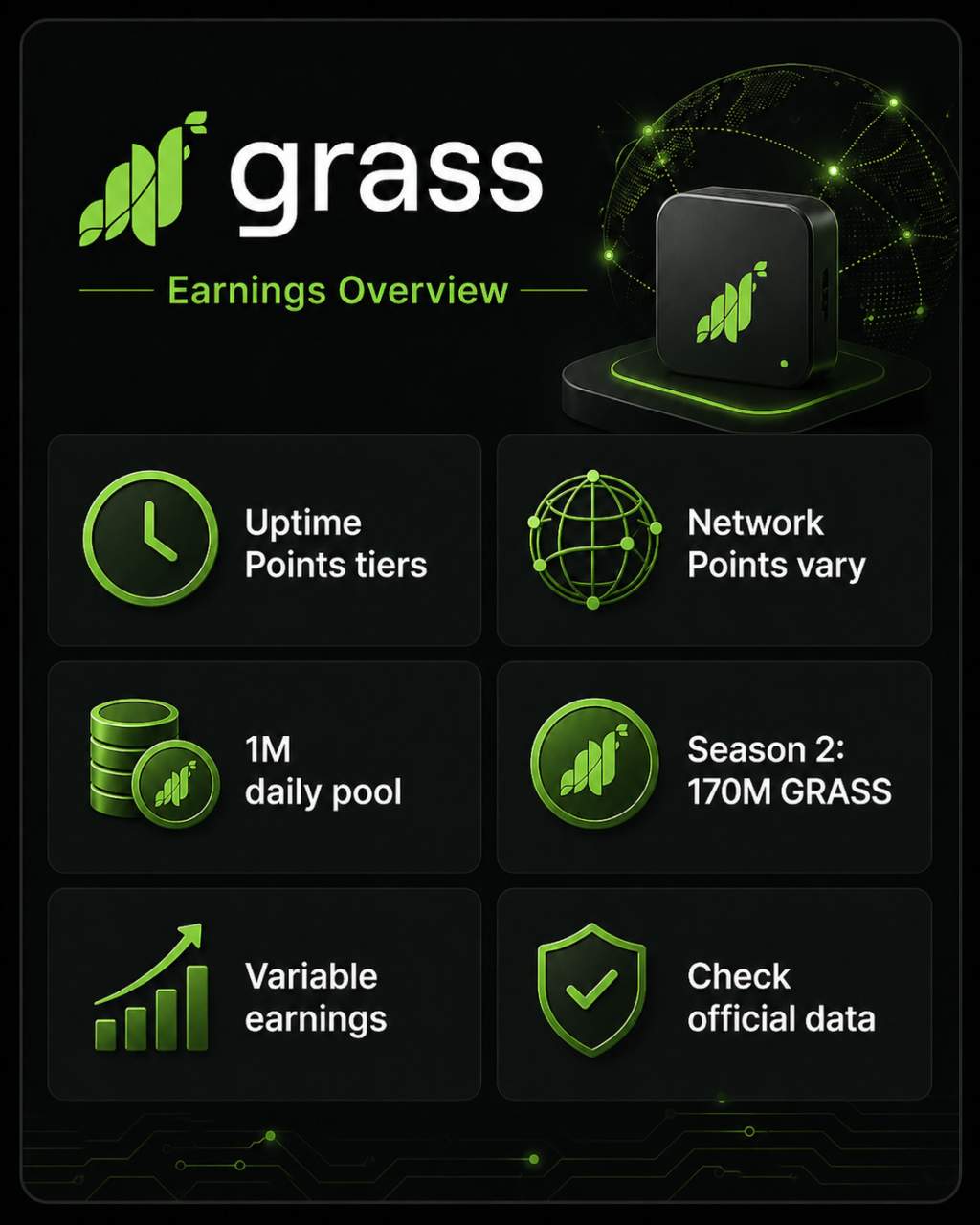
Grass operators earn two types of points: Uptime Points and Network Points. They are not the same, and they work differently when it comes to GRASS rewards.
Uptime Points
Grass publishes an official tier-based reward table with fixed GRASS amounts by Uptime Points rank:
| Rank | Uptime Points Cutoff | GRASS Reward |
|---|---|---|
| Iron | 0 | 0 |
| Bronze | 373 | 20 |
| Silver | 2,595 | 130 |
| Gold | 11,351 | 565 |
| Platinum | 36,351 | 1,800 |
| Emerald | 118,247 | 6,000 |
| Diamond | 375,443 | 19,000 |
| Conqueror | 2,767,564 | 50,000 |
| Vanguard | 7,394,899 | 100,000 |
| Titan | 49,616,939 | 250,000 |
These amounts should be treated as Season 2 reward-event amounts by rank, not recurring daily or monthly payments.
Some ranks may also include invite-based qualification paths, but this guide focuses on operator participation rather than referral farming.
These are official figures for what a user at a given Uptime rank receives. They are not monthly income. What they are worth in USD depends on the GRASS price at distribution, which market trackers put at around $0.35 as of April 28–29, 2026. Check live trackers before making any decision, because that number changes.
Network Points
A fixed daily pool of 1,000,000 Network Points is distributed based on actual bandwidth routed, connection stability, regional demand, and usage history. No fixed conversion formula for Network Points into GRASS has been published for Season 2. That is the bigger gap in the earnings picture.
Season 2 allocation
170 million GRASS is confirmed for Season 2. Eligibility criteria, conversion weighting between point types, and the distribution date are still pending. The official/general window remains H1 2026, but no specific distribution date has been confirmed. Community estimates for a specific month should not be treated as fact.
What this means in practice
The tier table makes part of the reward structure easier to understand. Your final GRASS amount still depends on Uptime tier, Network Points share, Season 2 eligibility, and token price at distribution. Most of those are not in your hands.
Do not treat the Uptime tier figures as recurring income. Do not convert them to USD without a current dated price and without knowing whether you will qualify under Season 2 eligibility rules.
10. Recent Network Updates
Last 90 days, operator-relevant only:
- Season 2 farming continues. Epoch 18 was active as of April 2026. Distribution details, eligibility rules, and the Network Points conversion formula remain pending official publication.
- Grasshopper remains waitlist-only. No open order batch, no confirmed shipping date, and no public price as of late April 2026. Earlier reports about broader Grasshopper availability remain unconfirmed. Treat any Grasshopper availability claim as unverified unless it comes from the Grass Foundation directly.
- Official Uptime Points tier table published. Grass now documents fixed GRASS reward amounts per Uptime rank. This improves visibility, but it does not resolve Network Points or Season 2 eligibility.
- GRASS token context. Market trackers put GRASS at around $0.35, with approximately 564.67 million tokens in circulating supply as of April 28–29, 2026. The token has traded well below its late-2024 highs. Check live figures before publishing or making decisions.
11. Pros and Cons
Pros
- No specialized hardware needed to participate at the software-node level
- Open onboarding, with no hardware purchase or token collateral required
- Official Uptime Points tier table gives operators a visible GRASS target per rank
- Reported protocol revenue suggests buyer demand, though not direct operator income
- Incremental electricity cost is low if a device is already running
- Android and desktop apps available, with confirmed Uptime Points multipliers per platform
Cons
- Network Points treatment in Season 2 and final eligibility rules are still unpublished
- Some home connections can get 0% Network Quality with no clear path to fix it
- GRASS has fallen well below its late-2024 high, making any points-to-USD estimate unreliable
- The daily Network Points pool is fixed, so a growing participant count can dilute each operator's share
- Grasshopper pricing, multiplier, and ordering are all unconfirmed
- No official date for Season 2 distribution
- Router participation is out of reach for typical home operators
- You accumulate points now and collect GRASS later, at whatever price exists then
12. Common Pitfalls to Avoid
-
Treating the Uptime tier GRASS amounts as monthly income. They are reward totals at a given rank, not recurring payments. USD value depends on token price at distribution.
-
Assuming Grasshopper has a fixed official multiplier. It does not. Community estimates circulate, but Grass has not published one. Buying the device based on those numbers means acting on unverified data.
-
Running the node on a VPS, VPN, or datacenter IP. This is a common mistake for operators comfortable with server infrastructure. Those IPs will almost certainly get 0% Network Quality, and there is no official workaround.
-
Connecting a well-funded wallet to an unfamiliar app. Use a dedicated wallet for Grass or check connection permissions carefully before linking.
-
Following fake airdrop or Season 2 claim links. These circulate heavily around distribution events. Only use wallet connections from official Grass Foundation sources.
-
Assuming Network Points convert the same way as Uptime Points. The tier table covers Uptime Points. Network Points treatment is a separate, still-unresolved part of Season 2.
-
Relying on outdated Grasshopper shipping or pricing claims. Multiple earlier estimates remain unconfirmed. Treat any Grasshopper claim as unverified unless it comes from the Grass Foundation.
-
Counting on a specific Season 2 date. No date has been officially confirmed. Do not build financial plans around one.
13. Tips for Home Operators
- Start with the device you already have. Confirm your IP quality and whether your region generates meaningful Network Points before spending anything.
- Check your Network Quality score early. A 0% reading within the first few days means your IP classification needs investigating. Restarting your router and turning off any VPN on that connection are the first things to try.
- If you have an Android device you can leave plugged in, it is worth testing. The 3x Uptime Points multiplier improves your tier trajectory, though it does not guarantee a proportionally better total outcome.
- Treat rewards as speculative until Season 2 details are fully documented. The tier table gives you a rank target, but it does not settle the full picture.
- Bookmark official Grass Foundation links before any Season 2 announcement drops. Phishing pages go up fast when airdrop news circulates.
- If you are curious about Grasshopper, stay on the waitlist without committing money. The case for buying gets clearer only once price and reward details are confirmed.
- Multiple nodes on the same IP will not produce proportional rewards. Network Quality is assigned to the IP, not to individual devices behind it.
14. FAQ
Does Grass now have an official reward table?
Yes, for Uptime Points. The table runs from Iron at 0 GRASS up to Titan at 250,000 GRASS, with fixed amounts per rank. It does not fully resolve the earnings picture because Network Points treatment, Season 2 eligibility, distribution timing, and token price at distribution are all still open.
Can I calculate my Grass income now?
Only partially. You can estimate the GRASS amount tied to your Uptime tier from the official table. USD value is still unclear because GRASS price changes, and your Network Points share cannot be calculated since no Season 2 conversion formula has been published.
Is Grasshopper worth buying?
There is not enough confirmed information to answer that yet. Grasshopper may offer stronger connection stability and better Network Points performance, but no price has been published, ordering is not open, and there is no official reward multiplier. Any ROI estimate built on community figures is speculation.
Can I run Grass on a VPS or with a VPN active?
No. VPS, datacenter, VPN, and proxy-classified IPs routinely get 0% Network Quality, which means no Network Points earned. There is no official path around this.
Is onboarding currently open?
Yes, for software nodes. Download the official app, create an account, connect a wallet, and start the node. Grasshopper hardware is still waitlist-only with no confirmed ordering window.
What is Network Quality and why does it matter?
Network Quality is how Grass scores whether your connection is residential, stable, and trusted enough for routed traffic. A 0% score means no Network Points, regardless of how long you stay online. IP classification, ISP reputation, proxy or VPN history, and regional factors can all affect the score.
What should I do if my Network Quality is 0%?
First, make sure no VPN, proxy, or datacenter connection is active. Then check your IP reputation using public IP reputation tools and try restarting your router to request a fresh IP from your ISP. If the IP remains flagged, there is no confirmed official appeal path, so the connection may not be suitable for Grass.
Is Season 2 confirmed and when does it distribute?
The 170 million GRASS allocation is confirmed. Eligibility criteria, conversion weighting, and the specific distribution date have not been officially confirmed. The official/general window remains H1 2026, but no specific date should be treated as fact.
What are the main risks for small home operators?
The main risks are getting 0% Network Quality even on a genuine home connection, GRASS price declining further before distribution, Network Points dilution as more participants join, Grasshopper ROI being unquantifiable, and Season 2 eligibility rules that may exclude some participants in ways not yet disclosed.
Does the $33M in protocol revenue mean operators earn more?
Not directly. Reported protocol revenue suggests buyer demand for Grass's service, but it does not flow to software-node operators as a fixed payout. It is not the same as operator income.
15. Final Verdict
Grass is a reasonable low-cost experiment for users who already have a clean residential IP, an always-on device, and no need to invest in hardware. The official Uptime Points tier table improves reward visibility and gives you something concrete to work toward. The core uncertainty has not changed: Network Points conversion, Season 2 eligibility, distribution timing, and GRASS token value at distribution all remain unresolved.
If you are comfortable treating the current farming period as speculative accumulation with an unknown future value, the software node is reasonable to test. If you are weighing Grasshopper hardware or building financial expectations around a specific Season 2 date, the confirmed data is not there yet to support those decisions.
The guide should be revisited once Grass publishes Season 2 eligibility rules, Grasshopper pricing, and the Network Points conversion formula.