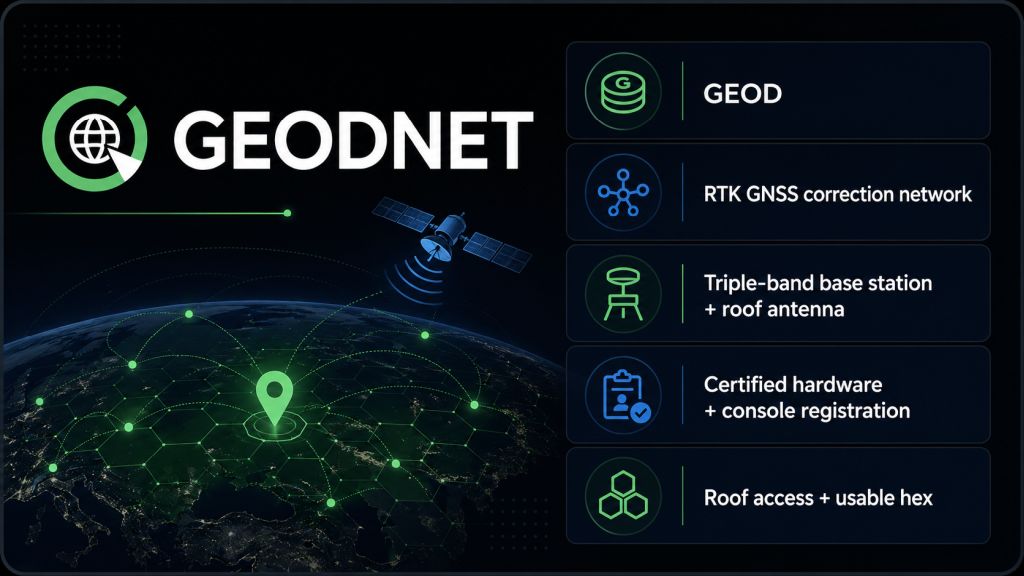
Disclaimer: This guide is for educational research only and is not financial advice. GEODNET operator returns depend on roof access, antenna placement, local hex competition, RRR performance, uptime, current reward rules, GEOD token price, wallet handling, and the June 30, 2026 reward halving. Hardware costs, token prices, multiplier zones, governance rules, and network statistics can change. Before buying a GEODNET base station, check your exact location in the GEODNET console map, verify current reward and multiplier rules, confirm that the hardware is triple-band, and calculate payback using current GEOD pricing rather than historical examples.
Quick Stats
| Field | Value |
|---|---|
| Token | GEOD, ERC-20 on Polygon, also available on Solana via migration path |
| Network Type | RTK GNSS correction network / geospatial DePIN |
| Network Size | 21,000+ active stations across 159 countries as of April 2026 |
| Min Hardware | Triple-band GEODNET base station, roof antenna, 2.4 GHz Wi-Fi, USB-C power |
| Base Reward | 12 GEOD/day until June 30, 2026 halving; 6 GEOD/day after, subject to performance and hex rules |
| Hardware Cost | Around $695 standard list price, with vendor and regional variation |
| Post-Halving Scenario | At $0.12 GEOD, 6 GEOD/day equals about $22/month and roughly 32 months to recover $695 hardware cost before other variables |
| Onboarding | Open hardware purchase from certified vendors plus console registration |
| Best For | Operators with roof access, empty or underserved hex, stable internet, and tolerance for token-price risk |
1. Quick Verdict
GEODNET is a cautiously positive fit for a specific type of operator: a homeowner or small business with unobstructed roof access, an empty or underserved local hex, certified triple-band hardware, and realistic expectations about getting paid in a volatile token. The project has real enterprise data revenue, a functioning buyback-and-burn model, and more than 21,000 active stations across 159 countries. Those fundamentals make GEODNET stronger than many token-only DePIN projects, but they do not remove the operator-level risks around placement, rewards, and token price.
The operator decision right now comes down to timing and placement. The June 30, 2026 halving cuts the base reward from 12 GEOD/day to 6 GEOD/day. At roughly $0.12 per GEOD as of April 29, 2026, the post-halving base scenario works out to about $22/month and a hardware payback period of around 32 months at the $695 standard list price, before accounting for token-price movement, hex competition, or RRR penalties. Anyone buying after the halving without a multiplier-zone advantage should run those numbers carefully before committing.
Apartment renters, operators in hex-saturated areas, and anyone expecting predictable fiat income are generally poor fits.
2. Best Fit / Possible Fit / Poor Fit
| Operator Profile | Fit | Why |
|---|---|---|
| Homeowner with roof access, clear sky view, empty or underserved hex, and stable internet | Best Fit | Matches the core physical and reward requirements: outdoor antenna, clean placement, and low maintenance after setup. |
| Small business, farm, warehouse, or workshop with roof access and reliable power | Best Fit | These sites often have better antenna placement than residential properties and may sit in less saturated hexes. |
| Operator located in a current StableHex, SuperHex, or GIP-13 multiplier zone, verified live | Best Fit, if verified | 6x / 4x / 2x multipliers from GIP-13 can materially improve payback, but the operator must check the live console map before buying. |
| Technical hobbyist in an empty hex who understands token risk | Possible Fit | Setup is not technically difficult, but the operator must accept GEOD price volatility and post-halving reward changes. |
| Operator buying after July 1, 2026 at current token prices without a multiplier zone | Possible Fit, cautious | Base reward drops to 6 GEOD/day; payback extends to roughly 32 months at $0.12 GEOD and $695 hardware cost. Needs strong placement and patience. |
| Apartment renter without roof access | Poor Fit | Balcony or window placement is usually not enough for reliable RRR scores and low multipath interference. |
| Dense urban operator in a saturated hex | Poor Fit or weak Possible Fit | Existing NFT-backed stations and nearby miners can split or reduce rewards even when hardware works correctly. |
| Legacy dual-band miner owner | Poor Fit unless upgraded | Dual-band miners became ineligible for rewards after GIP-6. Do not assume a used dual-band device will earn anything without confirming the upgrade path. |
| Operator looking for validator-node income | Poor Fit | Public onboarding documentation mainly supports base station operators. The independent validator path for individual home operators is not clearly documented. |
3. Why This Project Matters
GEODNET provides real-time kinematic (RTK) GPS correction data, which lets GPS-enabled devices achieve centimeter-level positioning accuracy instead of the standard meter-level range. The primary use cases are agricultural machinery, autonomous vehicles, surveying equipment, and robotics. These are real commercial use cases rather than only a proposed future market, although network revenue still does not guarantee operator profitability.
The network generates actual data revenue and routes approximately 80 percent of it into a GEOD buyback-and-burn model. GEODNET reports roughly $8.3M to $9M ARR as of March to April 2026. Verify the current figure directly from GEODNET's live dashboard before publication, as this appears to be an actively updated metric. That revenue does not guarantee operator profitability or protect against token-price swings, but it does show that customers are paying for the network's correction data.
That is the main reason GEODNET deserves a serious operator review instead of being treated as another token-only mining project.
4. Project Overview
GEODNET is a decentralized network of GNSS base stations that collect satellite signal data and transmit it as RTK correction streams to subscribers. Operators run certified triple-band base stations, usually roof-mounted, that contribute location-correction data to the network. In return, operators earn GEOD tokens based on their contribution quality, uptime, and local hex status.
The network reached 21,000+ active stations across 159 countries as of April 2026. GEOD is an ERC-20 token on Polygon with a Solana migration path available. GEODNET is not a server node, a GPU mining rig, or a software-only setup. The device is a small purpose-built base station, and where you mount the antenna matters far more than the hardware specs.
5. Main Operator Reality Check
-
Physical placement is the first gate. GEODNET is not a laptop or server node. You need a roof or elevated outdoor location with a clear sky view in all directions. Apartment renters and operators without roof access are typically excluded before any economics come into play.
-
Check the hex map before anything else. Hex status can change the economics before the device is even purchased. A strong NFT-backed station already in your hex, or several competing miners nearby, can split or reduce what you earn. Opening the GEODNET console map is step one, not step four.
-
The base reward is time-sensitive. A well-positioned triple-band station currently earns 12 GEOD/day, but the official halving schedule cuts the base rate on June 30, 2026. The pre-halving economics are time-limited.
-
For earning rewards, triple-band hardware is the safe baseline. Dual-band miners became ineligible for rewards after GIP-6. Buying old or used dual-band equipment without a confirmed upgrade path is a real and avoidable loss.
-
RRR monitoring is part of the job. Poor antenna placement, outages, firmware issues, or obstructed sky view can reduce or eliminate rewards during affected periods. Owning the device is not enough; you need to keep an eye on your RRR score.
-
The network's 80 percent buyback-and-burn model and enterprise revenue are genuine positives, but they do not protect you from token-price drops, post-halving earnings reductions, or a bad hex.
6. Is GEODNET Suitable for Small/Medium Operators?
Maybe, but only under specific conditions.
The answer looks different depending on when you buy.
Before the halving: An operator with roof access, a clean hex, and certified triple-band hardware has a realistic case under the current reward schedule. At 12 GEOD/day and $0.12 per GEOD, that is roughly $43/month at current pricing. Hardware payback is around 16 months at those inputs, before token-price movement, hex competition, and operating variables.
After the halving: The base scenario changes to 6 GEOD/day, about $22/month at $0.12 GEOD, and roughly 32 months to recover a $695 device cost. Post-halving buyers without a multiplier zone or a favorable token-price assumption should treat that 32-month figure as a floor, not a ceiling.
Other practical considerations:
- Roof access is the main physical filter. Ground-level or window placement is usually not viable.
- Hex competition can reduce rewards even when your hardware and placement are fine. Check the console map first.
- Setup involves roof mounting, cable routing, Wi-Fi signal confirmation, and antenna positioning. It is not plug-and-play, and occasional troubleshooting is normal.
- You are putting roughly $695 at risk with no guaranteed return in a volatile token. Size that against what you can afford to leave tied up for potentially years.
- GIP-13 passed and approved 6x / 4x / 2x multipliers for underserved coverage zones, but whether your location qualifies is something you confirm in the console, not assume.
- Electricity cost is low. The device draws minimal power, so this is not where the math breaks down for most operators.
7. Infrastructure Requirements
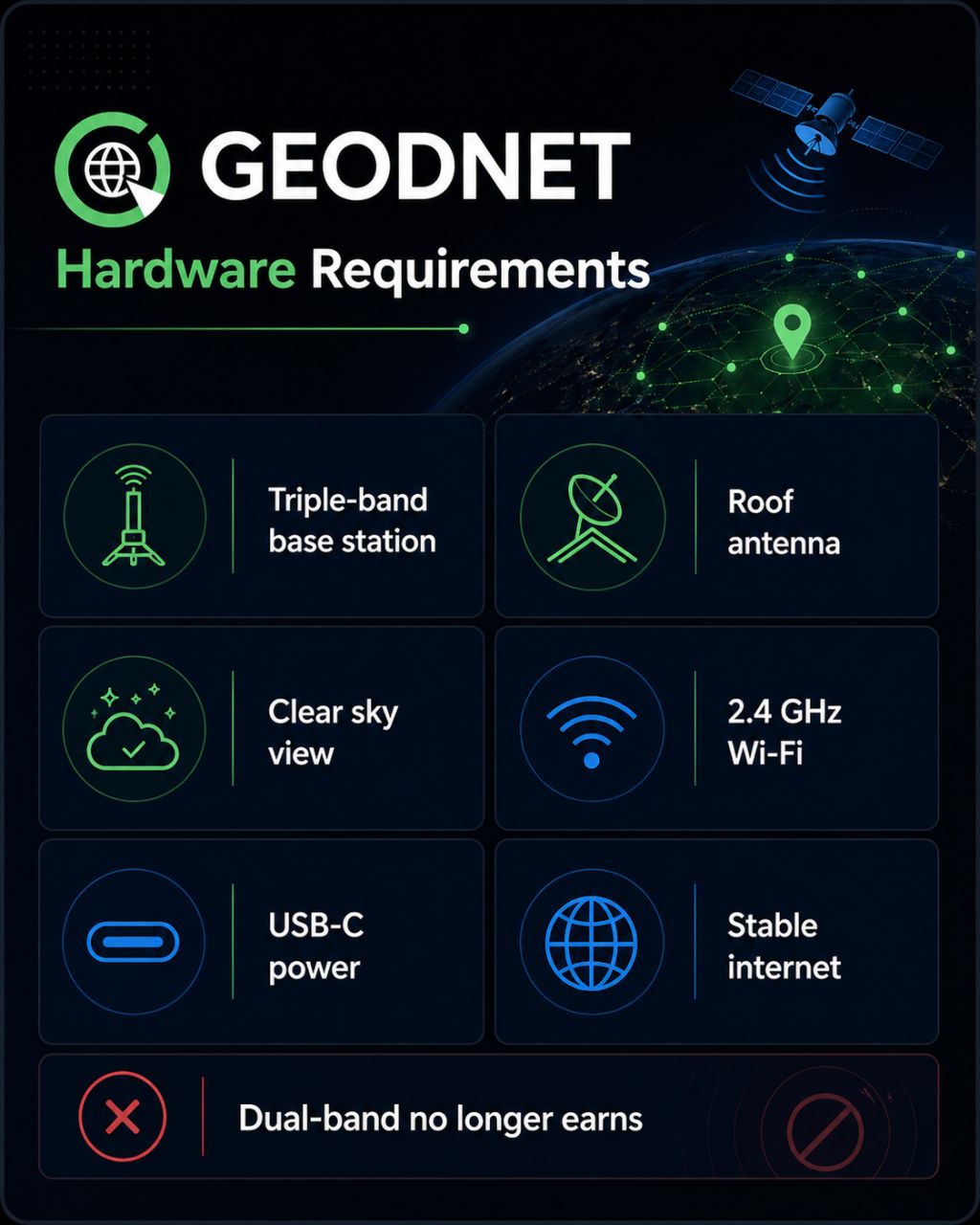
Official minimums:
- Certified triple-band GEODNET base station, typical list price around $695 with vendor and regional variation
- Outdoor roof antenna with clear sky view
- 2.4 GHz Wi-Fi connection
- USB-C power supply
- Stable internet connection with low bandwidth requirement
What actually matters during setup:
Antenna placement matters more than the device specs. The station itself is compact and low-power. The hard part is getting the antenna mounted high enough with a clean sky view and minimal multipath interference from nearby structures or metal surfaces.
Do not buy dual-band hardware for reward generation. Since GIP-6, dual-band miners no longer receive rewards. Triple-band is the only safe baseline for a new or replacement purchase. If you are buying used hardware, confirm the exact model and upgrade status before handing over money.
The certified vendor list exists for a reason. Uncertified hardware is not guaranteed to work correctly on the network, and hardware eligibility rules can change through governance. Buying off-list to save money is a specific risk worth avoiding.
8. Step-by-Step Setup
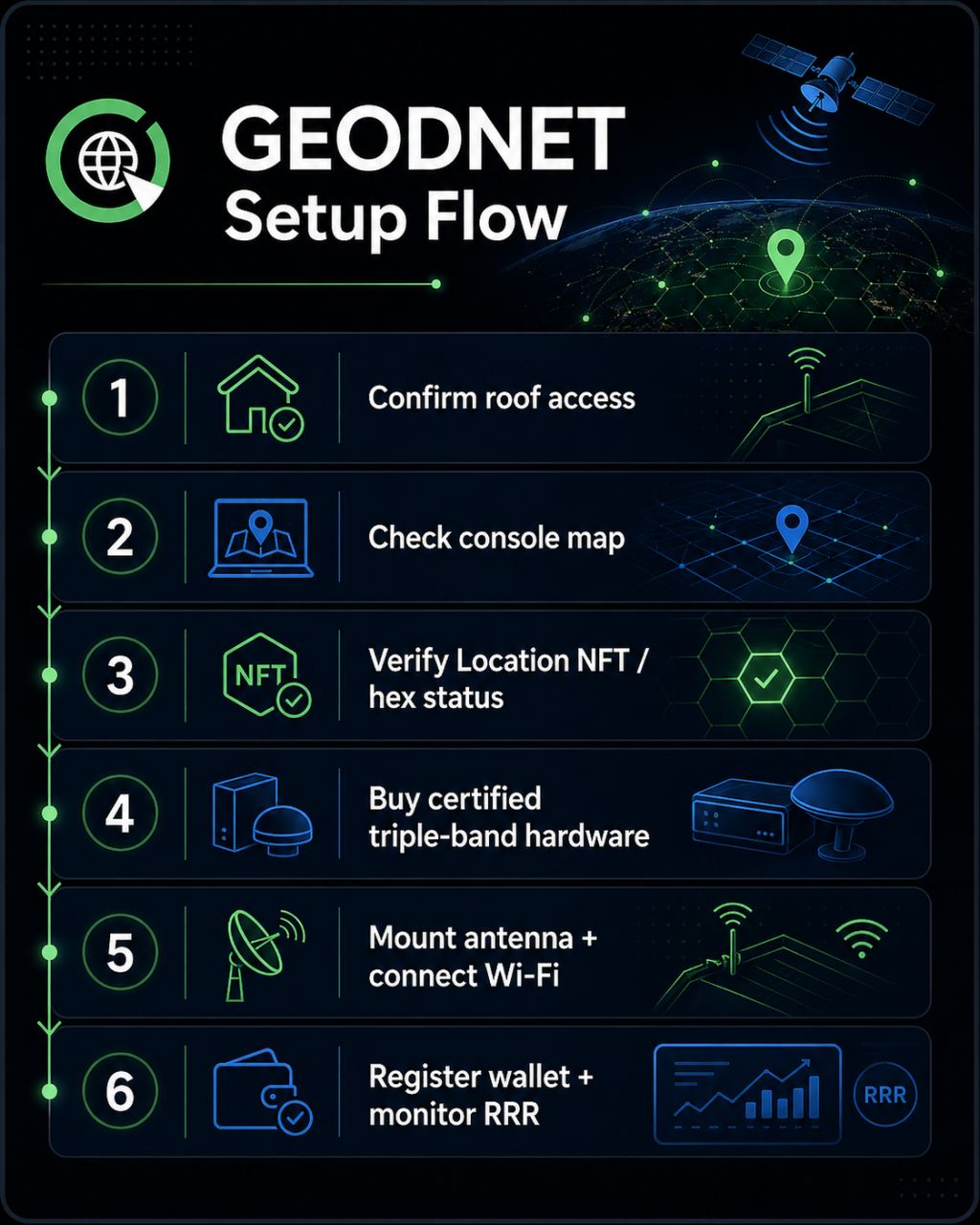
Before starting, confirm that you have rooftop or equivalent outdoor mounting access, stable 2.4 GHz Wi-Fi, indoor power near the cable route, safe roof access, and a compatible wallet. If you rent or share a building, check landlord or building rules before mounting hardware.
-
Check the GEODNET console map first. Before spending any money, open the GEODNET console map and examine your local hex for existing stations, Location NFT status, and hex competition. If StableHex / GIP-13 multiplier zones are visible for your region, check whether your address sits inside an active zone and whether the opportunity is still available. This step determines whether the economics work at your specific address.
-
Confirm your antenna location. Walk your property and find the highest point with unobstructed sky view. Roof ridge or chimney mounting is typical. Balcony or window placement usually produces high multipath and weak RRR scores unless the location has unusually clear sky exposure, which can reduce or even zero out rewards.
-
Purchase certified triple-band hardware. Purchase a certified triple-band GEODNET base station from the official vendor list. Dual-band hardware no longer earns rewards. Verify that the product description explicitly says triple-band and that it is listed as a certified GEODNET station. The typical list price is around $695, but confirm the current price, discounts, stock, and shipping time on the vendor page before ordering.
-
Mount the antenna and run the cable. Route the antenna cable from the roof antenna to a nearby indoor power and Wi-Fi source. Use the supplied antenna cable or an approved extension if needed, secure outdoor runs against wind and water ingress, and avoid sharp bends or strain on connectors. If you are not comfortable with roof work, consider using a professional installer.
-
Connect to 2.4 GHz Wi-Fi and power. Connect the base station to a stable 2.4 GHz Wi-Fi network and reliable power. Before finalizing the cable run, test Wi-Fi strength at the device location or consider a Wi-Fi extender if the signal is marginal.
-
Register the device on the GEODNET console. Create or connect a compatible wallet, using Polygon or Solana according to current GEODNET documentation for rewards, then follow the console registration steps and associate the device with your account. Check the docs for updates before choosing your main reward wallet. Avoid changing the reward wallet later without following GEODNET's documentation, as Location NFT and reward binding can be lost if mishandled.
-
Monitor RRR and reward performance. After the first 24 to 48 hours, check your RRR score and reward accumulation in the console. Aim for consistently high RRR, around 98 percent or better where Location NFT eligibility matters. Large drops below 80 percent in short performance windows can result in zero rewards for that period. If RRR is weak, check antenna positioning, Wi-Fi stability, power, cable quality, and sky obstructions before assuming the device is faulty.
-
Set up a smart plug for remote power cycling. Optional but recommended: connect the device to a smart plug so you can remotely power-cycle it when firmware hangs or connectivity drops occur, instead of waiting until you can access the device physically.
Roof work has physical safety risk. If you are not comfortable mounting equipment outdoors or routing cable safely, use a professional installer.
Useful official checks before buying:
- GEODNET console map for hex status and multiplier zones.
- Certified vendor list for triple-band hardware.
- GEODNET support/docs for wallet, reward, and Location NFT rules.
- Governance or voting pages for current GIP-13 / StableHex status.
9. Current Earnings Picture
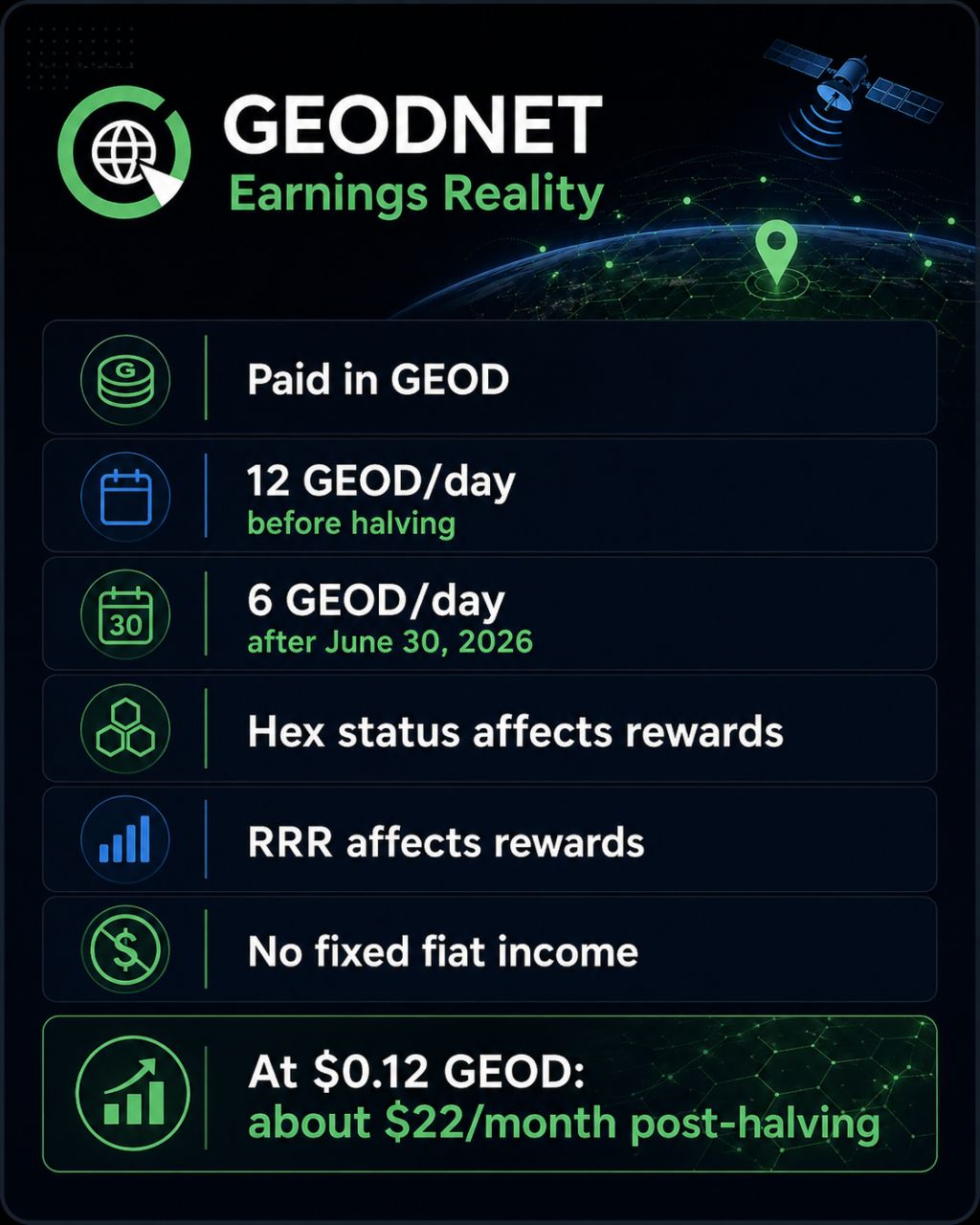
All figures below use a token snapshot of approximately $0.12 per GEOD as of April 29, 2026. Token price moves; use these as scenario inputs, not income forecasts.
Pre-halving, until June 30, 2026
A well-positioned triple-band station with no hex competition earns approximately 12 GEOD/day as a base reward. At $0.12 per GEOD, that is roughly $1.44/day or about $43/month. At $695 hardware cost, that scenario implies approximately 16 months to recover the hardware cost. It assumes stable token price, no hex competition, no RRR penalties, and no additional costs.
Post-halving, from July 1, 2026 onward
The base reward drops to 6 GEOD/day. At $0.12 per GEOD, that works out to roughly $0.72/day or about $22/month. Hardware payback extends to approximately 32 months at $695, before token-price movement, RRR penalties, or operating issues. This is the math for anyone buying after the halving without a multiplier-zone advantage.
With a GIP-13 multiplier zone
GIP-13 passed and approved 6x, 4x, and 2x multipliers for underserved coverage zones. If your location qualifies and the zone is active, the post-halving economics improve substantially. A 2x multiplier would bring the post-halving base back to 12 GEOD/day, matching the current pre-halving rate. Verify live zone availability in the console before treating any multiplier as a given.
A note on how rewards actually arrive
Rewards are not paid as fixed fiat. GEOD accumulates in your wallet and is subject to payout thresholds and token-price variation. There is no stablecoin payout option. The USD value of your daily reward changes with the market, and there is no floor.
10. Recent Network Updates
GIP-6, dual-band obsolescence: Dual-band miners are no longer eligible for rewards under GIP-6. This is not a pending change. It is the current rule. Any operator considering used hardware must confirm the device is triple-band and fully upgraded.
GIP-13 / StableHex multipliers, passed: GIP-13 has passed and approved 6x / 4x / 2x reward multipliers for operators in underserved coverage zones. The proposal also references coverage-decay penalty mechanics, though exact details were not fully available at research time. Live zone availability and console rollout status should be confirmed directly in the GEODNET console before any purchase decision is made on the basis of multiplier access.
Performance penalties: RRR, multipath, and uptime penalties are active in the current reward system. A station with poor placement or frequent outages can lose a meaningful share of its theoretical base reward, not just the marginal edge.
Network scale: The network has grown to 21,000+ active stations across 159 countries as of April 2026. If you are in an established market, factor hex saturation into your location check.
Hyfix AI chip raise: Hyfix AI, the hardware manufacturer behind GEODNET base stations, raised a separate $15M seed round for chip development in April 2026. This is distinct from GEODNET Foundation funding. No confirmed upgrade requirement for existing miners has been announced, but given that GEODNET already has a precedent of dual-band hardware becoming obsolete, it is worth tracking future hardware roadmap announcements.
11. Pros & Cons
Pros:
- Low power draw. Electricity cost is not a meaningful factor for most operators.
- Approximately $8.3M to $9M ARR as of March to April 2026. Customers are paying for RTK correction data, which gives GEODNET clearer demand signals than token rewards alone.
- Open onboarding, but still location-dependent. Operators can buy certified hardware and register on the console, but roof access and a usable hex matter before the purchase.
- No GPU or server hardware required. The base station is purpose-built, cheap to run, and does not need a home lab.
- GIP-13 multiplier zones can give underserved-area operators an earnings advantage when the location qualifies and the zone is active.
- The buyback-and-burn mechanism ties network revenue to GEOD supply reduction, which gives the token model a clearer link to network usage.
Cons:
- No roof access usually means no reliable deployment. Many potential operators are filtered out before the reward math becomes relevant.
- The June 30, 2026 halving cuts base rewards by 50 percent. Post-halving payback at current prices is roughly 32 months without a multiplier zone.
- Hex saturation is a real problem in denser markets. A well-placed station can still underperform if the local hex is crowded with existing miners.
- Rewards are paid in GEOD. The $22/month post-halving figure at $0.12 GEOD changes sharply with token-price movement in either direction.
- Passive income is not fully passive in GEODNET's case. RRR penalties, multipath, power drops, firmware hangs, and connectivity issues require monitoring.
- GIP-13 passed, but live StableHex zone availability is unconfirmed for most locations.
- Buying a used dual-band device is a material hardware risk. The model number matters and sellers do not always know or disclose it accurately.
12. Common Pitfalls to Avoid
Buying hardware before checking the hex map. The console map check should happen before any purchase. A saturated hex or a competing NFT-backed station can make a well-placed device earn far less than expected. This is the most preventable mistake on the list.
Assuming a balcony or window will work. It usually does not. Apartment or balcony placement often produces high multipath interference and weak RRR scores unless the location has unusually clear sky exposure.
Purchasing a used dual-band miner. Dual-band miners are ineligible for rewards under GIP-6. Buying one without confirming upgrade status is money lost before the device is even plugged in.
Running pre-halving payback math after June 30, 2026. Some third-party calculators and community posts still use 12 GEOD/day as a baseline. If you are buying after the halving, run the numbers on 6 GEOD/day with current token pricing.
Treating GIP-13 multiplier access as guaranteed. GIP-13 passed, but that does not mean your location qualifies. Check the live zone map in the console at your specific address before building that into your payback estimate.
Using the $25,000 SuperHex community example as a reference point. That was a historical best-case report from an unusually favorable location during a strong token price period. It is not a useful baseline for a new operator in 2026.
Planning around a fixed monthly dollar figure. Rewards accumulate in GEOD and their USD value fluctuates with the market. An operator who models income as a fixed fiat number and does not account for token-price movement will be surprised when reality diverges.
13. Tips for Home Operators
Check hex competition and StableHex eligibility together, in one session before you buy. Look at how many competing stations exist in your hex and whether your address falls within a GIP-13 multiplier zone. Those two factors together tell you more about your realistic earning range than any general estimate.
Spend more time on antenna placement than on anything else during setup. RRR is the main performance indicator and it is almost entirely a function of where you mount the antenna. Extra time spent validating antenna placement is usually more valuable than trying to optimize firmware settings later.
Put the device on a smart plug. Power cycling fixes most firmware hangs and connectivity drops. Doing it remotely saves trips to the roof and keeps uptime higher.
Take a screenshot of your hex map before you buy. Hex competition changes over time. Having a record of conditions at purchase gives you a reference point if rewards later diverge from your expectations.
Do not take a seller's word on used hardware. Check the model number yourself against the current certified hardware list before completing a purchase. Dual-band devices are still circulating and some sellers do not know or disclose what they are selling.
Check your RRR score at least once a week during the first month. Placement problems show up there first. Catching a weak score early means you can adjust the antenna before it costs you weeks of reduced rewards.
14. FAQ
Can I run GEODNET with consumer hardware, like a Raspberry Pi or a GPU?
No. GEODNET requires a purpose-built certified base station. General-purpose hardware is not supported. The device is compact and low-power, but it must be an officially certified triple-band GEODNET unit purchased from an authorized vendor.
Is onboarding currently open?
Yes. Operators can purchase certified hardware directly and register through the console without a waitlist. The main pre-purchase step is checking the console map to confirm hex status at your specific location.
Do I need to buy tokens, a license, or post collateral to start?
The primary cost is the hardware itself, currently around $695 at standard list price with vendor and regional variation. Wallet setup is required for reward accumulation, but buying GEOD upfront is not a stated onboarding requirement. Confirm current NFT and Location NFT rules in the official documentation before purchasing, as these can affect reward eligibility in some hexes.
How are operators paid?
Operators earn GEOD tokens, which accumulate in a connected wallet. The base rate for a well-positioned triple-band station is 12 GEOD/day until the June 30, 2026 halving, then 6 GEOD/day after. Actual daily earnings depend on RRR performance, hex competition, NFT rules, and reward pool mechanics. There is no fiat or stablecoin payout option.
Is GEODNET still worth running after the June 2026 halving?
For operators with strong placement, an empty or underserved hex, and possible access to a GIP-13 multiplier zone: possibly, with patience. At 6 GEOD/day and $0.12 GEOD, the base scenario is about $22/month and roughly 32 months to recover a $695 device cost. A 2x multiplier zone would halve that payback period. Without a multiplier advantage and at current token pricing, you are looking at a long-horizon commitment.
Can I run GEODNET from an apartment balcony?
Usually not reliably. GEODNET needs an outdoor antenna with a clear sky view and low multipath. Some balconies may work if they have unusually open sky exposure, but most apartment or window setups are poor candidates compared with roof mounting.
What happens if my hex gets a new NFT-backed competitor after I set up?
New miners in the same hex can split or reduce your rewards. This is an ongoing risk, not a one-time check. Hex conditions change, and there is no protection for early movers against new entrants.
What hardware and operator profiles are clearly not supported?
Dual-band miners, uncertified hardware, operators without roof access, and anyone targeting validator-node income through a home setup. Dual-band miners have been ineligible since GIP-6. The public individual validator onboarding path is not clearly documented.
What should I check before spending money?
In order: (1) your local hex on the GEODNET console map, (2) Location NFT status and local hex competition, (3) whether your location qualifies for a StableHex or GIP-13 multiplier zone, (4) current GEOD price and post-halving payback math using that price, (5) that the hardware you are buying is certified and triple-band, and (6) current NFT and reward rules from official documentation rather than community posts.
15. Final Verdict
GEODNET has stronger observable project-level fundamentals than many DePIN hardware projects: real revenue, a functioning burn model, and physical infrastructure with paying customers. But credibility at the project level does not automatically translate into a good individual operator decision. The economics are narrow: 6 GEOD/day after the halving, $695 hardware, StableHex eligibility, hex saturation, RRR performance, and token price all matter.
Operators with confirmed roof access, an empty or underserved hex, certified triple-band hardware, and the patience for a multi-year payback horizon have a realistic case. Apartment renters, operators in saturated hexes, and anyone expecting predictable monthly fiat returns should not proceed. The biggest open question for post-halving buyers is where GEOD token price and StableHex zone availability land over the next two to three years, and that is genuinely uncertain.
Check roof access, check the hex, check current reward and multiplier rules in the console, and run the post-halving math with the current token price before making a purchase decision.