Disclaimer: This guide is for informational purposes only and is not financial, investment, or hardware purchasing advice. As of April 27, 2026, Gensyn has not published a public mainnet onboarding path, hardware requirement list, uptime requirement, or reward rate for small compute providers. Historical RL Swarm requirements and testnet reward details should not be treated as current mainnet earning conditions. Do not buy or rent GPUs, servers, or cloud instances for Gensyn unless official mainnet compute-provider documentation is available and you have calculated your own electricity cost, hardware depreciation, token volatility risk, location constraints, uptime requirements, and job availability risk. Delphi participation is a market activity and may involve loss of funds.
Quick Stats
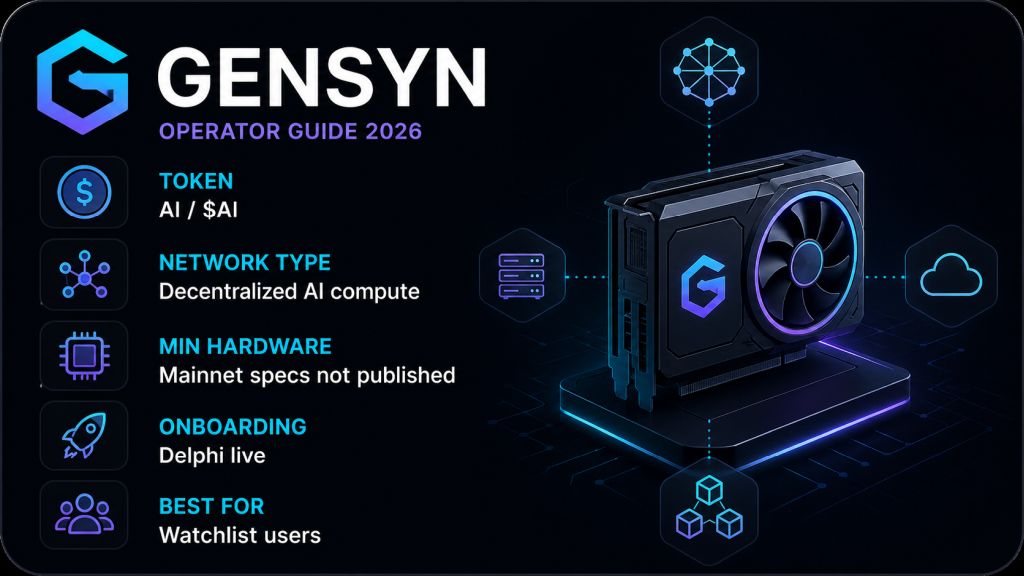
| Operator Status | Watchlist only. Not currently actionable for home compute providers |
| Token | AI / $AI, reported total supply 10 billion; TGE / exchange listing pending as of April 27, 2026 |
| Network Type | Decentralized machine-learning compute protocol; current live application is Delphi, an AI-settled prediction / information market |
| Min Hardware | No published mainnet compute-provider hardware spec. Historical RL Swarm required 32 GB RAM (CPU path) or a supported NVIDIA GPU. These are historical specs only. |
| Onboarding | Delphi is live. Public mainnet compute-provider onboarding for small operators is not published. |
| Best For | Watchlist users, former testnet operators, and Delphi participants who understand market risk |
1. Quick Verdict
Gensyn is not currently an actionable hardware-income opportunity for small or medium home operators. The RL Swarm testnet that attracted many node runners is deprecated, and public mainnet compute-provider onboarding has not been released.
This guide is a reality check, not a setup tutorial. If you are looking for a project where you can install software, connect a GPU, and start earning rewards, Gensyn does not offer that today. If you already followed the testnet, track decentralized AI compute, or want to monitor future Gensyn operator access, it belongs on a watchlist.
2. Best Fit / Possible Fit / Poor Fit
| Operator Profile | Fit | Why |
|---|---|---|
| Existing GPU owner monitoring DePIN compute opportunities | Possible fit | No mainnet compute-provider path is open yet, but existing hardware may become relevant if public onboarding launches later |
| Operator buying new hardware specifically for Gensyn | Poor fit | No published mainnet requirements or reward rates; buying hardware today has no confirmed return path |
| Beginner with limited Linux or CLI experience | Poor fit | Historical testnet had real technical friction, and the current public product is Delphi, not a node setup |
| High electricity cost operator | Poor fit | No compute-provider earning rate exists to offset power costs, so profitability cannot be calculated |
| Passive-income seeker | Poor fit | Delphi requires active market participation and carries financial risk; there is no passive node income path |
| Former RL Swarm testnet participant | Possible fit | Already familiar with the project; worth monitoring official channels for a compute-provider onboarding announcement |
| DePIN researcher or AI compute watcher | Best fit | Gensyn is relevant to the AI compute category, and Delphi gives a live product to evaluate now |
3. Why This Project Matters
Gensyn matters because decentralized AI compute is one of the more technically demanding categories in DePIN. The long-term idea is that some machine-learning workloads could run across distributed contributed hardware instead of relying only on centralized infrastructure.
For home operators, the key question is not whether the idea is interesting. The key question is whether there is a current way to provide hardware and earn rewards. As of this guide, that answer is no. Gensyn is relevant to monitor, but it is not ready as a public small-operator compute network.
4. Project Overview
Gensyn is building a decentralized protocol for machine-learning compute. In the broader protocol design, compute-provider roles are expected to contribute machine-learning work, but public operator documentation for those roles is not available yet.
The current live product is Delphi, launched April 22, 2026. Delphi is described as a prediction market where outcomes are settled by verifiable AI models rather than human arbitrators. The earlier public-facing node phase, RL Swarm, was a testnet program for peer-to-peer AI training and has since been deprecated.
5. Is Gensyn Suitable for Small/Medium Operators?
Not currently, for hardware operators.
Gensyn may become relevant later, but today there is no public mainnet compute-provider path for home operators.
- There is no active public node setup. No mainnet compute-provider onboarding has been published.
- RL Swarm is historical. Old RL Swarm tutorials should not be treated as current earning instructions.
- No reward rate exists for small compute providers. There is no reliable way to estimate income.
- No mainnet hardware spec exists. Historical testnet specs are not enough to justify buying or renting hardware.
- Delphi is separate. Delphi is live, but it is a prediction market with financial risk, not infrastructure operation.
- Future access is possible but unconfirmed. The operator path should be monitored, not deployed today.
If you own compatible hardware, the practical move is to wait for official mainnet compute-provider documentation. If you were planning to buy or rent GPUs for Gensyn, hold off.
6. Infrastructure Requirements
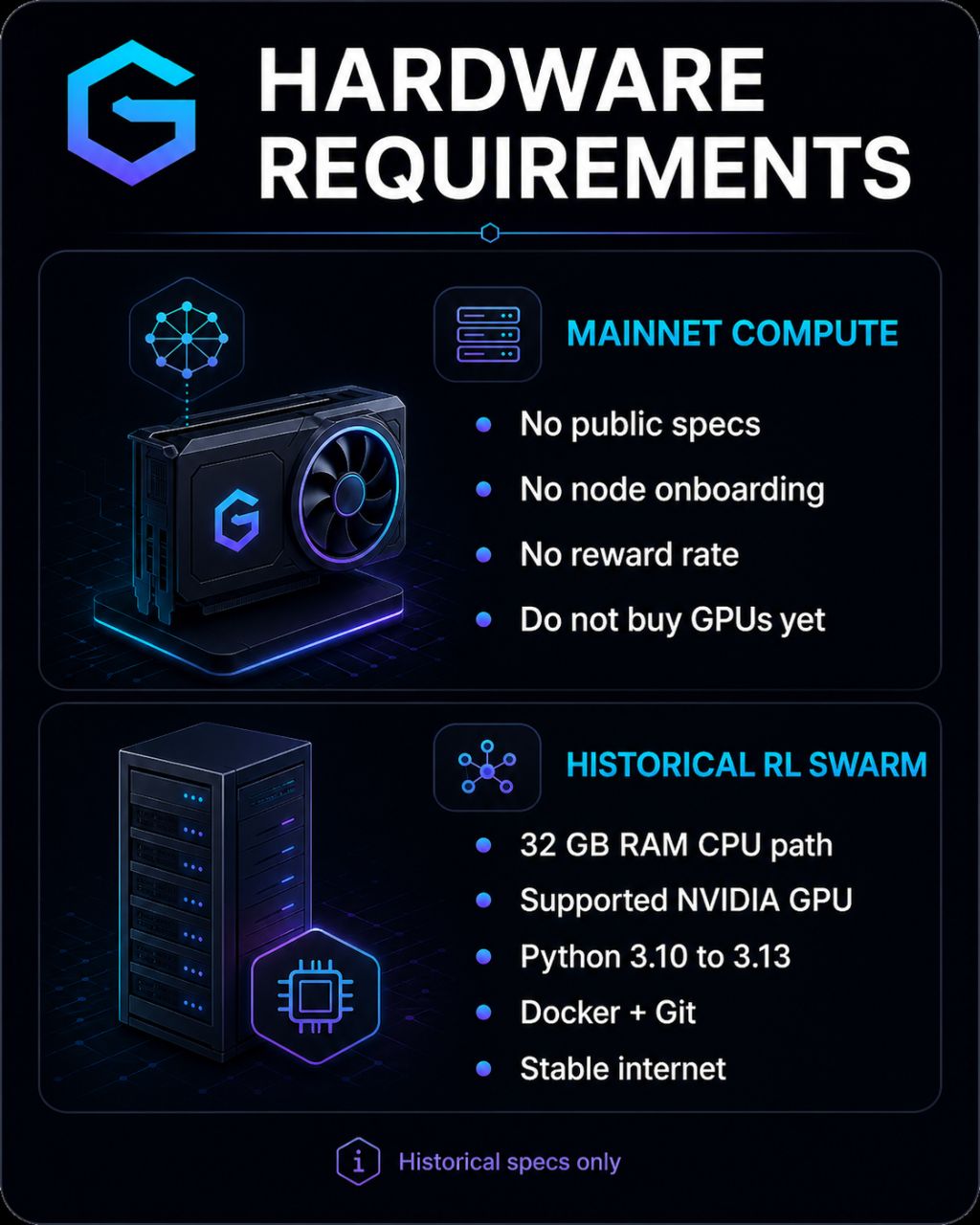
Mainnet compute-provider requirements: not published.
There is no verified mainnet hardware requirement list for small Gensyn compute providers. There is also no public onboarding path, uptime requirement, or reward rate for Solver or Verifier operators.
The specs below are historical, from the RL Swarm testnet. They are useful context only.
Historical RL Swarm system requirements:
- OS: Windows via WSL 2, Linux Ubuntu 22.04 or later, or macOS
- RAM: 32 GB minimum on the CPU-only path
- GPU: Supported NVIDIA GPUs were listed in the historical docs
- Python: 3.10 to 3.13
- Unsupported Python version: Python 3.14 was incompatible
- Dependencies: Docker, Git, stable internet connection
These specs describe what the testnet needed. They do not define what mainnet compute-provider participation will require.
7. Step-by-Step Setup
There is no valid Gensyn mainnet node setup to publish for small operators today. A normal setup tutorial would either repeat deprecated RL Swarm instructions or invent steps that do not exist.
What operators can do right now is a status check.
Current operator action plan:
-
Check the official docs
Go to docs.gensyn.ai and confirm whether a mainnet compute-provider onboarding section has appeared. -
Confirm RL Swarm status
As of April 27, 2026, RL Swarm is deprecated and no official swarms are running. -
Do not buy or rent hardware
Wait until official mainnet hardware requirements, onboarding steps, reward mechanics, and uptime expectations are published. -
Evaluate Delphi separately
Delphi is live, but it is a prediction market. It should not be treated as a hardware income path. -
Use official channels only
Gensyn's official website, docs, and verified social accounts are the only safe places to confirm operator onboarding. -
Run costs only after onboarding opens
Once real documentation exists, model electricity, hardware depreciation, token volatility, and likely work availability before committing capital.
8. Current Earnings Picture
No compute-provider earnings have been published for Gensyn mainnet. There is no verified Solver or Verifier reward rate for small operators.
That means there is no responsible way to calculate home-operator profitability. Any monthly earnings estimate for Gensyn compute providers should be treated as unsupported unless it comes from current official documentation.
Delphi has a different economic model. Market creators can earn a share of trading volume when a market they built settles, but that depends on attracting usage. Traders can also lose funds. Delphi is not passive node income.
The AI token has a reported total supply of 10 billion. TGE and exchange listing status were pending in the research used for this guide as of April 27, 2026. Token pricing, liquidity, and post-TGE behavior should not be used as a reason to buy hardware.
RL Swarm had testnet rewards, but those rewards were relative and pool-based. They should not be used as a proxy for future mainnet earnings.
9. Recent Network Updates
- RL Swarm deprecated: The historical testnet node-running path is no longer an active public operator route.
- Delphi launched April 22, 2026: Gensyn's first mainnet application is a prediction market where AI models settle outcomes.
- REE introduced: Gensyn's verification infrastructure is part of the broader protocol design, but it is not a public operator onboarding path.
- AI TGE pending in the supplied research: Token timing should be treated as unconfirmed unless official sources say otherwise.
10. Pros & Cons
Pros:
- Gensyn is working in a relevant AI compute category for DePIN operators to monitor
- Delphi is live on mainnet
- The project has a defined verification focus through REE and related infrastructure
- Historical RL Swarm participation showed that the project previously involved smaller operators
- Reported backing from known investors gives the project visibility and resources
Cons:
- No public mainnet compute-provider onboarding is available for small operators
- No verified node reward rate has been published
- No current hardware requirement list exists for mainnet compute providers
- RL Swarm specs are historical and should not be treated as current earning requirements
- Testnet rewards were pool-based and relative, not predictable income
- Delphi involves market risk and is not a hardware income substitute
- Outdated RL Swarm tutorials and unofficial guides can confuse new operators
11. Common Pitfalls to Avoid
-
Following old RL Swarm tutorials
They describe a deprecated testnet, not an active mainnet earning path. -
Buying GPUs for Gensyn before onboarding exists
Mainnet requirements and rewards have not been published. -
Renting cloud GPUs early
There is no verified compute-provider job or reward rate to offset rental costs. -
Assuming Delphi is passive income
Delphi involves trading and market creation risk, not infrastructure operation. -
Using testnet rewards as an earnings model
RL Swarm rewards were relative and pool-based. They do not define future mainnet income. -
Trusting unofficial token or onboarding links
Fake token sale pages, stale tutorials, and unofficial channels can mislead operators. -
Assuming token burn mechanics guarantee value
Buyback and burn mechanics depend on actual trading volume and should not be treated as price support.
12. Tips for Home Operators
- Treat Gensyn as a watchlist project, not a deployment target.
- Check docs.gensyn.ai directly when you hear new claims about Gensyn nodes.
- Do not buy or rent hardware until official mainnet compute-provider documentation exists.
- Separate Delphi updates from compute-provider updates.
- Ignore unsupported monthly income estimates.
- If you ran RL Swarm, keep that experience in context. Mainnet may not use the same specs, setup, or reward model.
- When onboarding opens, calculate electricity, hardware depreciation, uptime expectations, token risk, and likely work availability before joining.
13. FAQ
Can I run a Gensyn compute node today?
No. Public mainnet compute-provider onboarding has not been released as of April 27, 2026. RL Swarm is deprecated and no official swarms are running.
Is RL Swarm still active?
No. The official docs label RL Swarm as deprecated and state that no official swarms are running.
What is Delphi?
Delphi is Gensyn's live mainnet prediction / information market. Outcomes are settled by verifiable AI models. It is not a compute-provider node path.
Can Delphi generate income?
Market creators can earn a share of trading volume when their markets settle, but this depends on market usage. Traders can lose funds. Delphi should not be treated as passive infrastructure income.
Do I need to buy hardware for Gensyn?
No. There is no public mainnet compute-provider setup right now. Buying hardware before official requirements and reward mechanics are published is speculative.
What hardware is supported for mainnet?
No mainnet compute-provider hardware list has been published. Historical RL Swarm supported a 32 GB RAM CPU path or supported NVIDIA GPUs, but those are testnet specs only.
How are compute-provider operators paid?
No public mainnet Solver or Verifier reward rate has been published. Payment mechanics for small compute providers are not clear yet.
Is Gensyn profitable for home operators in 2026?
Not currently as a hardware operator. There is no public onboarding path, no reward rate, and no current hardware requirement list. Profitability cannot be calculated responsibly from the available information.
What should I check before spending money?
Check for official mainnet compute-provider onboarding, supported hardware, reward rates, uptime rules, payment mechanics, and token liquidity. If those details are missing, do not spend money on hardware or cloud rental.
14. Final Verdict
Gensyn is a credible project to monitor in decentralized AI compute, but it is not ready as a home-operator deployment opportunity. Former RL Swarm participants, AI compute researchers, and Delphi users may have reasons to follow it.
Small operators looking for current hardware income should wait. The main uncertainty is whether and when Gensyn will publish a public mainnet compute-provider path with clear requirements and rewards.