Operator note: FluxNode rewards, costs, and eligibility can change with live node counts, FLUX token price, benchmark rules, ArcaneOS requirements, uptime, hardware performance, hosting costs, electricity costs, and Parallel Asset claim fees. Before locking FLUX or buying hardware, check the official Flux dashboards, current ArcaneOS documentation, and the latest benchmark thresholds. This guide is not financial advice and should not be treated as a guarantee of profit.
Quick Stats
| Token | FLUX |
| Network Type | Decentralized cloud / compute infrastructure |
| Min Hardware | Cumulus: 2 vCores / 4 threads, 8 GB RAM, 220 GB SSD/NVMe, 25 Mbit/s bandwidth, 1,000 FLUX collateral; active benchmark minimums: 180 MB/s DWS and 240 eps_multithread |
| Base Reward | 14 FLUX per block total; per queue call: 1 FLUX (Cumulus), 3.5 FLUX (Nimbus), 9 FLUX (Stratus), 0.5 FLUX to Foundation |
| Onboarding | Open / permissionless, with collateral, hardware, wallet setup, benchmark pass, and uptime requirement |
| Best For | Technical operators with low-cost hardware, stable internet, and long-term FLUX exposure tolerance |
1. Quick Verdict
Flux is technically open to individual operators at the Cumulus tier. There is no waitlist, no geographic approval, and 1,000 FLUX is a low collateral bar compared to many other DePIN networks. At the current FLUX price of roughly $0.067, that collateral is worth around $67.
The economics are the problem. A Cumulus node earns an estimated 0.69 FLUX per day based on refreshed node counts as of April 29, 2026, which works out to around $1.40 per month at current prices. That does not cover typical VPS hosting and may or may not cover home electricity depending on hardware and local rates. Operators treating this as a monthly income source will likely be disappointed.
There is also an active benchmark transition happening right now. During April and May 2026, Flux is rolling out new eps_multithread minimums across all tiers. Any operator buying hardware or provisioning a server without checking the new threshold first is taking real risk. Old EPS scores do not map directly onto the new metric.
The operator this is best suited for is someone who already has compatible low-power x86-64 hardware, is comfortable with the setup and maintenance involved, and is not depending on near-term fiat returns to make it worthwhile. Anyone expecting fiat-positive monthly income from a standard VPS will find current Cumulus economics do not support that case.
Before spending money, check four things first: current Flux rewards dashboard numbers, your hardware's eps_multithread result, ArcaneOS compatibility in BIOS or hosting settings, and your real electricity or hosting cost. Do not rely on the static examples in this guide without checking live data.
2. Best Fit / Possible Fit / Poor Fit
| Operator Profile | Fit | Why |
|---|---|---|
| Technical home operator with spare low-power x86-64 hardware, stable internet, and willingness to hold FLUX long term | Best Fit | Can run Cumulus with relatively low marginal cost, can troubleshoot benchmarks and networking, and is not dependent on immediate fiat-positive returns. |
| Operator already running a home lab or small server with good uptime and low electricity cost | Best Fit | Flux is more realistic when the operator already has infrastructure in place and adds only modest extra power, maintenance, and monitoring burden. |
| User who wants FLUX exposure without operating hardware | Possible Fit | Titan staking starts at 50 FLUX and has no hardware burden, but it is staking participation rather than node operation. Treat any yield or APY claim with caution and check official Titan documentation before committing funds. |
| VPS-based beginner planning to run a Legacy Cumulus node for monthly profit | Poor Fit | Current reward value is too low versus typical VPS costs, Legacy nodes are ineligible for PNR, and ArcaneOS is unlikely to work on most VPS hypervisors due to Secure Boot limitations. |
| Operator who needs predictable monthly income in fiat | Poor Fit | Rewards fluctuate with live node counts, token price, queue position, uptime, and benchmark status. There is no fixed payout schedule. |
| Non-technical user unable to troubleshoot networking, wallet, benchmark, or update issues | Poor Fit | Flux is permissionless, but operating a node still requires wallet setup, benchmark passing, networking configuration, monitoring, and failure recovery. |
3. Why This Project Matters
Flux is one of the more established decentralized cloud networks by node count. As of April 29, 2026, the live dashboard showed roughly 7,662 active nodes across three tiers, providing compute and hosting capacity for applications running on FluxCloud.
Unlike traditional cloud providers, the network runs entirely on user-operated, collateral-backed nodes maintained through benchmark compliance. Participation is open, but the risk is yours to manage.
The shift from GPU-based mining to Proof of Useful Work v2 made node operation the primary contribution mechanism, with block rewards distributed to queue-selected nodes across Cumulus, Nimbus, and Stratus tiers. ArcaneOS adds automated maintenance and PNR eligibility on top of that base model.
4. Project Overview
Flux runs a decentralized cloud network called FluxCloud, powered by a global set of user-operated nodes. Operators lock FLUX as collateral and provide compute, storage, and bandwidth in exchange for block rewards distributed via a queue system. The network has three node tiers with escalating hardware and collateral requirements: Cumulus at the entry level, Nimbus in the middle, and Stratus at the top.
Traditional GPU mining was removed in favor of Proof of Useful Work v2, which ties block production to node uptime and benchmark compliance rather than hash rate. ArcaneOS, Flux's purpose-built node operating system, is now the recommended path for new deployments and the requirement for PNR eligibility, though it adds hardware requirements that exclude many VPS environments. Titan provides a no-hardware staking option for users who want network participation without running infrastructure.
5. Main Operator Reality Check
-
Flux is open, but not passive. Anyone with the required collateral, hardware, and network configuration can join with no approval process. The node still needs to pass Flux benchmarks and stay online to remain eligible for rewards.
-
Cumulus is the realistic home-operator tier. It requires 1,000 FLUX, 2 vCores / 4 threads, 8 GB RAM, 220 GB SSD/NVMe, and 25 Mbit/s bandwidth. Achievable on modest hardware, yes, but benchmark compliance, including the new
eps_multithreadminimum, is where many setups fall short. -
ArcaneOS changes what is actually available to you. It requires TPM 2.0, UEFI, and Secure Boot, plus x86-64 architecture. Most standard VPS hypervisors cannot meet those requirements, so if your hardware or hosting cannot support ArcaneOS, you run Legacy mode: no PNR eligibility and more manual maintenance.
-
Rewards depend on a queue, not a fixed monthly stream. A node waits its turn, receives its block reward when selected, and then waits again. Downtime or benchmark failures can push the node back in the queue or delay the next payout. This is not a continuous income stream.
-
The April-May 2026 benchmark transition is an active risk, not a future one. New
eps_multithreadminimums are rolling out right now: 240 for Cumulus, 640 for Nimbus, 1,520 for Stratus. Hardware that met older EPS requirements may not pass the new multithread threshold. The exact enforcement mechanism, block height, and grace period had not been confirmed at the time of this writing. Check official channels before provisioning anything. -
Current Cumulus economics are weak in fiat terms. Based on refreshed node counts as of April 29, 2026, a Cumulus node is estimated to receive roughly 0.69 FLUX per day. At approximately $0.067-$0.068 per FLUX, that converts to around $1.40 per month before electricity and hosting costs.
6. Is Flux Suitable for Small/Medium Operators?
Maybe, but the bar is specific.
The operators for whom this realistically works tend to share a few things: they already own compatible x86-64 hardware with TPM 2.0, UEFI, and Secure Boot support; their electricity costs are low enough that running a modest machine 24/7 does not eat past the roughly $1.40/month snapshot reward; and they are not expecting Flux to replace other income in the near term.
Comfort with the maintenance side matters too. Wallet setup, networking, benchmark compliance, and ongoing monitoring are all part of the job. Treat FLUX collateral as locked capital: 1,000 FLUX at current prices is about $67, which is modest in fiat, but the opportunity cost and token price risk are still real.
Flux is not a fit for someone buying new hardware specifically for Cumulus returns at current reward levels. It is also not a fit for operators planning to run on a standard VPS while expecting ArcaneOS and PNR eligibility to follow automatically. Most VPS environments cannot meet ArcaneOS's Secure Boot requirements, and no amount of configuration changes that.
7. Infrastructure Requirements
Official Tier Minimums
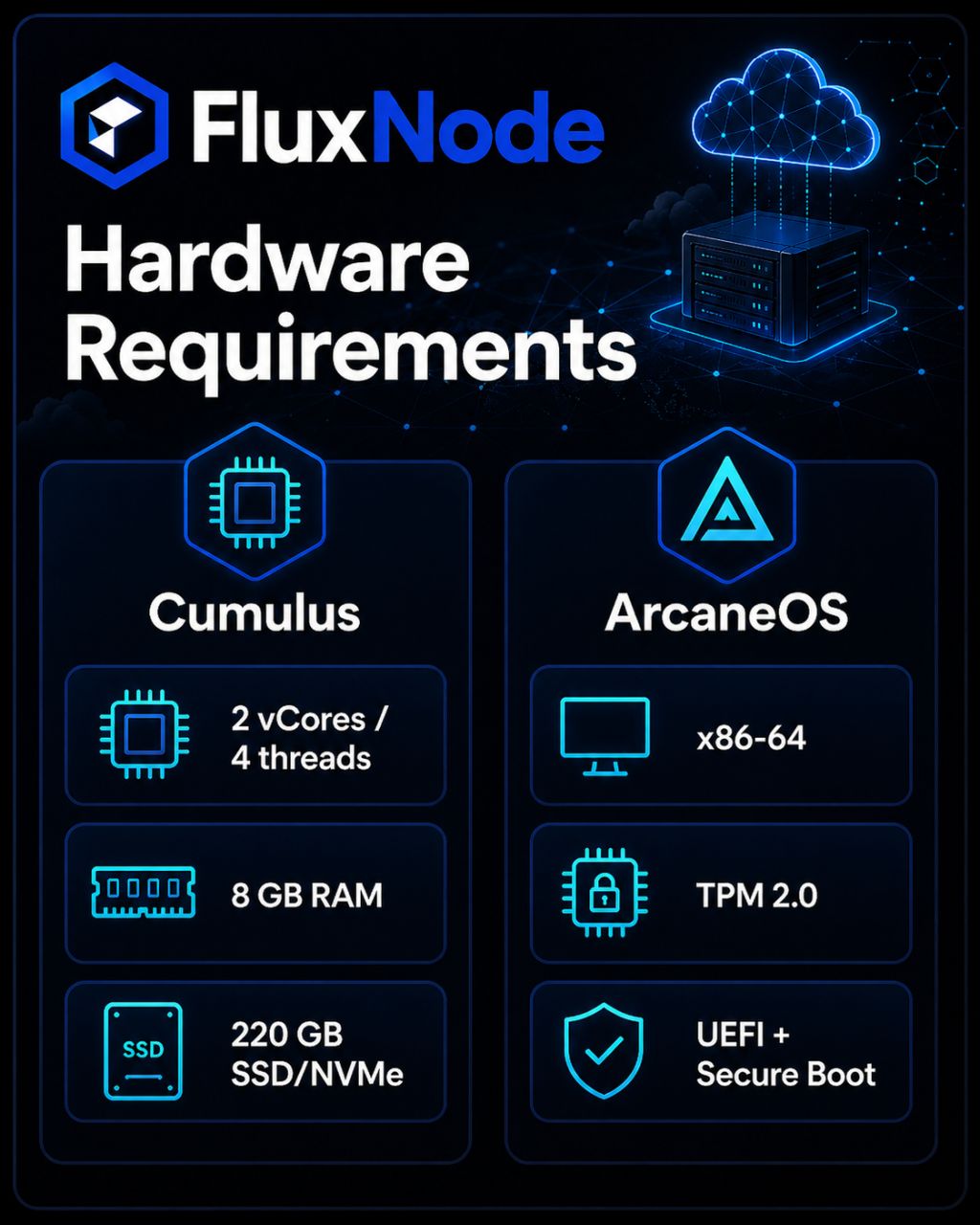
| Tier | Collateral | CPU | RAM | Storage | Bandwidth |
|---|---|---|---|---|---|
| Cumulus | 1,000 FLUX (~$67) | 2 vCores / 4 threads | 8 GB | 220 GB SSD/NVMe | 25 Mbit/s |
| Nimbus | 12,500 FLUX (~$838) | 4 vCores / 8 threads | 32 GB | 440 GB SSD/NVMe | 50 Mbit/s |
| Stratus | 40,000 FLUX (~$2,680) | 8 vCores / 16 threads | 64 GB | 880 GB SSD/NVMe | 100 Mbit/s |
Collateral USD values are based on a FLUX price snapshot of approximately $0.067, taken April 29, 2026. These figures change with token price.
Benchmark Requirements
Hardware specs are the starting point. Nodes also need to pass FluxBench tests:
| Tier | DWS Minimum | eps_multithread Minimum |
|---|---|---|
| Cumulus | 180 MB/s | 240 |
| Nimbus | 400 MB/s | 640 |
| Stratus | 800 MB/s | 1,520 |
Active Benchmark Change: eps_multithread Transition
Flux is currently moving from the legacy eps metric to eps_multithread. This is not a scheduled future change; it is happening during April-May 2026. Nodes that met prior EPS thresholds may not automatically pass the new multithread requirement. Before buying hardware, provisioning a server, or assuming your current machine qualifies, test against the eps_multithread threshold for your intended tier. The enforcement block height, grace period, and removal mechanism had not been publicly confirmed at the time of writing. Verify the current status through official Flux documentation or community channels before making any capital commitment.
ArcaneOS Hardware Requirements
ArcaneOS requires x86-64 architecture, TPM 2.0, UEFI firmware, and Secure Boot support. Most standard VPS hypervisors do not provide Secure Boot, so ArcaneOS, and by extension PNR eligibility, is generally not available on typical VPS deployments. Bare-metal hardware at home or at a dedicated server provider is the more realistic ArcaneOS path.
The public dashboard does not clearly report the ArcaneOS versus Legacy node split, so there is no reliable public figure for current ArcaneOS adoption.
Network Requirements
A stable connection with a static or consistently reserved IP address is necessary. Home routers may need UPnP or DMZ configuration. Multi-node setups have additional network requirements, including limits per external IP. Check current official documentation before attempting more than one node at the same location.
8. Step-by-Step Setup
Flux setup details can change during benchmark and ArcaneOS updates. Use this as orientation, then go to official Flux documentation for the current specifics.
-
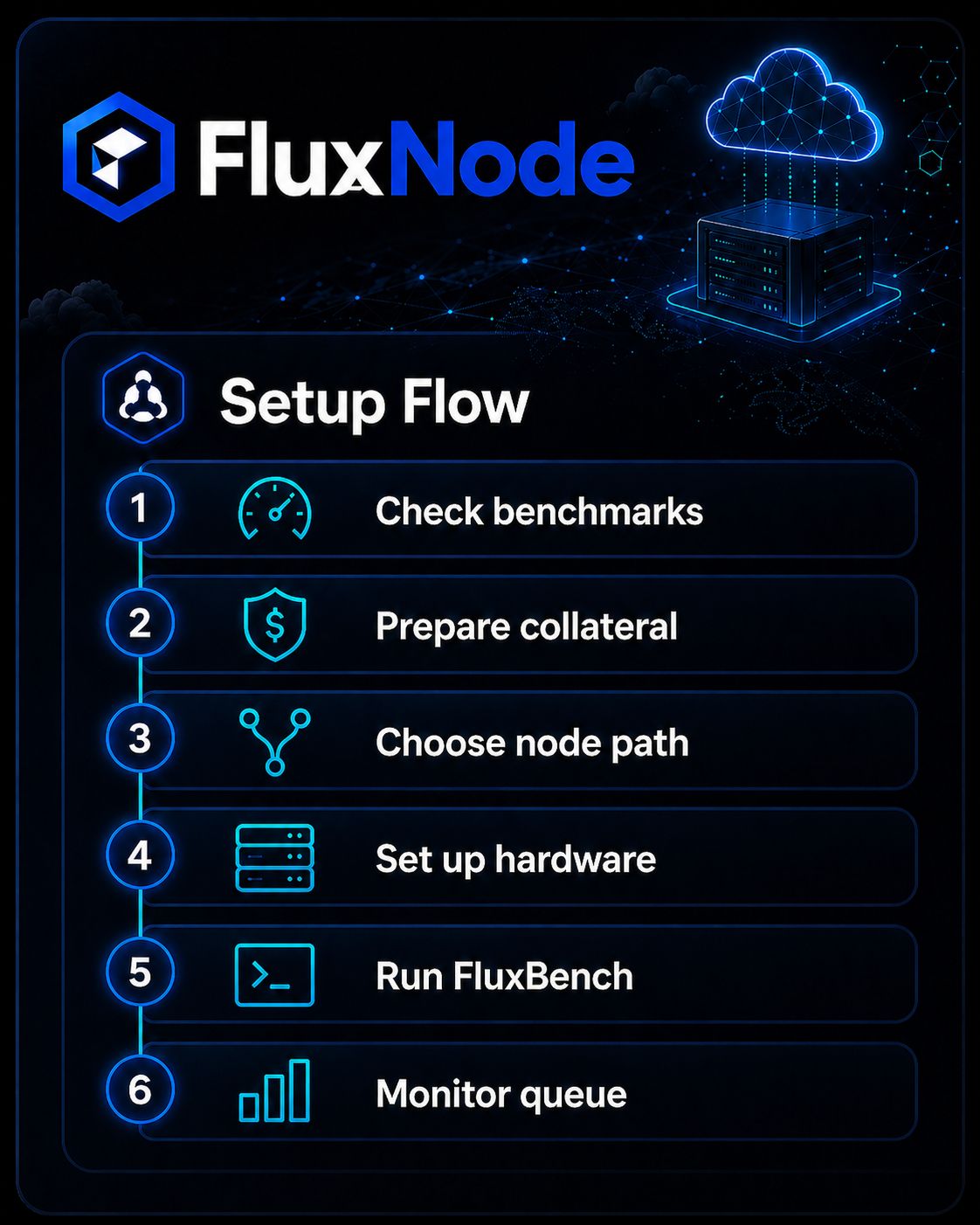
Check benchmark compatibility first. Test whether your hardware meets the
eps_multithreadthreshold for your intended tier before touching anything else. During the current April-May 2026 transition this is non-negotiable. A machine that passes raw CPU spec requirements can still fail the multithread benchmark. -
Acquire FLUX collateral. Buy the required FLUX on a supported exchange and transfer it to a compatible wallet. ZelCore or SSP Wallet are the relevant wallet options. The collateral must remain locked while your node is active.
-
Choose your path: ArcaneOS, Legacy, or Titan.
- ArcaneOS requires TPM 2.0, UEFI, Secure Boot, and x86-64 hardware. This is the recommended path for new deployments and the only route to PNR eligibility.
- Legacy FluxNode runs without Secure Boot but needs more manual updates and has no PNR eligibility.
- Titan involves no hardware at all; it is staking participation rather than node operation.
-
Prepare your hardware or server. For ArcaneOS, download the official image and install it on your hardware. Before booting, go into BIOS and confirm TPM 2.0 is enabled and Secure Boot is active. For Legacy, install the supported Linux distribution per official requirements.
-
Configure networking. Set a static or consistently reserved IP where possible. Follow the current Flux networking guidance for your node type. For home setups, this usually means a stable public IP setup with UPnP or DMZ where appropriate. Do not assume manual port forwarding is the preferred path, since older port-forwarding guidance may be outdated.
-
Install and configure the FluxNode software. Follow official installation instructions for your chosen path and set your wallet address along with the collateral transaction details.
-
Run FluxBench and fix any failures before registering. Check your DWS score against your tier's minimum: 180 MB/s for Cumulus, 400 MB/s for Nimbus, and 800 MB/s for Stratus. Then check your
eps_multithreadscore against the threshold for your tier. Do not register a node that is not passing. -
Register and start the node. Work through the registration process in the Flux ecosystem interface. Collateral transaction confirmation is part of this step.
-
Monitor the reward queue and node health. Use the live Flux dashboard to track uptime, benchmark status, and queue position. A silent failure, whether a stuck process, a network interruption, or a benchmark regression, can delay the next payout.
Likely blockers: ArcaneOS Secure Boot incompatibility on VPS hosts, eps_multithread failures on older or underpowered CPUs, dynamic IP changes disrupting connectivity, and collateral wallet configuration errors.
9. Current Earnings Picture
Flux rewards are queue-based, not continuous. A node receives its reward when selected in the queue. How long that takes depends on how many nodes are in the same tier and how consistently the node stays eligible.
Block reward structure: 14 FLUX total per block. When a node is queue-selected, it receives 1 FLUX (Cumulus), 3.5 FLUX (Nimbus), or 9 FLUX (Stratus). The Foundation receives 0.5 FLUX. Blocks occur approximately every 30 seconds.
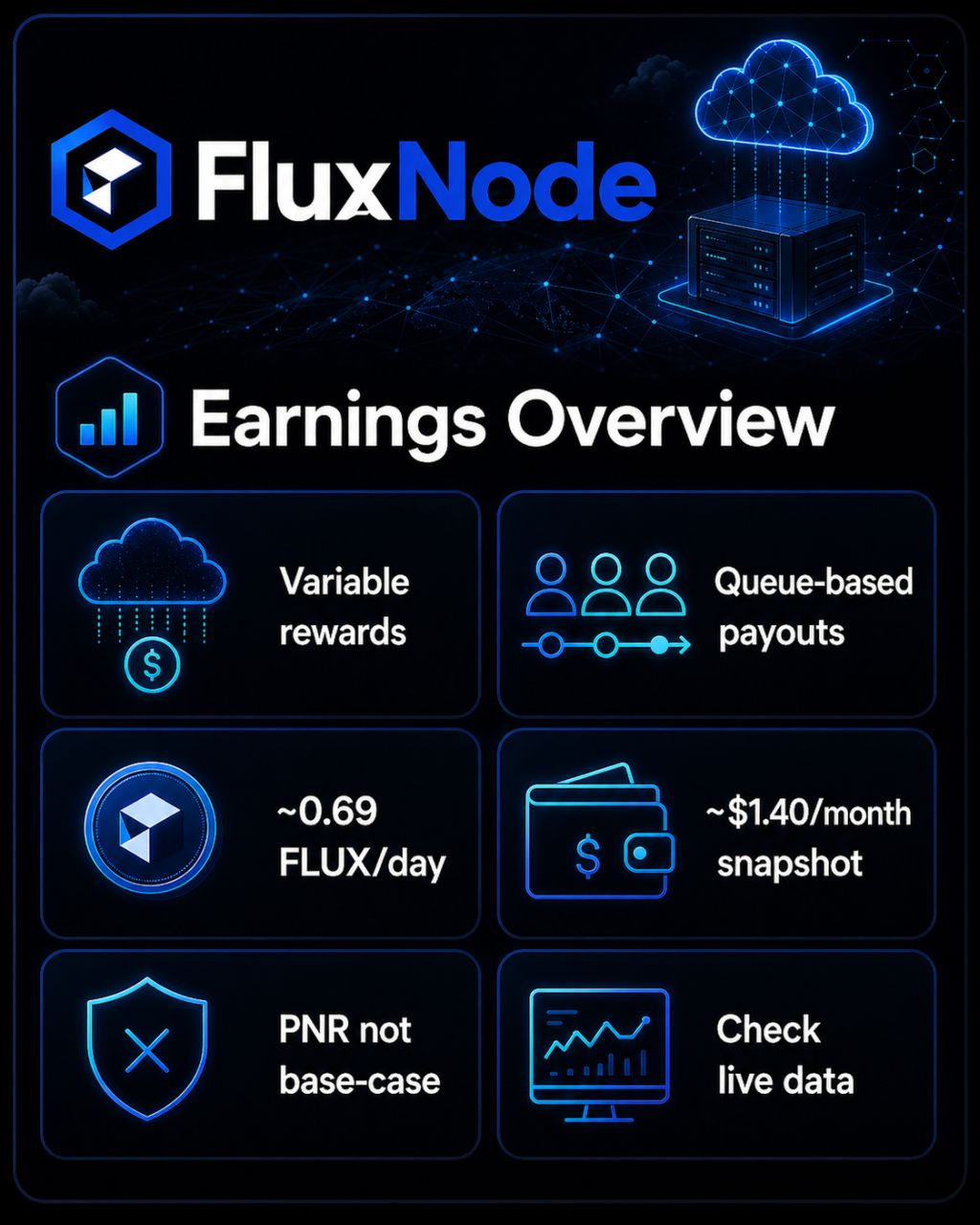
Snapshot-derived Cumulus estimate (April 29, 2026):
- Approximately 4,173 Cumulus nodes in the tier
- Approximate payout interval: roughly 34.8 hours
- Approximate daily reward: roughly 0.69 FLUX
- At ~$0.067/FLUX: approximately $1.40 per month
This is a snapshot estimate based on refreshed node counts and a live FLUX price check. Node count, token price, queue position, uptime, and benchmark status all affect the actual number. Do not treat it as a reliable monthly projection. Check the live Flux rewards dashboard before making any operator decision.
What this does not cover:
- VPS or managed hosting costs, which at typical rates exceed current Cumulus reward value
- Home electricity costs, which vary by hardware draw and local rate
- Parallel Asset claim fees, which on Ethereum can make small accumulated amounts uneconomical to claim
PNR (Progressive Node Rewards): PNR is an ArcaneOS-linked reward mechanism. No confirmed public dashboard or operator report showing active PNR payouts for small operators was found during the refresh. Do not include PNR in any earnings calculation until you can confirm live payout amounts through official sources. Treat PNR as a possible bonus, not part of the base-case economics, until you can verify actual payout data from official dashboards or your own node.
Parallel Assets: Nodes may accumulate Parallel Assets as extra rewards. Claiming them requires a manual transaction through the Flux ecosystem, and on chains with higher fees, a small balance can cost more to claim than it is worth. Check the claim fee before confirming the transaction.
10. Recent Network Updates
These updates affect active operators or anyone evaluating Flux during Q1-Q2 2026.
PoUW v2 / Proof of Nodes: Flux completed its shift away from GPU mining. Block production is now tied to node uptime and benchmark compliance across all three tiers. The 14 FLUX block reward and 30-second block cadence are the current production parameters.
ArcaneOS and PNR: ArcaneOS is Flux's purpose-built node OS, designed to handle automated updates and provide PNR eligibility. PNR has been announced as an ArcaneOS-linked reward mechanism, but no public data on active payout amounts for individual small operators was confirmed during the April 2026 refresh.
eps_multithread benchmark transition: Flux is rolling out new multithread EPS thresholds during April-May 2026: 240 for Cumulus, 640 for Nimbus, 1,520 for Stratus. Hardware that previously qualified under the old eps metric may not pass the new threshold. The enforcement mechanism and grace period were not confirmed at writing time. Check official Flux announcements before assuming your node is still compliant.
Q2 2026 roadmap: Flux has referenced a new benchmark tool in the Q2 roadmap. This may affect how operators test and verify compliance going forward. Follow official channels for release details.
11. Pros and Cons
Pros:
- Permissionless onboarding with no waitlist or geographic approval
- Roughly 7,662 active nodes as of April 29, 2026, making this one of the more established DePIN compute networks
- 1,000 FLUX collateral for Cumulus (~$67 at current prices) is low compared to many competing node models
- No GPU required for base node operation
- ArcaneOS reduces ongoing maintenance burden for compatible hardware
- Titan is available as a hardware-free participation option starting at 50 FLUX
- Block reward structure and queue mechanics are documented with live dashboards
Cons:
- Estimated Cumulus reward of roughly $1.40/month at current FLUX price does not cover typical hosting costs
- ArcaneOS is incompatible with most standard VPS hypervisors due to Secure Boot limitations
- The April-May 2026
eps_multithreadtransition creates active disqualification risk for both existing and new operators - Queue-based rewards mean downtime can delay the next payout or affect queue position
- PNR has not been confirmed as active, meaningful income for small operators
- Token price volatility can shift the fiat value of rewards substantially
- Small Parallel Asset balances may cost more to claim than they are worth on high-fee chains
- Legacy node operation requires more manual maintenance and misses PNR eligibility
12. Common Pitfalls to Avoid
Buying or provisioning hardware without checking eps_multithread first. The April-May 2026 benchmark change means an old EPS score is not enough. A machine that looks fine on paper may fail the new multithread requirement. Test before spending.
Assuming a VPS equals ArcaneOS eligibility. Most VPS hypervisors do not support Secure Boot. ArcaneOS requires TPM 2.0, UEFI, and Secure Boot. If your provider cannot enable those, you are in Legacy mode: no PNR eligibility and more manual updates.
Counting PNR as income before you can verify it. No public operator report confirmed active PNR payouts at the time of this writing. Do not build PNR into a budget until you can verify live payout amounts through official Flux sources.
Running on a dynamic IP without a workaround. Dynamic IP changes can interrupt node connectivity and disrupt queue eligibility. A static IP or a consistently reserved DHCP assignment is the practical fix. This is a known issue in home network deployments.
Claiming small Parallel Asset amounts on Ethereum without checking the gas cost first. Gas fees can exceed the value of a small Parallel Asset payout. Check the claim fee before confirming the transaction.
Locking collateral before verifying the full setup works. Confirm your hardware passes benchmarks, your network setup follows current Flux guidance, and your wallet is configured correctly before transferring collateral into the registration process.
Trusting old community earnings reports. Monthly income estimates in forums often reflect older FLUX prices or different node counts from months or years ago. The live rewards dashboard gives you a current number; use that.
13. Tips for Home Operators
Start with the live dashboard, not the forums. The Flux rewards dashboard shows current per-node estimates, live node counts, and tier distribution. Run those numbers with today's FLUX price before doing anything else.
If you already own the hardware, the cost profile is less unfavorable. At current Cumulus reward levels, buying new equipment to run a single node is hard to justify. A machine already sitting at low idle power draw changes that calculation considerably.
Test eps_multithread before assuming you are eligible. Use FluxBench against the current threshold for your intended tier. During the April-May 2026 transition, do this before committing anything.
Treat Cumulus as a long-term infrastructure participation commitment, not a monthly income machine. The operators who make this work are not expecting $50/month. They want FLUX exposure and are willing to hold through token price cycles.
For ArcaneOS, check BIOS before anything else. Confirm TPM 2.0 is enabled, UEFI is active, and Secure Boot can be turned on. Finding out at the installation stage that your board does not support it wastes time.
Silent failures are the main maintenance risk. Set up basic uptime and connectivity monitoring. A stuck process, network drop, benchmark regression, or queue issue can delay payouts without an obvious alert.
Check Parallel Asset balances before claiming, not on a schedule. On high-fee chains, let small balances accumulate until the claim fee is a small fraction of the total rather than a significant chunk of it.
14. FAQ
Can I run a FluxNode on a standard VPS?
A Legacy FluxNode is possible on some VPS environments, but most standard VPS hypervisors cannot enable Secure Boot. That means ArcaneOS and PNR eligibility are off the table. Legacy mode is more manually intensive and misses the ArcaneOS-linked reward mechanism. Check with your specific provider rather than assuming compatibility.
Do I need to check the new Flux benchmark before running a node?
Yes. During April-May 2026, Flux is transitioning to eps_multithread minimums: 240 for Cumulus, 640 for Nimbus, 1,520 for Stratus. Test your hardware against the current threshold for your intended tier before deploying or buying equipment.
Is onboarding currently open?
Yes. Flux uses a permissionless model with no waitlist or geographic restriction. The real filters are collateral, compatible hardware, a wallet, a passing benchmark score, and stable uptime.
Do I need to buy hardware, a license, or tokens?
You need to lock FLUX as collateral: 1,000 FLUX for Cumulus, which is around $67 at current prices. There is no separate license. Hardware either meets the spec or it does not. There is no staking token separate from FLUX.
How are operators paid?
A queue system selects one node per tier for each block. When your node is selected, it receives 1 FLUX (Cumulus), 3.5 FLUX (Nimbus), or 9 FLUX (Stratus). How often that happens depends on how many nodes are in your tier and how consistently yours maintains eligibility. Based on April 29, 2026 node counts, the estimated Cumulus payout interval is roughly 34.8 hours.
Is running a FluxNode profitable in 2026?
At current reward levels and FLUX price, a Cumulus node earns an estimated 0.69 FLUX per day, or roughly $1.40 per month. That does not cover typical VPS costs and may not cover home electricity depending on hardware and local rates. Operators on already-owned hardware with low electricity costs may come out ahead; most others will not at current figures. Use the Flux rewards dashboard, current FLUX price, and your tier's benchmark result before locking collateral.
Is PNR confirmed income for FluxNode operators?
No confirmed public payout amounts were found at the time of this writing. PNR is an announced, ArcaneOS-linked mechanism. Do not treat it as income until you can verify active distributions through the live dashboard or official operator reports.
What hardware or configurations are not supported?
Hardware without TPM 2.0 or Secure Boot cannot run ArcaneOS. Hardware failing eps_multithread thresholds will not pass benchmarks during the current transition. Dynamic IP addresses create connectivity risk. Standard shared VPS hosting is unlikely to be ArcaneOS-compatible.
What should I check before spending money?
In order: the live Flux rewards dashboard for the current per-node daily estimate and FLUX price; whether your hardware meets the current eps_multithread threshold; whether your hardware can run ArcaneOS (TPM 2.0, UEFI, Secure Boot); your local electricity cost versus the reward snapshot; and what 1,000 FLUX costs in fiat today.
15. Final Verdict
Flux has open participation, a documented reward structure, and a low Cumulus collateral requirement relative to many DePIN peers. What makes it a difficult call in 2026 is the economics: current Cumulus rewards are weak in fiat terms, PNR has not been confirmed as active income for small operators, and the April-May 2026 eps_multithread transition is a real disqualification risk for anyone who has not checked their hardware against the new thresholds.
The operator who fits is someone technical, already hardware-equipped, comfortable with low near-term returns, and interested in participating in decentralized cloud infrastructure over a longer time horizon. Running Flux for predictable fiat-positive returns from a standard VPS does not hold up against current Cumulus economics, and ArcaneOS eligibility is likely out of reach on most hypervisors anyway.
If you match the first description, check the live dashboard, run FluxBench, verify ArcaneOS compatibility, and continue only if the numbers and compatibility checks still make sense. If you match the second, this is probably not the right time.