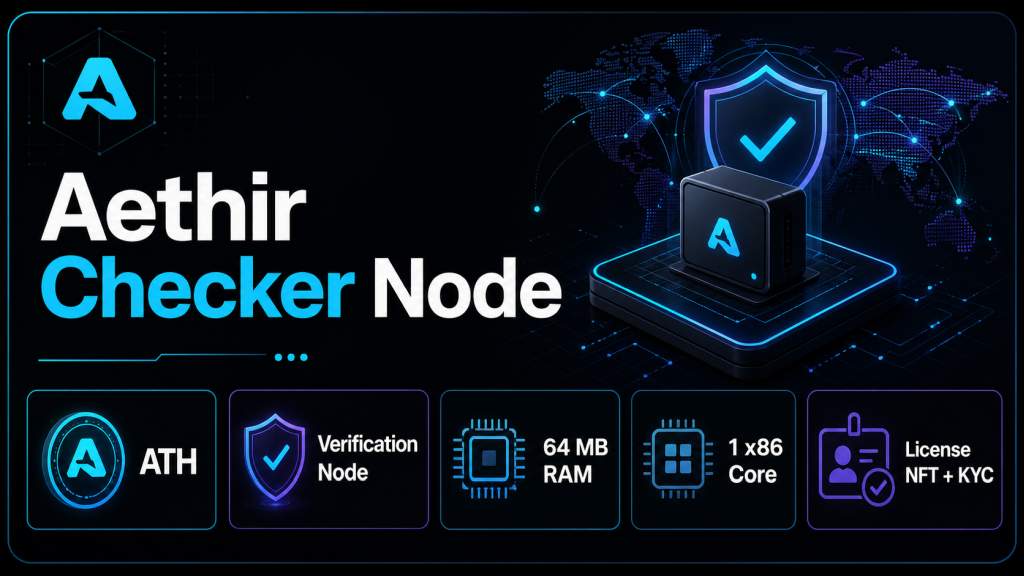
Operator note: Aethir Checker Nodes require a Checker License NFT and pay rewards in ATH, not in a fixed fiat amount. Before buying a license or running a node, check the current secondary-market floor price, ATH price, KYC eligibility, restricted-country rules, reward vesting terms, early-withdrawal penalty, hosting or NaaS cost, uptime requirement, and current Aethir migration and security announcements. US persons and some restricted jurisdictions cannot claim or withdraw rewards. The April 2026 ATH bridge exploit was reported not to disrupt Checker operations on Arbitrum, but operators should verify where they hold ATH and follow official compensation or migration instructions where relevant.
Price snapshot note: ATH price, license floor, and secondary-market liquidity change quickly. Any price or floor figures in this guide are point-in-time research snapshots from April 28, 2026 and should be refreshed on OpenSea, OKX, and current ATH market trackers before making a purchase decision.
| Token | ATH, max supply 42B, circulating ~19.25B as of April 28, 2026 |
| Network Type | Decentralized GPU cloud / AI compute; Checker Nodes are verification nodes, not compute providers |
| Min Hardware | 64 MB RAM, 1 x86 core at 2.1 GHz, 10 GB disk, 10 Mbps internet per license |
| Onboarding | Buy or hold Checker License NFT on secondary markets, delegate or self-run Checker Client, pass KYC to claim rewards |
| Best For | Existing license holders or speculative buyers outside restricted jurisdictions with low-cost infrastructure |
1. Quick Verdict
Aethir Checker Nodes are technically accessible to many operators with a basic VPS or low-power machine, but only eligible license holders can turn that setup into claimable rewards. The real decision centers on whether the license NFT is worth acquiring given where ATH is priced, a 180-day default vesting schedule, KYC rules that block US persons and some other jurisdictions from claiming rewards entirely, a greater-than-95% uptime threshold for bonus eligibility, and a v2 migration with no confirmed operator guide as of April 28, 2026.
Existing license holders outside restricted jurisdictions with cheap infrastructure have the clearest case for continuing to operate. New buyers are taking speculative ATH exposure as much as they are running a node business.
2. Best Fit / Possible Fit / Poor Fit
| Operator Profile | Fit | Why |
|---|---|---|
| Existing Checker License holder outside restricted jurisdictions | Best Fit | License cost is sunk, hardware costs are minimal, and continuing may make sense if ATH exposure, vesting, uptime monitoring, and migration uncertainty are acceptable |
| New buyer treating the license as speculative ATH exposure | Possible Fit | Secondary-market license required; check live OpenSea/OKX floor before buying. Returns are ATH-denominated and not reliable fiat income |
| Operator with a stable low-cost VPS or always-on mini PC | Possible Fit | The technical workload is light, but stable uptime and correct task execution are required to avoid reward loss or bans |
| Operator planning to use NaaS instead of self-running | Possible Fit | Delegation reduces maintenance burden, but 2026 NaaS pricing is not fully verified and fees may consume a significant share of rewards |
| US person or resident of a restricted jurisdiction | Poor Fit | KYC restrictions block reward claims and withdrawals entirely |
| Operator expecting predictable fiat income | Poor Fit | Current ATH price and reward variability make this unsuitable as a passive income source |
| Operator unwilling to monitor migration and security updates | Poor Fit | v2 migration instructions are unconfirmed, and the April 2026 bridge exploit shows that wallet and chain monitoring still matters |
3. Why This Project Matters
Aethir is a decentralized GPU cloud network built to supply AI compute to enterprises and applications that need on-demand GPU resources. The network separates compute providers, indexers, and verification operators so each layer can be run independently. Checker Nodes fill the verification role: they monitor GPU Container quality, liveness, and task correctness rather than providing compute themselves. For small operators, that separation is the practical point of entry, since running a Checker requires no GPU hardware.
4. Project Overview
Aethir's network consists of Container nodes, Indexer nodes, and Checker nodes. Container nodes provide GPU compute, Indexer nodes handle routing and matching, and Checker nodes verify quality. Checkers confirm that GPU Containers are online, responsive, and returning correct task results. Operators who hold a Checker License NFT can run this verification layer and earn ATH rewards for doing so. The license NFT is the access credential, not the software itself.
5. Main Operator Reality Check
-
Checkers verify, they do not compute. Checker Nodes monitor GPU Container quality and liveness. Operators earn rewards for verification work, not for providing GPU capacity. No GPU is needed, but there is also no compute revenue.
-
The license NFT is the real entry barrier. The original sale is over. New operators must buy a Checker License NFT on secondary markets. At the April 28, 2026 research snapshot, Checker License NFTs were trading on secondary markets, but floor prices varied by marketplace and can change quickly. Check live OpenSea and OKX data before buying.
-
Minimum hardware is low, but stability matters more than raw specs. Official minimums are 64 MB RAM, one x86 CPU core at 2.1 GHz, 10 GB disk, and 10 Mbps internet per license, scaling linearly by license count. A system that is underpowered for its license count, or that produces incorrect task results due to instability, can trigger temporary or permanent bans, not just missed rewards.
-
Reward figures are theoretical, not guaranteed. A rough emission-based calculation suggests a theoretical upper range in the tens of ATH per day per license under ideal conditions. This is not an expected reward rate. Actual rewards may be significantly lower and depend on task completion, correct results, active delegated license count, uptime, and current reward rules. The most recent publicly referenced delegated-license figure found during research was 86,309 from April 2025. A live dashboard check is recommended before making decisions based on current network participation.
-
KYC and jurisdiction eligibility come first. KYC is required to claim or withdraw rewards. US persons and residents of sanctioned or restricted jurisdictions cannot claim or withdraw. Running the software is technically possible for these users, but it produces no accessible rewards.
-
The April 2026 bridge exploit matters for how you hold ATH, even if Checker operations on Arbitrum were unaffected. The exploit hit ATH on several alt chains, and compromised bridge contracts were disconnected pending audit. Affected holders needed to file compensation claims. Checker operators on Arbitrum kept running normally, but those holding ATH on affected chains were still impacted.
6. Is Aethir Suitable for Small/Medium Operators?
Maybe, with meaningful conditions.
-
Hardware requirements are minimal. A basic VPS or always-on home machine may be enough for a small license count if it is stable, not overloaded, and keeps the Checker Client online.
-
The economics are harder to justify. License cost, ATH price, vesting rules, and reward variability mean fiat returns are genuinely uncertain, not just theoretically so.
-
Jurisdiction determines whether you can participate at all. US persons and restricted-jurisdiction residents cannot claim or withdraw under current KYC rules, so the rest of this guide is not relevant to them.
-
Uptime monitoring is ongoing work, not a one-time setup. Staying above 95% for bonus eligibility means actively checking that the node is healthy.
-
v2 migration remains unresolved. No confirmed launch or Checker operator migration guide existed as of April 28, 2026, which means new operators are entering during a period of architectural uncertainty.
7. Infrastructure Requirements
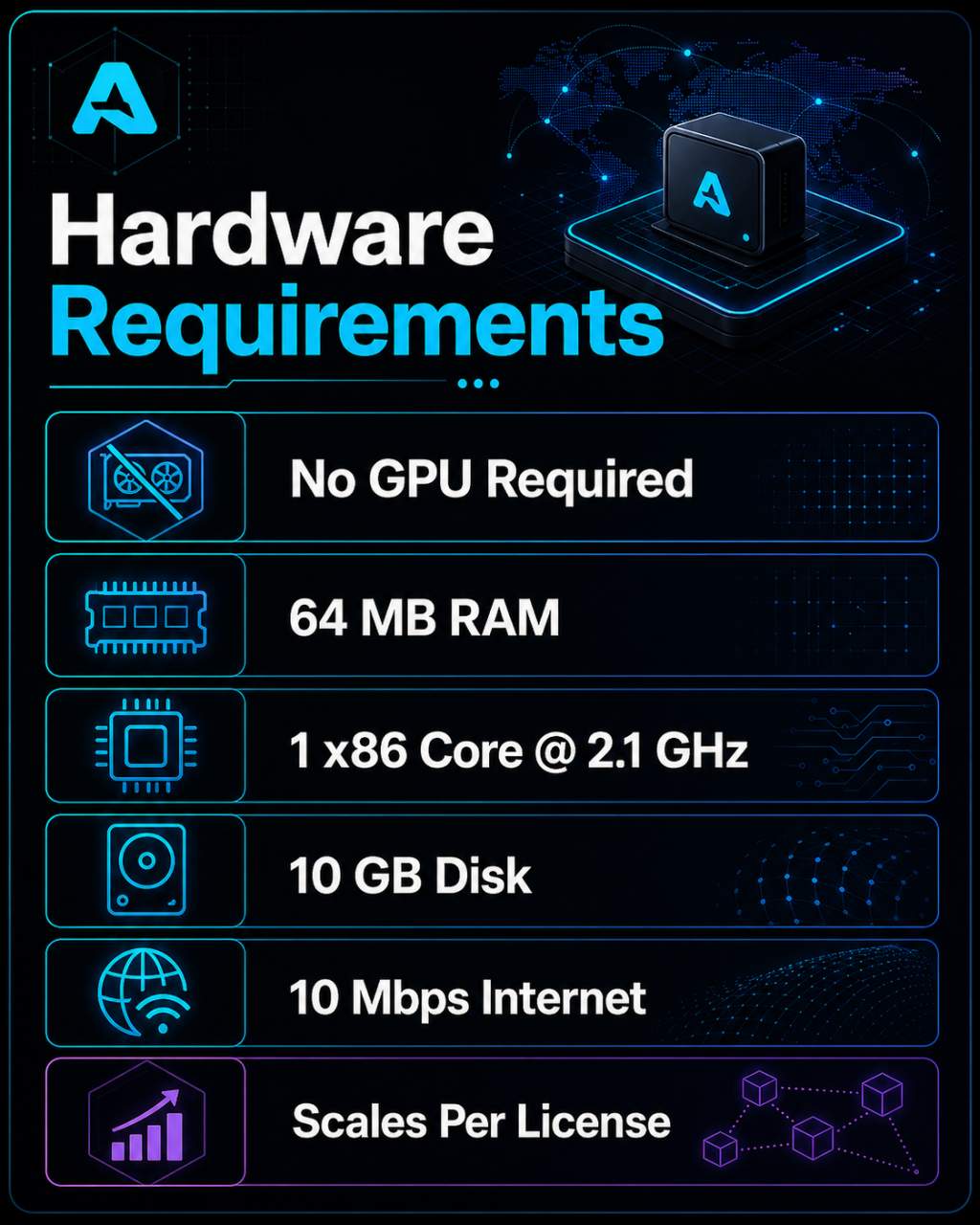
Official per-license minimums:
- RAM: 64 MB
- CPU: 1 x86 core at 2.1 GHz
- Disk: 10 GB
- Internet: 10 Mbps
Requirements scale linearly with license count. Running two licenses requires double the official minimums, and so on.
No GPU is required. The Checker role is CPU and network work, not compute work.
Practical notes:
A shared VPS at the absolute minimum spec may be adequate for a single license, but a machine that is overloaded or that produces incorrect task outputs can result in bans. Stability and network reliability matter more than raw compute power. Resources should not be shared with other demanding workloads if uptime or task accuracy could be affected.
8. Step-by-Step Setup
-
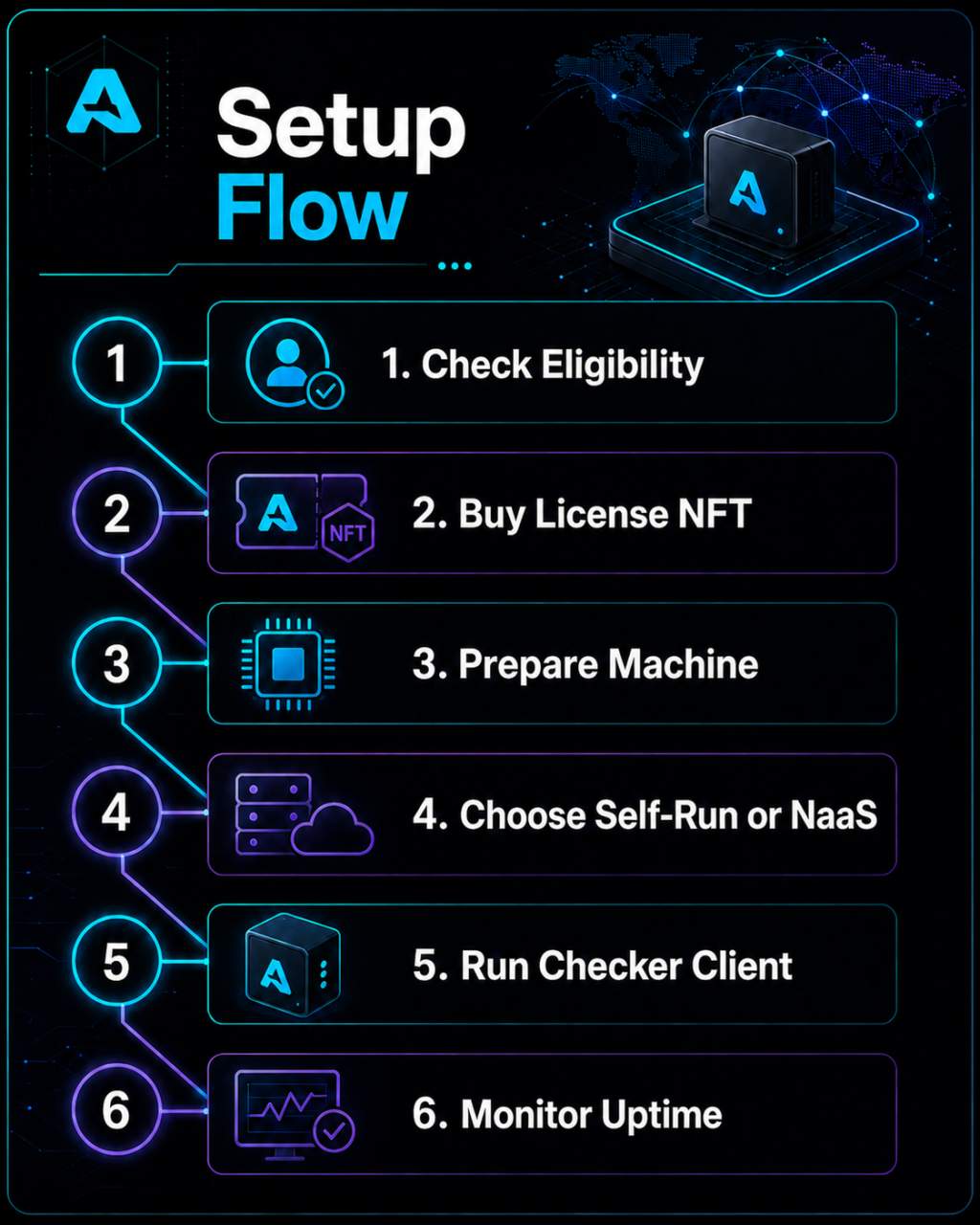
Verify eligibility. Confirm your jurisdiction is not on Aethir's restricted list and that you can complete KYC. US persons cannot claim or withdraw rewards.
-
Acquire a Checker License NFT. The original sale is closed. Licenses are available on secondary markets such as OpenSea and OKX. At the April 28, 2026 research snapshot, Checker License NFTs were trading on secondary markets, but floor prices varied by marketplace and can change quickly. Check live OpenSea and OKX data before buying.
-
Prepare infrastructure. Set up a VPS, home server, or mini PC meeting the per-license minimums. Confirm stable uptime capability before proceeding.
-
Choose self-run or NaaS. You can run the Checker Client yourself or delegate your license to a Node-as-a-Service provider. NaaS reduces maintenance but introduces fee costs. Verify 2026 pricing directly with providers before comparing expected rewards. At low ATH prices, even modest NaaS fees can represent a meaningful share of potential rewards.
-
Delegate your license and run the Checker Client. Follow current official Aethir documentation to connect your license, configure the Checker Client, and bring the node online.
-
Complete KYC. KYC must be completed before reward claims or withdrawals. Do not skip this step or delay it after setup.
-
Monitor node status and uptime. Bonus rewards require greater than 95% uptime. Check task completion and node status regularly. Incorrect task results can trigger temporary or permanent bans.
-
Track reward mechanics. Rewards are paid in ATH via vATH. Default vesting is 180 days. Early withdrawal carries a 75% penalty. Each claim requires a 5 ATH fee and a 30 vATH minimum.
-
Follow migration and security announcements. v2 Mainnet migration is planned but unconfirmed. Check official Aethir channels before making infrastructure changes, and avoid unofficial migration links or bridge instructions.
9. Current Earnings Picture
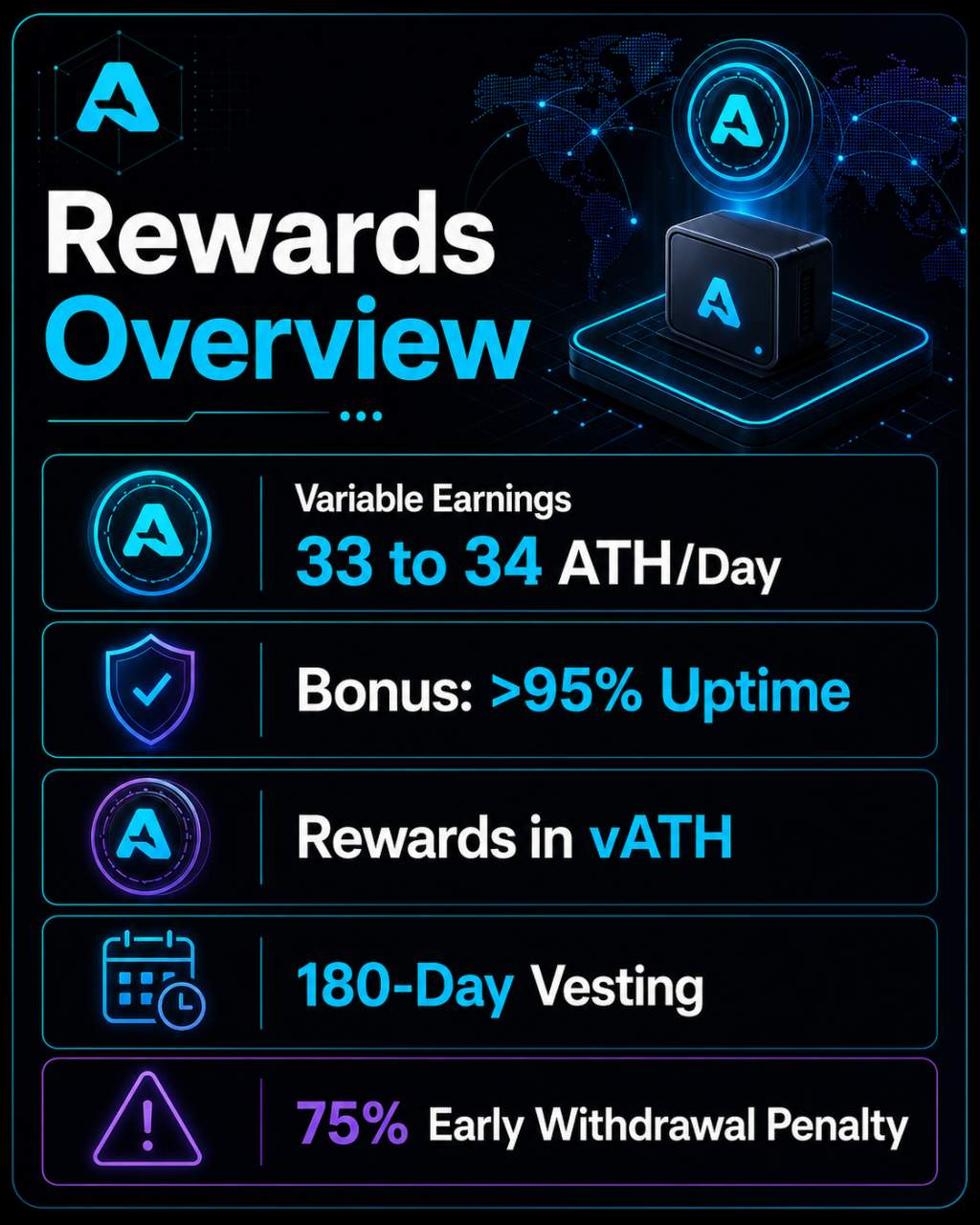
Aethir Checker rewards have two components: daily base rewards and quarterly bonus rewards.
Base rewards: A rough emission-based calculation suggests a theoretical upper range in the tens of ATH per day per license under ideal conditions. This is not an expected reward rate. Actual rewards may be significantly lower and depend on task completion, correct results, active delegated license count, uptime, and current reward rules.
Bonus rewards: Quarterly bonuses require greater than 95% uptime. A March 12, 2026 bonus distribution was confirmed in the research. Missing the uptime threshold means forfeiting the bonus portion entirely for that period.
Reward mechanics:
- Rewards distribute as vATH
- Default vesting: 180 days
- Early withdrawal option: 30-day window with 75% penalty
- Claim fee: 5 ATH per claim
- Minimum claim: 30 vATH
Current ATH price context: The live refresh found ATH trading around $0.00590 to $0.00599 on April 28, 2026. At low ATH prices, even theoretical ATH rewards can translate into a small fiat value, and actual rewards may be lower than the emission-based estimate.
For new buyers, license cost on secondary markets can vary significantly and should be verified against live OpenSea and OKX data. At current ATH prices and theoretical reward rates, recovering the license cost under best-case calculations would still take an extended period, before accounting for fees, downtime, reward variance, token price changes, or opportunity cost.
10. Recent Network Updates
March 2026 bonus distribution: A quarterly bonus reward distribution tied to the greater-than-95% uptime rule was confirmed on March 12, 2026. Operators who met the uptime threshold received their bonus allocation.
April 2026 bridge exploit: ATH on several alt chains was affected. Compromised bridge contracts were disconnected pending audit, and affected holders needed to file compensation claims. The canonical Ethereum ATH supply, the ETH-to-Arbitrum bridge, and Checker operations on Arbitrum were reported as unaffected. Operators should verify which chains they hold ATH on and follow any official compensation or audit updates.
v2 Mainnet and chain migration: Aethir has announced v2 Mainnet and chain migration plans. As of the April 28, 2026 refresh, no confirmed launch date or Checker operator migration guide was publicly available. Setup steps or portal workflows may change when migration occurs.
11. Pros & Cons
Pros:
- No GPU required; hardware minimums are among the lowest in DePIN
- The license NFT is transferable, which creates a possible resale path, but exit price and liquidity depend on the live secondary market
- You can self-run or delegate to a NaaS provider, depending on how much maintenance you want to handle
- Quarterly bonuses reward reliable uptime with additional ATH on top of base rewards
- Checker operations on Arbitrum were reported unaffected by the April 2026 exploit
Cons:
- Licenses must be purchased on secondary markets; the floor and liquidity can shift quickly
- Rewards are paid in ATH, which is currently priced well below earlier market levels
- Under default vesting, rewards take 180 days to unlock unless you accept the 30-day early-withdrawal option with a 75% penalty
- Early withdrawal cuts rewards by 75%, making it a costly option if you need liquidity
- KYC blocks reward access entirely for US persons and residents of restricted jurisdictions
- Earning the quarterly bonus requires staying above 95% uptime, which takes active monitoring, not just initial setup
- Incorrect task results can trigger temporary or permanent bans, not just lower earnings
- v2 migration is planned but unconfirmed, which creates continuity uncertainty for current operators
- 2026 NaaS pricing is not fully verified; fees may take a larger share of rewards than expected
- Operators holding ATH on non-Arbitrum chains were directly affected by the April 2026 exploit
12. Common Pitfalls to Avoid
Buying a license without checking the live floor. At the April 28, 2026 research snapshot, Checker License NFTs were trading on secondary markets, but floor prices varied by marketplace and can change quickly. Check live OpenSea and OKX data before buying.
Skipping KYC eligibility before spending anything. If you are a US person or in a restricted jurisdiction, KYC will block reward claims and withdrawals regardless of node performance. Figure this out first.
Treating theoretical rewards as expected income. A rough emission-based upper-bound calculation only; actual rewards may be significantly lower. Task completion rates, active delegated license count, uptime, and rule changes all affect what you actually receive.
Running more licenses than your hardware can handle cleanly. Requirements scale linearly. An underpowered machine spread across too many licenses can affect task accuracy and lead to bans.
Letting the node run unmonitored after setup. The greater-than-95% uptime threshold is not met passively. A node that goes offline for maintenance or hardware issues loses its bonus for that period.
Withdrawing early without doing the math first. The 75% early withdrawal penalty plus the 5 ATH claim fee make early exit genuinely costly. The 30 vATH minimum claim also applies.
Assuming v2 migration is either done or irrelevant. No confirmed launch or operator migration guide exists as of April 28, 2026. Watch official Aethir channels before making any infrastructure changes, and do not follow unofficial migration instructions.
Holding ATH on alt chains without checking bridge status. The April 2026 exploit affected several alt chains. Verify where you hold ATH and follow official compensation and audit updates.
Using old NaaS pricing figures. Earlier research cited $5 to $20 per month, but those numbers are not confirmed for 2026. Get current pricing directly from providers before comparing costs to expected rewards.
13. Tips for Home Operators
-
Confirm KYC eligibility and jurisdiction rules before anything else. This takes a few minutes and determines whether the rest of this guide is relevant to you.
-
Check the live license floor and ATH price within 24 hours of any purchase decision. Both figures in this guide are snapshots from April 28, 2026 and will have changed.
-
Do not run the Checker Client on a machine with competing demanding processes. The greater-than-95% bonus threshold and incorrect-task ban risk both depend on a stable, well-resourced environment.
-
Set up uptime monitoring specifically because quarterly bonus eligibility depends on staying above 95% uptime. A simple alert when the Checker Client process stops or the machine becomes unreachable protects your bonus eligibility without requiring constant manual checks.
-
Think through the vesting schedule before you start. Under default vesting, rewards take 180 days to unlock unless you accept the 30-day early-withdrawal option with a 75% penalty. Factor this in before committing.
-
Do not buy dedicated hardware only for this Checker role. The node does not need a GPU, and current ATH rewards do not justify new hardware spending for most operators.
-
Keep ATH on supported, unaffected chains and follow official bridge and migration announcements. The April 2026 exploit showed that chain-level risks hit ATH holders even when node operations continue normally.
-
Get current NaaS pricing directly from providers. If you prefer delegated operation, contact NaaS partners for 2026 pricing before assuming any specific fee level.
14. FAQ
Do Aethir Checker Nodes need a GPU?
No. Checker Nodes verify GPU Container quality and liveness but do not provide GPU compute. The official hardware minimums are 64 MB RAM, one x86 CPU core at 2.1 GHz, 10 GB disk, and 10 Mbps internet per license.
Do I need a license NFT to run a Checker Node?
Yes, and the original sale is closed. New operators have to buy a Checker License NFT on secondary markets such as OpenSea or OKX. At the April 28, 2026 research snapshot, Checker License NFTs were trading on secondary markets, but floor prices varied by marketplace and can change quickly. Check live OpenSea and OKX data before buying.
Can US users claim Aethir Checker rewards?
No. US persons and residents of sanctioned or restricted jurisdictions cannot claim or withdraw rewards under Aethir's current KYC rules. Running the software is technically possible, but it produces no accessible rewards for these users.
What is vATH?
vATH is the vested ATH token used to distribute Checker rewards. Default vesting is 180 days. Early withdrawal is available within a 30-day window but carries a 75% penalty. Each claim also requires a 5 ATH fee and a minimum balance of 30 vATH.
Are rewards fixed or guaranteed?
No. Theoretical upper-bound math only; actual rewards may be significantly lower. Actual rewards depend on task completion rates, correct task results, active delegated license count, uptime, and current reward rules.
What happens if my uptime falls below 95%?
Quarterly bonus eligibility requires greater than 95% uptime. Falling below that threshold means forfeiting the bonus for that period. Base rewards may still accrue, but the bonus portion is lost.
Should I self-run or use NaaS?
Self-running gives you more control over uptime, costs, and monitoring, but it requires basic server management. NaaS reduces hands-on work, but current 2026 pricing is not fully verified and fees may consume a meaningful share of ATH rewards. At low ATH prices, even modest NaaS fees can represent a meaningful share of potential rewards. Check current provider pricing before choosing.
Did the April 2026 bridge exploit affect Checker Nodes?
Checker operations on Arbitrum were reported as continuing normally. The exploit hit ATH on several alt chains, and compromised bridge contracts were disconnected pending audit. Operators running on Arbitrum were unaffected at the node level, but those holding ATH on affected alt chains still needed to file compensation claims.
Has v2 Mainnet or chain migration launched?
Not as of the April 28, 2026 research refresh. The v2 Mainnet and chain migration are planned but unconfirmed, and no public Checker operator migration guide was available. Do not follow unofficial migration instructions.
15. Final Verdict
Aethir Checker Nodes are technically straightforward to operate but hard to justify as a current income opportunity for most small operators. Existing license holders outside restricted jurisdictions with cheap, stable infrastructure are in the clearest position to keep running: the license cost is already paid and the ongoing work is minimal. New buyers are making a speculative bet on ATH price recovery and future reward conditions. Vesting delays, KYC restrictions, an unresolved v2 migration, and a bridge exploit still pending full resolution all add to that uncertainty.
Whether the license makes sense ultimately comes down to jurisdiction eligibility, tolerance for holding ATH through a 180-day vesting window, access to cheap stable infrastructure, and comfort operating during an unconfirmed migration.